

Why I Wrote Raised Bed Recovery
The photo books have been moved, and this is not particularly interesting news unless you are the person who has been avoiding the task for months. They sit together now as heavy square volumes with glossy pages and increasingly sophisticated cover designs, because at some point I decided the annual Fredrickson family record required actual art direction.
I pick up the 2019 book with both hands. The cover is cool and slick against my palms, and the weight of it pulls slightly at my wrists.
Inside are the children before they became tall, the dog before his face went gray, Christmas pajamas, swimming goggles, and a birthday cake listing slightly to port. A forgotten vacation returns in full when a photograph hands back the temperature, and the sound of somebody complaining from the back seat.
There are hundreds of these ordinary moments preserved in print. Nothing photographs better in retrospect than an ordinary life.
The 2020 volume feels heavier in my hands, although of course it isn't. I remember making it as an excruciating process. I would sit at the computer, drag a photograph into place, adjust the crop, and discover that my shoulders had crept toward my ears. Sometimes I closed the program and walked away. Then I came back.
2021 was worse, yet I forced myself to finish that photo book, too.
Photo-book software shows a peculiar brutality when the year has not gone well, cheerfully offering BEST YEAR EVER in seventeen fonts while you stare at March and wonder what happened to April. Still, I made the books every single time, because I always make the books.
I move past 2022 and 2023 until I reach the empty end of the shelf. My hand goes automatically toward the next book before I remember there isn't one.
There should be another volume. Actually, there should be two.
I have not made the 2024 book, and I have not made the 2025 book either. Standing in front of that gap, I finally admit why I have been putting the work off for so long.
I simply do not have enough photographs to fill the pages the way I once did.
This summer I have about three photos of my kids. I have hundreds of promotional videos for the business I built.
I stand very still with that arithmetic.
There are photographs from these years, of course. A few ordinary afternoons. The dog remains disproportionately represented. But the accumulation that used to happen almost without my noticing has thinned. My daughter no longer wants her picture taken, and we do not even have the annual family photograph from last year.
I put my thumb between two pages of an older book and feel their glossy edges slide against each other.
Every year you think you are capturing faces, but you are actually taking pictures of time.
My chest tightens before the thought has completely formed. I can feel my jaw set. There is a familiar pull across my shoulders, the body arriving at the conclusion a fraction of a second before the mind agrees to read it.
I have spent plenty of time mourning the big losses, and I can inventory a career, a reputation, money, opportunity, and an entire farm without much trouble.
God knows my kids can mourn that farm. They both enjoyed small town life.
I had moved my entire family to the country. We rehabbed a shack built in 1931 and were building a little crop-test operation and U-Pick berry patch.
We had bought a huge greenhouse shed, and I was growing native food-forest trees. There was going to be a bait shop and a tea room, because there is no reason why rose hip tea and fathead minnows should continue living separate lives. I planted seventy-five linear feet of asparagus growing in a hügelkultur bed.
We never even tasted that asparagus.
Doors slammed in my face as I started a new job search after workplace mobbing.
- A man I barely knew told me I had “said just about enough."
- An old co-worker had the balls to stand in front of me and actually admit, “Things never change around here.”
- My boss took my laptop, looked at me with disdain, and said, “Gee, you worked really hard.”
My husband is a police officer. He watched what happened and told me he thought I had been hurt nine out of ten by workplace mobbing.
There were lies, trash talking, humiliation, and a lot of people behaving like troglodytes. I treated people with courtesy and professionalism and tried to get along with everyone.
I also ran the demographics. Rural America is aging, and communities like this will increasingly depend on people who weren't born there, including transplants from cities. The future of farming requires making room for outsiders.
As someone important told me early in the job, “Good luck with that.”
The Real Cost of a Healing Journey
That shared weight has been the hardest part of everything that happened. Adults are skilled at inventories. We make lists, calculate damages, and invent alternate timelines in which none of it occurred and we continued merrily toward whatever future we once expected.
Children do not live in alternate timelines. They live in right now and what is for dinner.
They live in the ride home from school, the look on everyone's face, whether somebody has the bandwidth to hear the entire story, and summers that happen only once.
I cannot give a single one of those days back to them.
There is another piece of the accounting I would rather avoid.
I created Fredhappy out of my pain. I mined it for the product while my kids took some of the hit.
It was never only what happened to me. There was also the relentless business-building afterward, the attempt to make something useful and profitable from private damage. While I was writing and researching and building and trying to turn the worst thing that had happened to me into something that might help somebody else, family life kept moving at its ordinary speed.
Summer does not pause while you finish a product page. Children keep growing while their mother tries to understand what happened.
I can still ask why. I have asked the questions again and again. What was wanted from me? What was the point of it all? Why humiliate somebody rather than have a grown-up conversation. Why take it that far?
What happened to me was tawdry, pathetic and cringe.
There are things I understand now that I did not understand then, and there are other things I may never fully know. That unfinished quality is part of betrayal trauma because the story does not always arrive with a clean ending.
Sometimes you receive evidence without complete explanation, behavior without clear motive, and an answer that creates three more questions. The mind hates an unfinished row.
A garden does not care.
A garden deals in what is present: soil, water, light, weather, the condition of the roots, what was planted, what survived, and what needs support right now.
I look again at the empty space beside 2023.
This is where Raised Bed Recovery begins to mean something entirely different to me.
I wrote the book around a garden because I understood gardens. Tomatoes need structure. Companion plants affect the bed around them. Soil compacts. Roots encounter clay, gravel, and loam. Plants need water without drowning. Some things need pruning. Some things need pulling. Winter arrives and otherwise sensible adults spend far too much money on seeds.
But now I understand the raised bed itself. It is a container with edges.
You decide what goes into it. You improve the soil you actually have rather than the soil you wish you possessed.
Trauma is not a gift. Growth can be.
Post-traumatic growth does not make what happened acceptable, and it does not turn someone else's choices into a favor they accidentally performed for you.
The growth belongs to the person who grew it. The harvest belongs to the person who tended it.
No harvest can reimburse you for lost time.
I close the book.
The covers meet with that soft, padded thump particular to photo books, and for a moment I keep both palms resting on top of it.
I am alive.
I still get to make 2024 and 2025. They may be thinner than the earlier volumes. There will be pages I wish were fuller and at least one photograph that will always be missing.
I am going to make them anyway. Then I am going to take more pictures. Not because I can recover the seasons that have already passed. I cannot.
But I know what a gardener does with a season she cannot get back. She tends the one that is growing.
Inside Raised Bed Recovery
Here's a preview of what you'll find inside the book.
Hope is not about seeing the whole path. Hope is the flicker in the dark—the quiet, stubborn spark that says, “maybe.” It’s what lets the seed keep resting underground, even when it doesn’t feel the sun. Hope doesn’t need to shout. It just needs to breathe.
In this phase, you are invited to rest, to re-root, and to remember that your body and your soul already know how to begin again. You don’t need to bloom yet. You only need to belong to this moment and trust that the light will find you when you’re ready.
Roots Come First
A seed does not wait passively underground. Germination begins with water, followed by the emergence of the first root. Before there is anything to see above the soil, the plant is already anchoring itself and building its capacity to grow.
Betrayal can create an urgent need for answers. What happened? What did I miss? What can I trust now? Those questions matter, but you do not have to answer all of them before recovery begins.
Post-traumatic growth starts with something quieter: enough stability to begin again. Before the bloom, before the fruit, before anyone can see the change, there are roots.
RECOVER
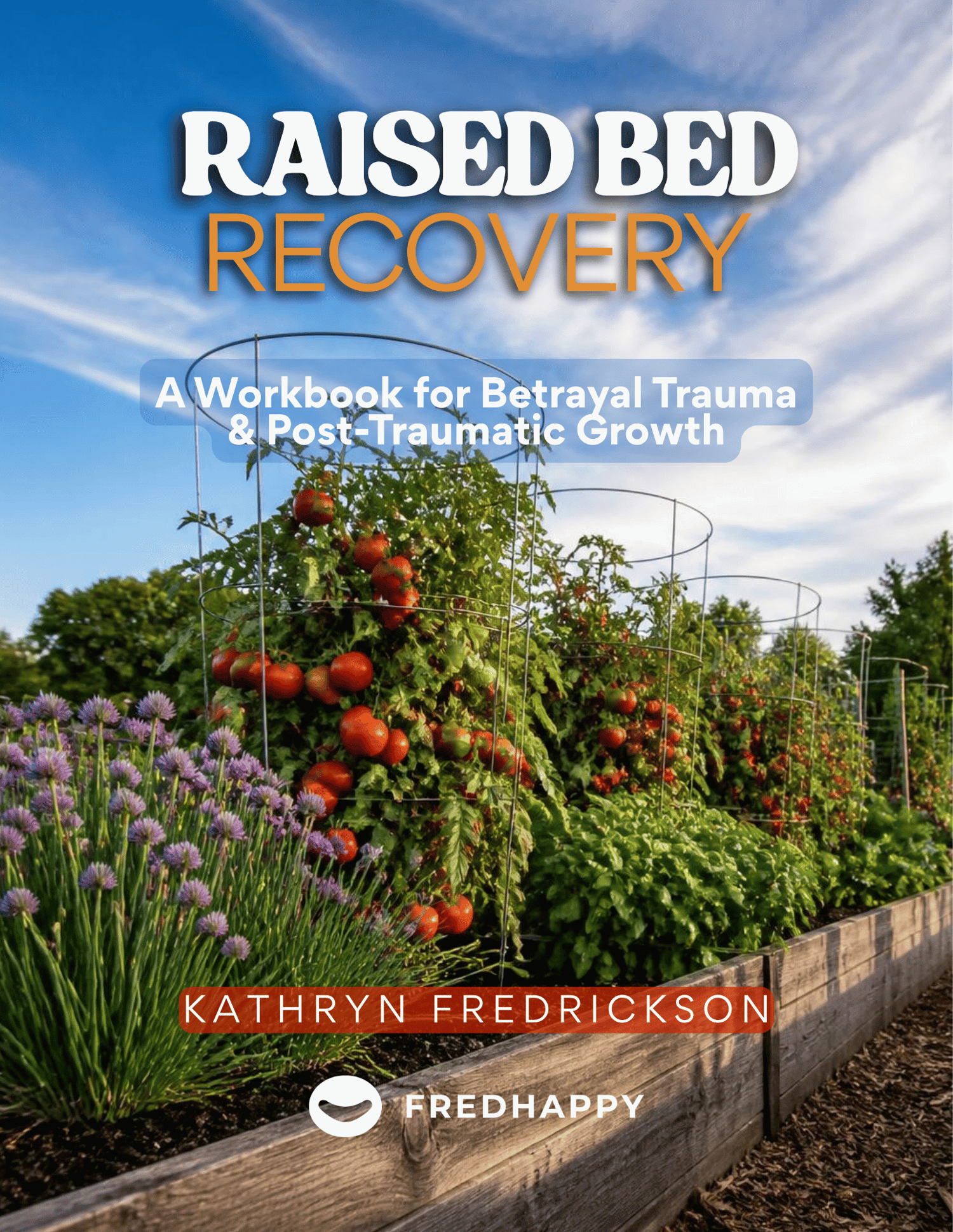
Raised Bed Recovery
A Workbook for Betrayal Trauma & Post-Traumatic Growth
After betrayal, what needs tending—and what do you want to grow next? This gentle, 52-page workbook uses real garden mechanics, reflection prompts, and simple breath practices to help you work through anger, boundaries, and self-trust, even when some questions remain unanswered.


