

Electrical engineering already has language for a situation most people only describe as a feeling. A human body conducts. A room is a network of possible paths.
Contact is a bond. Current does not disappear because someone meant well. If there is no path to earth, the loop closes through whatever just connected.
This page is not an argument that people are circuits. It is an argument that geometry matters: posture, electrical reference, insulation, and who volunteers to become the return path.
The case study is simple on purpose. A person sits in an ergonomic chair with both feet off the floor. Other people close distance. Something dumps.
The question is not whether that felt like a mood. The question is what the layout of the room actually was.
What is a floating node, in plain language?
In building electrical design, ground is the reference. Protective earth keeps a chassis near the potential of the planet so leftover charge has a planned place to go. Shoes on a floor already make a messy, high-impedance path toward that reference.
When both feet leave the floor in a chair on a fabric shell over dry, crunchy foam, even that weak path is gone. The frame of the chair is never bonded to the building’s green wire.
What you then have is ordinary and easy to miss. The body plus the isolated chair is a floating node. Building earth is a reference that node is not tied to. A floating node can sit at a different potential from people who are standing on the floor.
In a dry office that is everyday electrostatics. In human terms it is also this: the seated person is not dumped into the planet. Charge, tension, stored state — use whichever word you trust — has no designed earth clamp.
Why do people get shocked when someone touches them in an office chair?
Because the seated body was isolated and then someone completed a loop. Kirchhoff’s current law says that current leaving a node must return through some closed path. That is bookkeeping, not poetry. If earth is not in the loop, the loop is completed by the person who just bonded to the node.
A designed system specifies the return in advance. A sloppy system grabs the interesting node and is surprised when equalization current runs through the grabber.
That is why a spark at a handshake can look personal when the geometry was furniture, dry air, rubber wheels, and a standing body that happened to be earth.
The social story is often one-way. I attach. You receive. I remain unchanged.
That is not how a loop works. If they are the only bond to a floating node, they are not only the source. They are also the return.
What is return-path current, and why does intention not cancel it?
Return-path current is the current that has to come home through the person who closed the loop. Common-mode discharge is an isolated mass equalizing onto whoever referenced themselves to it. An electrostatic discharge (ESD) event is the office version: an isolated body accumulates charge, a person leans in, and the potentials equalize.
In dry weather that can be a literal spark. The spark does not exhaust the meaning of a human event. It does describe the geometry.
An arc, in the electrical sense, is dielectric breakdown. The insulating gap fails and current jumps. Energy that had no earth path uses the new path. The person who seated the contact did not have to understand any of this for the path to exist.
Can coupling happen without a hard touch?
Yes. A hard touch is a galvanic bond, metal-on-metal or skin-on-skin. Near-field coupling is different. Two conductors close together form a capacitor. A changing field produces displacement current.
You do not need a solder joint. You need proximity and a difference in potential. That is why a face leaned in at short range can couple without a handshake.
A doorway is a different layout again. If there is only one exit and someone stands in it, they have put themselves in series with the node that wants out. The contact is no longer a side tap. It is the constriction. Current that was going to leave the room has to consider that body as part of the path.
Why does sitting with your back to people change the interface?
Orientation changes which surface is offered. A face-to-face exchange is closer to a designed input: visible, negotiated, a port you chose.
A person seated with their back to others presents the enclosure. Coupling to the case is messier than coupling to a specified input. Enclosure currents flow where the body allows, not where the other person intended.
That is why hardware designers bond a chassis on purpose and give surge a planned path to earth. They do not use a bystander as the green wire. A competent layout bonds the chassis, defines the return, puts ESD paths to earth on purpose, and never treats an unconsenting body as protective earth.
A novice sees a floating interesting node and grabs it. They have just volunteered to be the ground strap.
What happens to a whole group when the contact is on a shared bus?
In power systems a grid is a network of nodes and branches with state: voltage, current, on or off, who is generating, who is load. The books are kept because the state of one node is not private if the branches are still connected.
If several people already share unofficial bonds — extra jumpers that never appear on an org chart — they are a bus. A fault on a shared bus raises current on every branch that is still bonded.
Weak joints cook first. Skinny undocumented jumpers overheat first. Dirty extra connections are not extra protection. They are extra paths for the same surge.
There are two different moments, and they should not be glued together.
During the event, a floating charged node that is suddenly bonded does not perform a polite handshake. Impedance collapses. Current spikes. Everything riding that net sees the surge.
Power engineers call it a fault. Lightning people call it flashover. Component people call it electrical overstress. Plasma is briefly a better conductor than the wire, then it expands and quenches. The brief interval in which everything dumps is that collapse.
After the event, a destroyed port fails in one of two ways. It can fail open, which means the trace is gone, new cheap cords have nowhere to seat, and later sloppy jacks do not complete a loop. It can fail short, which means the pin welds and then everything sticks. The node becomes a sink.
“Nothing will attach now” is not a law of nature. It is one failure mode: fail open after a cleared fault. In utility language the protective device operated, fault current ended, and the line is isolated.
In pipeline language that run is shut in. Status is not in service. Insulation can track later. Someone can build a new bond. Moisture can sit in a socket.
What remains useful is narrower: after hard overstress, the original cheap interfaces often stop working. People keep trying the same jack and look confused because the receptacle they used is no longer a receptacle.
What is the difference between a hold and a lift in this geometry?
A hold clamps the node to someone else’s reference and keeps it in-circuit as load. A lift opens the unwanted branch, dumps energy off that net, and stops being their load.
Changing impedance on your own side is a control input. Breath, posture, and putting feet on the floor later change whether you are floating, bonded, or discharging.
They are not incantations. They are geometry.
Putting your feet on the floor is bonding to earth so leftover charge does not have to use a person as the strap. Standing near moving water is using a large, changing earth reference: a dump that is not a human.
How do you ground yourself after sitting in an insulated chair?
You restore a reference that is not another person’s body. Feet on a floor, a known grounded object touched on purpose, humidity in the room, and time for charge to leak off through a planned path all change the layout.
The point is not ritual. The point is that an isolated workstation was never specified as one, and the first standing body to close distance should not have to be the green wire.
What this case study is not answering
This is not a diagnosis. It is not a claim that magnets are minds. It is not a replacement for law, medicine, or clinical care. It is not a personality type.
It is a one-line diagram for a situation that keeps getting described only as a vibe. You can be isolated from earth by furniture. You can be contacted by people who think a bond is one-way.
The loop will close anyway. If they are the bond, they are the return. If they already share a bus, the fault is not private.
That is human geometry in the only sense this page intends: bodies, reference, insulation, and the path current actually takes.
Further reading
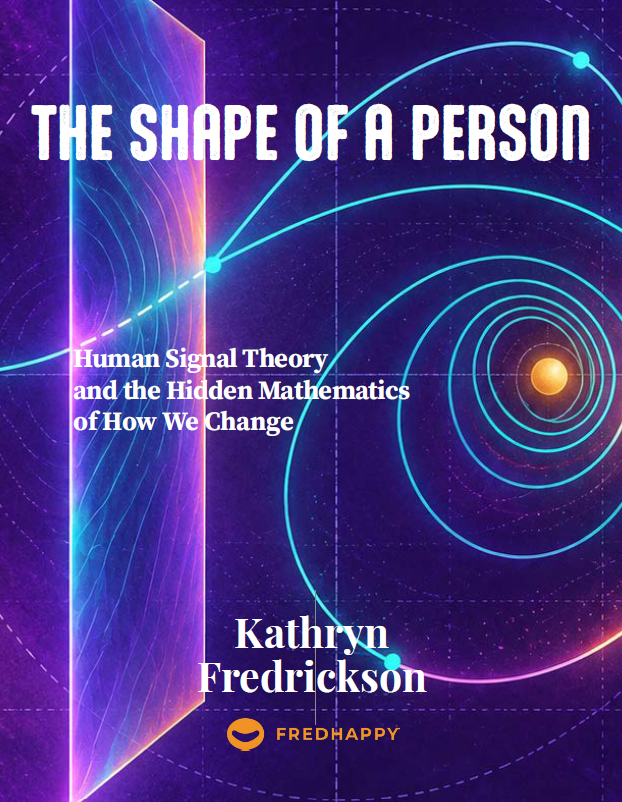
If you want the larger map this case study sits inside — shape rather than a one-dimensional score, why a state can stay loaded after the event ends, and why the path out is not the path in — that framework is in Fredhappy's The Shape of a Person: Human Signal Theory and the Hidden Mathematics of How We Change.
The book starts from a simple claim. You are not a one-dimensional real value. You have a shape. The pattern you keep living is not proof of who you are. It is evidence of the system you have been orbiting.
Four questions sit on top of the math.
- What pattern keeps happening?
- What does this system make cheap, and what does it make expensive?
- What state is still loaded now that the event has ended?
- What would make a different next move actually affordable?
The book will not tell you every outsider is right. It will hand you a map precise enough to see the mechanism. What you do with the map is yours.
EXPAND
The Shape of a Person
Human Signal Theory and the Hidden Mathematics of How We Change
A clear model of how identity, relationships, repeated patterns, and the body shape human change—and how a changed signal can open a different future.


