

Ecclesiastes goes hard, and chapter six has no intention of making you comfortable. It imagines a person who lives two thousand years, possesses abundance, and still cannot enjoy being alive.
That is where my mind went to the vampire. Imagine surviving century after century with an appetite that never learns the meaning of enough.
What Does Ecclesiastes 6 Say About Never Feeling Satisfied?
If you are looking for the meaning of Ecclesiastes 6, the separation between having and enjoying is a place to begin. The chapter gives us wealth without satisfaction, astonishing longevity without fulfillment, and a mouth whose labor never finally quiets its hunger.
I find Ecclesiastes obtuse on purpose, as though it wants me to sit with the question until my first convenient answer gives way. Here is the question it left with me: what happens when we lose the capacity for wonder?
You could have two thousand years and still walk past everything that might have made one afternoon worth having. I keep thinking that the smallest things are the largest things, because a life can turn on whether anything still reaches us.
This post contains Amazon affiliate links. As an Amazon Associate I earn from qualifying purchases.
For readers drawn to the language and difficult questions of these texts, Robert Alter’s The Wisdom Books: Job, Proverbs, and Ecclesiastes offers a translation with commentary. Choon-Leong Seow’s Ecclesiastes, in the Anchor Yale Bible Commentaries, offers a sustained scholarly exploration of this one extraordinary book.
What Do the Dead Sea Scrolls Say About Being Human?
The Dead Sea Scrolls go hard, too. In the Thanksgiving Hymns, the speaker confronts the strangeness of being made of earth and somehow able to contemplate mysteries larger than a lifetime.
The section marked X in the translation I was reading asks how a creature of clay can understand such marvels. Elsewhere on the same page, bodily decay and renewal occupy the same imaginative world, with dust becoming capable of knowledge and speech.
I can spend a long time there. We are temporary bodies that can ask about eternity, and sometimes we use that astonishing capacity to decide that we have already seen everything worth seeing.
To explore these ancient writings further, Géza Vermes’s The Complete Dead Sea Scrolls in English: Seventh Edition brings the texts together with introductions and notes. It is a companion for anyone who wants to linger over the questions that a brief passage opens.
Why Do People Believe the Dead Have Unfinished Business?
The older Central European vampire is a particularly unpleasant companion for this thought. Forget the immaculate evening clothes for a moment and imagine the ruddy, swollen body that frightened people when a grave was opened, with apparent blood around its mouth.
Decomposition supplies physical explanations for features once read as signs of feeding, including swelling and fluid escaping from the body. Hair and nails do not keep growing after death; drying skin retracts and can make them look longer.
Knowing that explains something about a body. It leaves us with another question about the people gathered around it: why did they believe this particular person had come back, and what did they think remained unsettled?
When we compare beliefs about the restless dead across cultures, we find recurring concerns about obligation, appetite, dangerous death, improper burial, and relationships that have not come to rest. A person can die while a debt, a grievance, a duty, or a bond remains insistently alive among the people who knew them.
In parts of Slavic Europe, fear of the returning dead led to interventions including decapitation and the placement of barriers against the body. At Drawsko in Poland, archaeologists studied graves containing sickles across bodies and stones placed at the throat or jaw, interpreted as measures against a feared return.
What Can Restless Spirits and Hungry Ghosts Tell Us About Care?
Now place those graves beside Japan's medieval Hungry Ghosts Scroll, which depicts beings tormented by hunger and thirst. The Kyoto scroll also depicts their relief through offerings, teaching, and compassion, including the story of a son seeking help for his mother.
The comparison is powerful because it lets us ask what a community believes suffering requires of it. One response restrains a threatening body, while another reaches toward a suffering being with the possibility of relief.
These stories give form to unfinished relationships and specify what somebody should do next. The ties that bind can become a duty of care, a source of fear, or a reason to keep bringing something to someone who can no longer ask.
How Did Ancient Egyptians Prepare for the Afterlife?
I think of the tomb of Seti I in Egypt's Valley of the Kings. I was there, and I would have visited every single tomb if I could.
The labor involved in telling someone how to pass through death is extraordinary. Seti's tomb contains funerary compositions including the Amduat and the Book of Gates, and its burial-chamber ceiling carries an astronomical scene.
These were protocols for passage, with encounters, knowledge, and divine relationships made visible in a place prepared for the dead. Imagine committing that much artistry and collective effort to the conviction that someone should know how to proceed.
At Hatshepsut's temple, I was struck by the view from the valley and the view back down into it. Your position changed what you could see, and the building became part of how you understood the landscape around you.
That bodily experience stays with me when I think about belief. A story can be something you enter, climb through, look out from, and carry away in your sense of where you belong.
Many of us now move among competing accounts of death, carrying pieces of family religion, private experience, science, and stories we scarcely remember learning. We can have excellent directions to the hospital and feel completely unprepared for the conversation that needs to happen inside it.
Along the narrow, twisting roads in rural America, I saw shrines for the dead, and the number of them hurt to see. The driving felt fast, the roads felt treacherous, and each memorial made the possibility of loss painfully specific.
I read those roadside memorials as navigation of another kind. They marked where a life had ended and asked something of the people still passing through.
A stranger could slow down because someone had taken the trouble to remember. In that moment, grief might protect a person whose name the bereaved family would never know.
What Would You Notice If You Lived for 11,000 Years?
Now imagine being eleven thousand years old and remembering places before they became archaeology. You could have known Göbekli Tepe while people still used its monumental buildings, long before excavation returned their animal-covered pillars to view.
You would remember a world in which the sky supplied bearings and the recurring movements of the sun and moon helped mark time. You would also have lived long enough to notice changes within what shorter lives experienced as dependable.
I sometimes imagine Göbekli Tepe as a starport. In that speculative picture, a lizard relief marks a local creature whose energy signature an arriving ship could recognize, turning a carving into an address.
That is my imaginative reading of the site, and the question fascinates me. What would an arrival point look like to someone who had forgotten what arrived, or how its users found their way there?
The actual filling of Göbekli Tepe's buildings has its own complicated history, involving human activity as well as natural sediment movement. Our long-lived witness might remember the sequence of events that we are still trying to reconstruct from what remained.
By the time the Bronze Age city at Kemune flourished beside the Tigris, that witness would already have been ancient. They could have seen the earthquake destruction associated with its Mittani-period buildings around 1350 BCE, and millennia later watched the ruins disappear beneath the modern Mosul reservoir.
When falling water exposed the site in 2022, archaeologists recovered an archive of more than a hundred clay tablets. Some still sat inside clay envelopes, carrying words through a span of time their writers could scarcely have imagined.[9]
Our witness would have watched buildings change purpose, languages become unreadable, and familiar routes disappear. Change would be the constant, and the question would be whether so much witnessing had deepened their attention or exhausted it.
Would another sunrise still be worth watching? Would they recognize a particular person's attempt to make things right as something consequential, even after seeing empires come and go?
What Is the Shanidar Cave Flower Burial?
That is where I return to flowers. The smallest things are the largest things, and a little pollen can hold my attention longer than an empire.
At Shanidar Cave in present-day Iraq, pollen found near the remains of a Neanderthal became the basis of the famous “flower burial” interpretation. The burial is often described as roughly sixty thousand years old, and the possibility that someone placed flowers with the dead has occupied imaginations for decades.
I know that the pollen's origin is contested and that later research has proposed other ways it could have arrived. I choose to believe it was devotion.
When I picture that possibility, I see someone taking the time to gather something beautiful and bring it to a body. There would be no later conversation in which to receive thanks, yet the gesture could still have mattered enough to make.
Why do we put flowers on graves?
Among the many meanings we give the practice, I recognize the desire to keep expressing love when the ordinary exchange has ended.
Flowers also make an effort visible. Somebody came, somebody remembered, and somebody chose what to bring.
I can hold the archaeological question open and still let the possibility of ancient devotion affect how I live now. The belief asks something of me: if care might reach across sixty thousand years through a trace of pollen, what am I doing with the people within reach today?
How Do Our Beliefs About Death Shape the Way We Live?
This is why the anthropology of death is also an inquiry into living. The things we do around a death reveal whom we count, what we owe, what frightens us, and what we hope can continue.
We make those choices long before anyone enters a tomb. They appear in whether a family can tell an uncomfortable truth, whether a community keeps caring after the ceremony, and whether a leader notices the person whose silence has become convenient.
A witness can help by making a life harder to erase. We can remember the person's own words, name what happened accurately, and allow a story to become more complete as we learn more.
Wonder matters here because it keeps another person from becoming a finished explanation. There may still be something to understand about the parent, colleague, stranger, or long-dead maker whose meaning we thought we had settled.
And the question “What do we choose to believe about how to live and die?” has consequences. We can make the call, offer the apology without demanding forgiveness, ask the question we have been avoiding, or pay attention when someone tells us what they need.
Some relationships will remain unfinished, and we may have to grieve what cannot be repaired. We can still choose how we carry their history and what we teach the next person to expect from us.
Transformation becomes tangible in those choices. A story of inevitable cruelty can change when someone behaves with care, and a culture that rewards silence can change when someone with authority makes truth safer to speak.
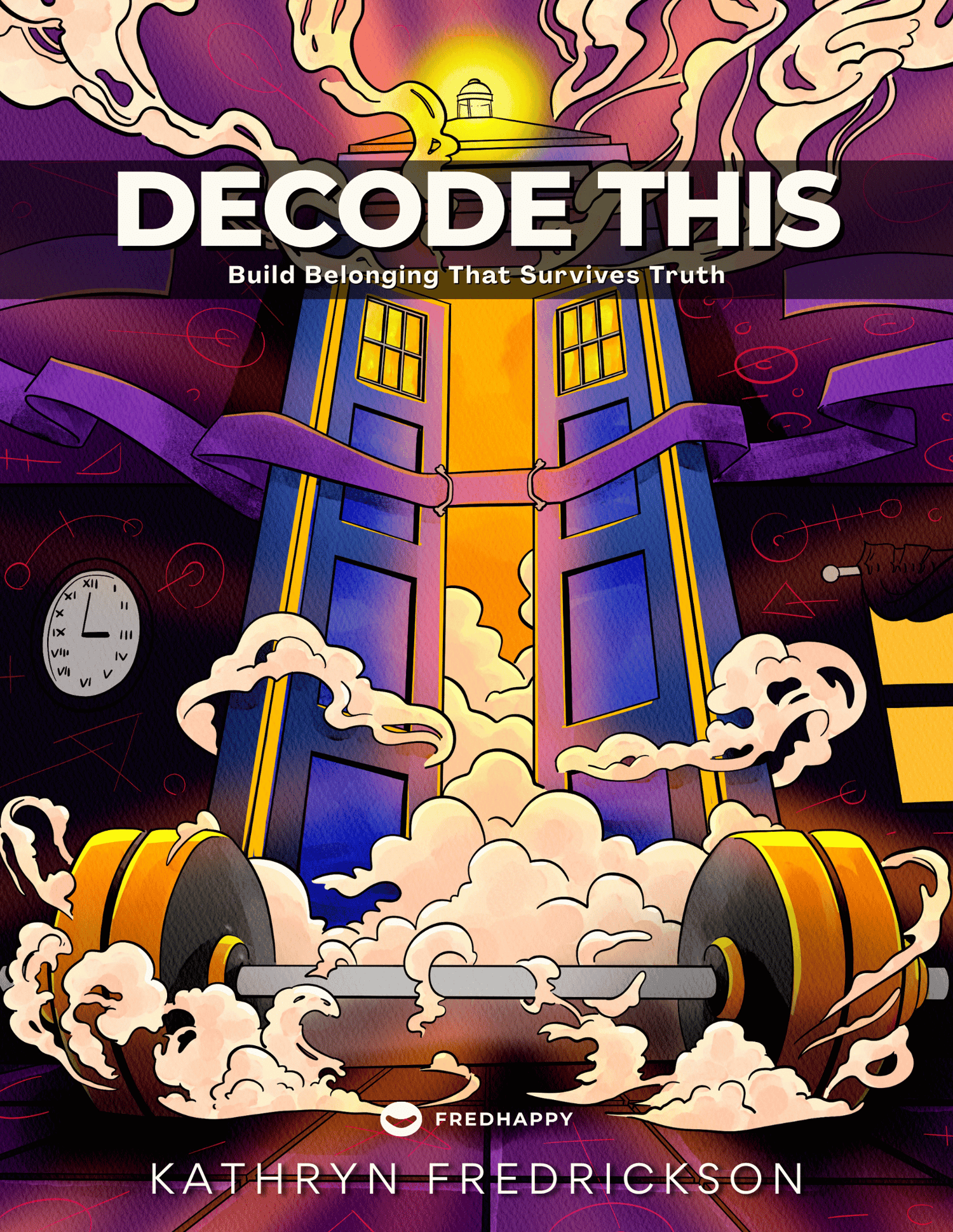
That is the work I explore in DECODE THIS: Build Belonging That Survives Truth, a Fredhappy Leadership book for people building teams, cultures, events, communities, and brands. It examines how symbolic environments shape attention, identity, and group behavior, and how belonging can strengthen people while leaving them able to disagree and see clearly.
I wrote it for people who want the worlds they build to support both belonging and clear sight.
EXPAND
DECODE THIS
Build Belonging That Survives the Truth
DECODE THIS examines what happens when belonging depends on what can and cannot be said. It offers a different way to think about groups, truth, disagreement, and the kind of belonging strong enough to survive reality.
If you have wondered how to build a team culture where people can tell the truth, the book takes these questions into everyday leadership. It helps you recognize when alignment becomes performance, intensity replaces execution, or a leader becomes a symbol that the group is afraid to question.
I return to Ecclesiastes with that in mind, still unsettled by the person who could have two thousand years and remain hungry. I want to live in a way that lets something small reach me before I ask the world for more.
The person who might have gathered flowers at Shanidar is beyond our conversation, but their possible gesture still asks something of mine. I choose devotion, and I want the people around me to experience what I mean by it while we are here.


