

Human beings are completely hackable.
Music can change your mood before you notice you were in one. An afternoon with someone who makes you laugh can send you home feeling more like yourself. The right sentence in a book can follow you for twenty years. A single smell can drop an entire summer back into your body so precisely that for a moment you are standing in two decades at once.
We like to imagine that a strong person moves through the world from a sealed interior command center — observing, deciding, maintaining boundaries, and remaining essentially unaffected. Actual human beings are more interesting than that.
We are open systems. Our environments enter us continuously through sensation, language, relationships, attention, memory, and experience.
The room matters. The people in it matter. What we repeatedly hear and repeatedly do matters.
Beauty gets in. Fear gets in. Laughter gets in. A miserable day at work can follow us all the way home.
This is not a design flaw. It is the design.
We use our own openness all the time
Most of ordinary life is an attempt to influence our own internal state. We put on music to work. We exercise to clear our heads. We go outside because the walls have started closing in. We call one particular friend because we already know the conversation will change our perspective. We change the lighting, rearrange rooms, travel to interrupt familiar grooves of attention, and read books because we actively want someone else’s ideas to enter our minds.
Culture is built around this permeability.
Architecture shapes behavior.
Ritual uses repetition, sound, and symbol to create meaning.
A stadium can generate an atmosphere strong enough to pull a reasonable adult out of a chair.
We do not merely tolerate being influenced. Much of the time we seek it on purpose.
Openness is how human beings learn, connect, adapt, and grow. If experience could not reach us, experience could not change us. We would be perfectly protected and almost completely useless.
The feature and the vulnerability share the same seat
We often talk about strength and vulnerability as opposites. More strength should mean less vulnerability. Enough strength should eventually make a person wonderfully difficult to disturb.
I used to believe a version of that. Becoming stronger meant becoming harder to affect. If something hurt, build a thicker wall. If another person unsettled you, care less.
The problem is obvious once you look at it: the wall does not know which experiences you wanted to keep.
The same openness that allows rejection to hurt is involved when belonging feels wonderful.
The mind that can become preoccupied with something frightening can also become absorbed by an idea.
The capacity to attach creates the possibility of grief; removing attachment to remove grief would be an astonishingly expensive bargain.
Even attention works this way. We complain when something captures it against our wishes, yet that same ability to become absorbed is what lets us learn, make things, solve hard problems, or lose an hour doing something we love.
The feature and the vulnerability are often sitting in the same chair. Once I understood that, invulnerability stopped looking intelligent.
Our environments are always participating
Put the same person in two different environments and different things become possible.
- One workplace can make someone expansive; another has them checking every sentence.
- One friendship can make a person funnier; another can make them quieter.
- A long stretch without rest can turn an ordinary inconvenience into a crisis.
- An afternoon outside can restore proportions that felt unavailable an hour earlier.
This does not mean we are helpless puppets. It means the organism and its conditions are in constant conversation.
We already understand this with houseplants. We do not put a plant in a dark closet and then lecture it about mindset. We look at light, water, and soil.
Humans are more complicated than philodendrons. We can change environments, reinterpret experiences, set boundaries, leave people, seek people, create routines, and deliberately introduce new influences.
Our openness does not only make us vulnerable to conditions. It also gives us an extraordinary ability to participate in changing them.
Not everything that gets in deserves to stay
Openness is not the same as having no boundaries. A healthy living system sorts, responds, rejects, integrates, and repairs. We do this imperfectly because we are human.
An idea can enter and later prove wrong. Someone else’s opinion can hang around long enough to start sounding like our own. A frightening experience can leave the body preparing for conditions that have already changed.
The opposite is also true: a teacher can permanently enlarge what we believe is possible. A friendship can teach ease. A place can wake up an interest we did not know we had.
We are altered by what we encounter, and then we carry some of those alterations forward. That is why I became less interested in the project of becoming unaffected and more interested in the practice of stewardship.
If I am going to remain open to life, what exactly am I taking care of?
That question eventually led me to notice that human life depends on certain capacities being available. I began mapping those capacities — not as personality traits or moral categories, but as ordinary human strengths. I eventually identified eight that kept appearing across very different kinds of experience.
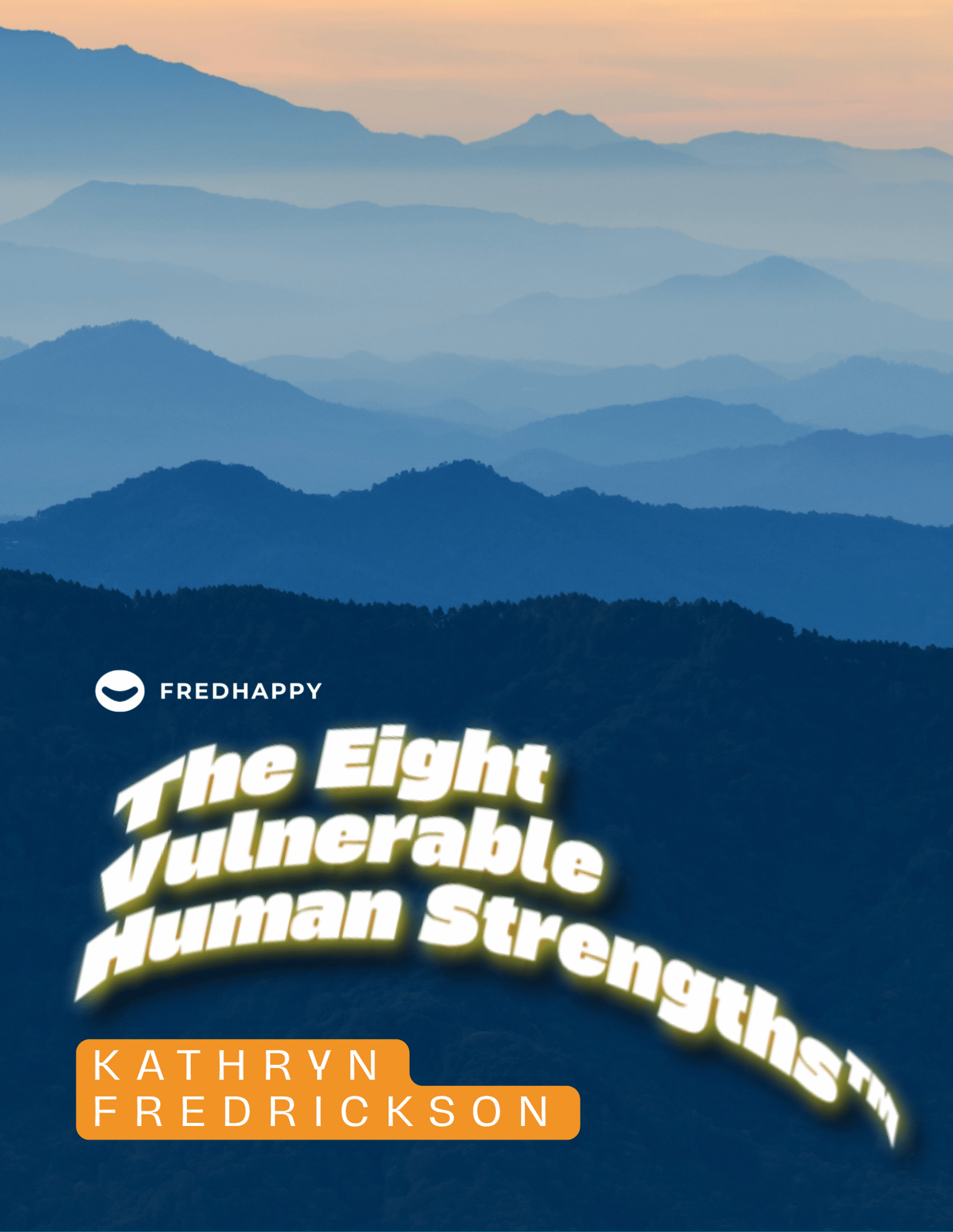
That work became The Fredhappy Eight Vulnerable Human Strengths™.
I am deliberately not listing the eight here. The framework is the book.
What matters for this conversation is the idea underneath it: some of the things that make human beings strong are vulnerable precisely because they must remain open in order to work.
Strength does not have to mean becoming impermeable. It can mean becoming more aware of what affects us, more discerning about what we invite in, more capable of noticing when something important is under pressure, and more practiced at returning when life knocks something sideways.
Human beings are completely hackable. That is why the world can get to us. It is also why the world can still surprise us, teach us, delight us, and change us.
I would not trade that away. Would you?
EXPAND
Eight Vulnerable Human Strengths™
Eight Vulnerable Human Strengths explores an unexpected paradox: some of the qualities that make us most capable, connected, and fully human can also become points of vulnerability. This Fredhappy™ framework helps you see those openings differently and become more deliberate about what gets access to them.
Digital PDF · Immediate access


