

Why We Wrote This
He had been there longer than most marriages.
Longer than several zoo directors. Longer than the concrete sea lion enclosure they finally tore out in the nineties. Longer than the painted jungle mural that faded into a nicotine-colored ghost behind the reptile house vending machines. Longer than the years when children still arrived clutching paper tickets and sweating through church shoes.
You had known him since childhood.
Not personally, of course. Not in the sentimental way people claim ownership over animals they have only visited. But he had existed inside the architecture of your life for so long that his continued presence felt geological.
Reliable as limestone. Reliable as summer cicadas. Reliable as the old cottonwoods leaning over the path behind the primate building.
And on that afternoon, for reasons known only to tortoises, he came close enough to study properly.
The day was bright but not cruel. Midwestern sunlight filtered through a high wash of pale clouds, turning the dust along the enclosure into soft gold. Children shrieked somewhere near the flamingos. A train whistle moved through the distance beyond the university district. The air smelled faintly of pond water, mulch, and hot concrete.
The tortoise approached with impossible slowness and absolute commitment. Not laziness, or stupor. Intention.
Every movement looked ancient enough to have survived extinction. The front legs rose and descended like hydraulic pillars from another epoch. Thick scales overlapped in pyramidal stacks, weathered and geometric, each one edged in old ivory and earth-dark shadow. The skin itself looked plated rather than soft, like dinosaur leather left beneath desert wind for fifty years.
His claws were long, curved, deliberate things built less for attack than for persistence. Tools for carrying civilization on the back.
You sat down without realizing you had done it. And then you stayed. Fifteen minutes at least. Maybe longer. Long enough for the world to stop demanding narrative. Long enough to really study the shell.
The shell was not smooth. That surprised you.
Childhood memory had simplified him into cartoon curves, but the real architecture was severe and beautiful. The scutes rose in worn domes and ridges, stacked into one another with mathematical patience. Old amber. Charcoal. Dust. Stone. An entire epoch lived in those textures.
Nothing decorative. Everything load-bearing. And underneath all that armor, life.
That was the revelation.
Not hardness. Structure.
The shell did not exist because the tortoise hated the world. The shell existed because the living body required protection strong enough to keep moving through the world for a century.
He turned toward you then.
Those eyes.
Round, dark, intelligent eyes holding the strangest expression you had ever seen on an animal: wise and surprised at the same time. As though existence remained slightly astonishing even after fifty years beneath the same sun.
There was no fear in him. Not bravado either. Something older.
A kind of graceful certainty. Ancient composure. The confidence of a creature that had fully accepted its own design.
That was what struck you hardest.
He was not apologizing for the shell.
Not performing toughness. Not trying to appear harmless. Not overexplaining his existence to earn permission to take up space in the world.
He simply was. Heavy. Ancient. Deliberate. Carrying protection without shame.
At one point he paused directly in front of you, close enough that you could see the fine cracks in the scales around his eyes and the faint crescent of old dirt packed gently into the folds of skin above the claws. You had the strange feeling that if you remained still enough, the entire frantic human world might pass around you both without entering.
And for a few minutes, it did. No performance or proving. Just sunlight warming shell. Dust settling slowly onto prehistoric skin. Two nervous systems resting beside one another in complete absence of demand.
You realized then that softness and protection were never opposites.
The tortoise carried both at once.
EXPAND
Degrees of Visibility
Modern Exposure
A strange and practical field guide to being seen, protecting what matters, and expanding without leaving yourself behind.
Inside the Book Degrees of Visibility: Modern Exposure
Introduction: Visibility Has Consequences
Some people move through visibility intact. They walk into a room, answer a question, post a photograph, speak in a meeting, sing in public, tell the truth, ask for help, or make a mistake, and the event passes through them without becoming a referendum on their worth. They may feel nervous, embarrassed, proud, exposed, pleased, uncertain, or tired afterward, but they do not lose themselves. Being seen does not automatically become danger.
Other people learn something different. They learn that visibility has terms. They learn that being seen may bring praise, but also scrutiny. They learn that attention can come with appetite. They learn that a room may welcome the useful version of them, the polished version, the funny version, the grateful version, while quietly rejecting the parts that are still unresolved, angry, tired, needy, brilliant, or inconvenient.
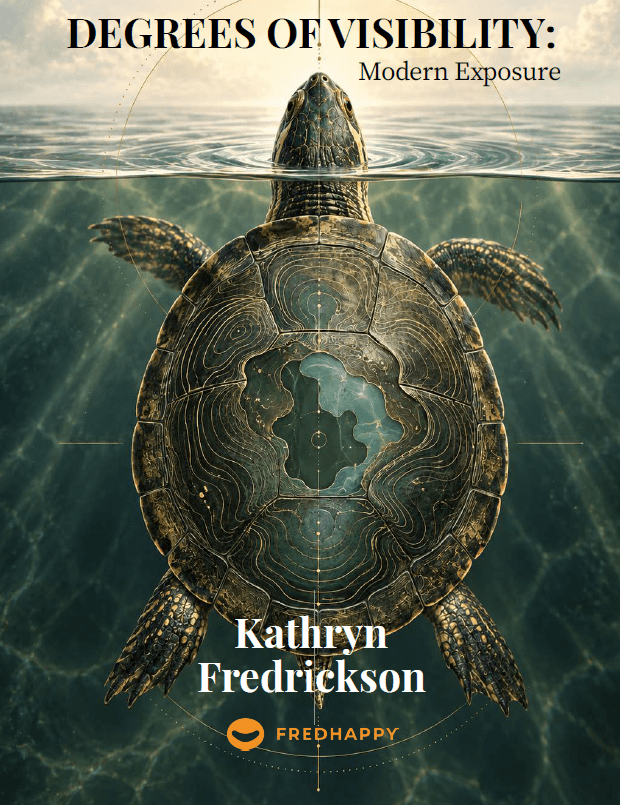
This book is about those terms. It began with a turtle. More specifically, it began with the realization that living creatures build protection for a reason. The goal is not maximum visibility. The goal is self-connected visibility.
Four forces often sit beneath visibility: attachment, shame, visibility itself, and threat. Attachment asks what happens to connection when you are seen. Shame asks what being seen seems to mean about you. Visibility asks what part of you is actually being shown. Threat asks what consequences your body expects if the moment goes wrong.
This book will not tell you to become wide open. It will not ask you to prove your healing by making yourself endlessly available. Some walls were built because something real happened. Some shells formed because exposure had consequences.
That is where the sensitive turtle lives: in a beautiful grassy meadow with a shallow-edged pond nearby. The pond is still there. The nesting ground is still there. The turtle still knows, in the old body way, how to move between the two.
The question is not whether you have protection. The question is whether your protection still fits the life you are trying to live now.


