

Some truths only arrive wearing a shiver. They hide in the pause between words, in the moment a stranger’s hands start shaking, in the smell that shouldn’t be there.
My uncanny fiction stories are not escape. They are pattern recognition wrapped in dread. They let the reader feel what the body once had to hide.
Let me TELL you about Trauma Blindness
Trauma blindness is an adaptive perceptual mechanism. When threat feels constant, the nervous system narrows its focus to the most immediate, manageable dangers while quietly tuning out closer or relational threats that feel too overwhelming to handle right now.
What looks like “forgetting” is actually a clever neuroprotective strategy. The brain archives the heaviest material and stores it away until the environment feels safe enough for it to surface.
Now I'll TELL you about Hypervigilance, the natural follow-up
Once safety is established, the nervous system flips into heightened scanning mode. Everyday cues— a certain smell, a quick glance, a tone of voice—get rapidly screened for danger.
Both trauma blindness and hypervigilance are intelligent adaptations to sustained threat. These are not flaws.
Now I’m going to SHOW you about Hypervigilance
The sky out there was too big. Empty blue pressed down on flat fields for miles, the kind of sky that should have felt like freedom. Instead it felt like an eye.
She was weeding between the young elderberries when the first one flew directly overhead — low, deliberate, engine roar vibrating straight through her ribs. The metal roof rattled hard enough to loosen dust. She straightened slowly and watched it pass, studying every rivet, every marking on its pale underbelly.
Another came days later while she reached between the planting beds, so close she could count the bolts. She didn’t flinch. She stared back.
She began tracking them. Noting the timing. The direction. The way one always appeared minutes after she posted a video. The way they found her in the exact center of the open lot, no cover anywhere.
She kept her hands in the dirt, shoulders set, jaw tight — a small, stubborn act of defiance against the feeling of being watched from above by something that had no business being there.
One buzzed the gravel road at dawn, low enough to wake the neighbor’s babies with its thunder. Another caught her on the dock. As she bent over the boards, the roar slammed in from behind. The paddle dropped from her hand and slapped the dark water. She stayed crouched, neck craned, eyes locked on the plane until it shrank to a speck.
The sky stayed enormous. And it never blinked.
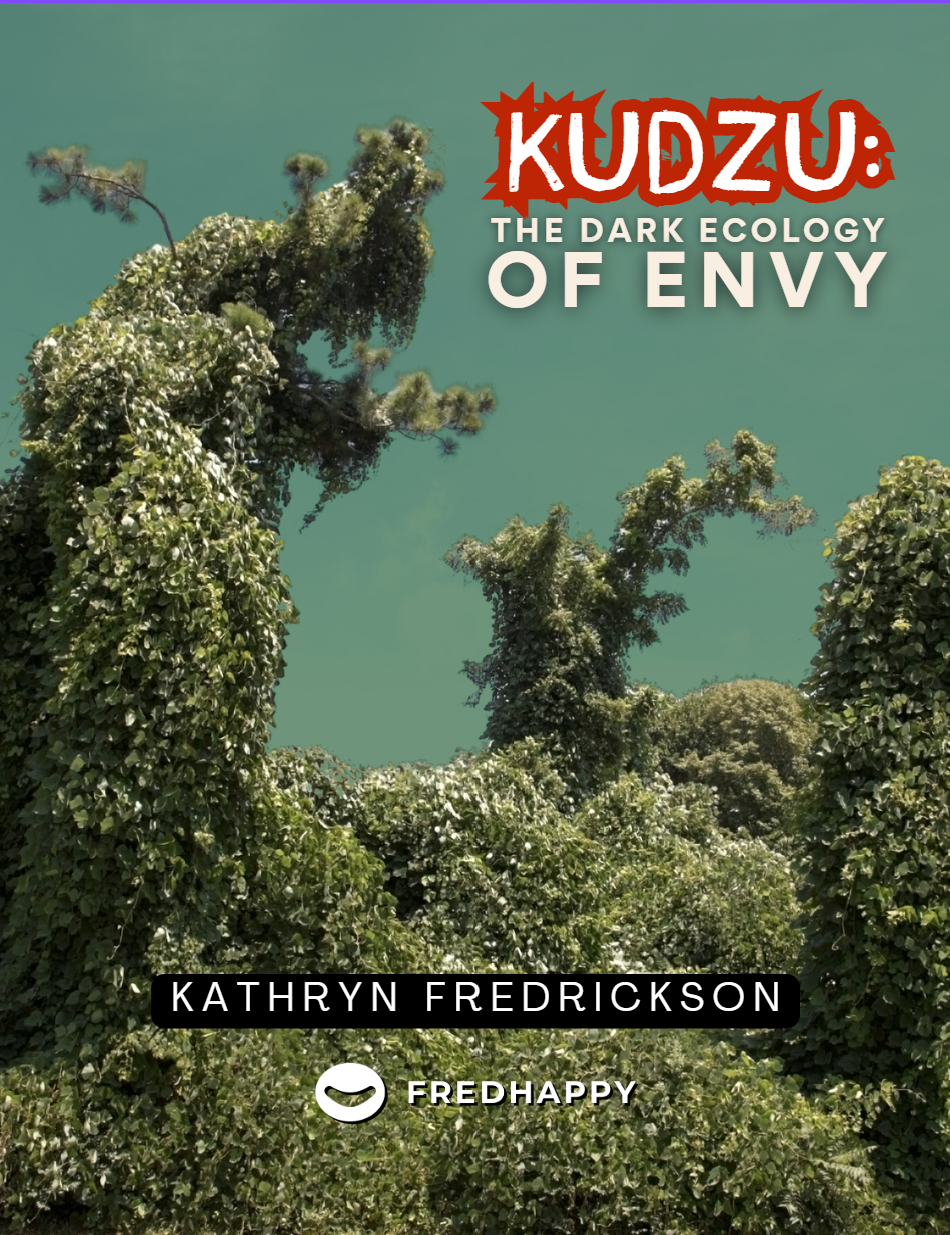
PROTECT
KUDZU
Dark Ecology of Envy
Examine how envy spreads through relationships and groups, how scarcity stories distort perception, and how resentment can grow into exclusion, sabotage, or social control.


