

People get hurt by manipulation that arrives wearing the language of care. The mechanism is older than any single workplace or small town. Perhaps you’ll recognize yourself in the words that follow.
Manipulation doesn’t always come with raised voices or obvious threats. Sometimes it arrives as a story that must be protected, a design that feels inevitable, and a quiet pressure that makes resistance feel like betrayal. It runs on current — electrical, emotional, and energetic — and it becomes nearly invisible once the story, the repetition, and the offering are accepted as normal.
How Coercive Control Begins with Structure and Repetition
There is a way that the foundations of Maslow’s hierarchy — safety, belonging, esteem, and the sense of self-actualization that comes from doing meaningful work — can be systematically targeted in high-control and cult-like environments. It begins with four corners and a rhythm.
They probably won’t announce it. But you’ll see how they move like they’re tightening wires. Someone worthy comes through and gives a nod to the one running the current. The day before, a man at the top approves projects while watching the target closely.
The room gets smaller. One person blocks the only way out while the work happens behind you.
The square locks into place. Ordinary words start carrying extra weight. The body registers the pattern before the mind fully names it.
How Repetition Locks People Into Coercive Systems
- The first time may have sounded like a name.
- The second time defined leisure and status using golf carts on a controlled course.
- The third time may have sounded like an old nickname for a man from town who knew how these things worked. No one even remembered his real name anymore.
- The fourth time landed like current straight into the base of the skull.
That’s how you lock a square. You drive the rhythm until the body starts finishing the pattern on its own. The pressure builds in the chest, behind the eyes, in the place where words and space meet.
The echo can keep humming for weeks afterward. The square doesn’t need the people running it once the echo takes over.
All of this can and should be documented. And all of it was.
Why High-Control Groups Target Those Who Carry Their Own Power
Long before any modern office or small-town circle, certain people carried knowledge and power that changed how things moved through groups. They were often punished not just for what they knew, but for refusing to fully submit to the existing order.
Prometheus stole fire and gave humans the ability to shape their own world. For this, he was chained to a rock while an eagle ate his liver every day. Enki slipped forbidden knowledge into human hands. Azazel taught skills that allowed people to defend themselves, adorn themselves, and see differently. In each case, the one who carried something new or dangerous was made to bear the cost.
These figures were often turned into carriers — forced to hold the consequences of knowledge or power that others wanted to control or suppress. When they refused to fully metabolize what was placed on them, or when they refused to remain the perfect ground for someone else’s current, it was treated as rebellion.
This pattern is ancient. High-control systems have always gone after those who carry something they cannot fully own or redirect — whether that something is knowledge, perception, autonomy, or simply the refusal to keep carrying what was never theirs. The punishment is rarely just about the knowledge itself. It is often about breaking the one who will not stay grounded where the system wants them.
The ones who refused to keep metabolizing what was forced on them, and who refused to remain perfect conductors for someone else’s current, became the early examples of reclamation. They showed that even when the circuit is built around you, it is still possible to stop completing it.
How Stories Are Used to Justify Control
Every working circuit needs a justifying story. The story is usually simple and repeated until it feels like common sense: someone must be protected. The group’s safety depends on keeping a particular person or idea safe. Anyone who questions the arrangement is repositioned as a threat to that safety.
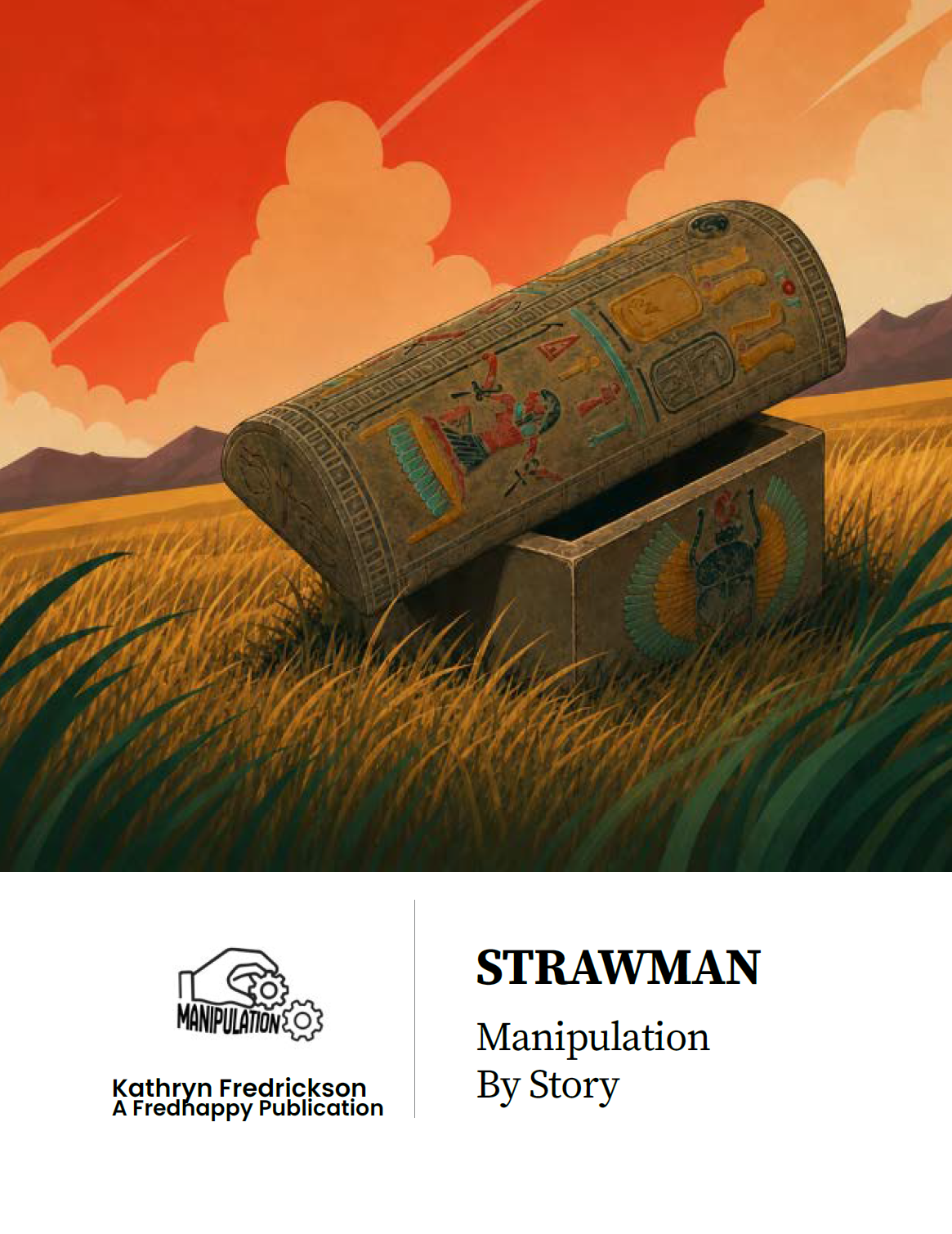
This is the STRAWMAN: Manipulation by Story layer. Once the story is accepted, resistance feels like betrayal. The current flows more easily when people believe they are doing something righteous.
How Refusal Is Made Expensive in Coercive Environments
Four times is not a coincidence. It is architecture.
Each repetition charges the loop. The first time might pass as ordinary speech. The second time begins to feel familiar. The third time starts to organize the nervous system. The fourth time lands like a live wire.
Four directions. Four anchors. Four quadrants of experience. The square holds the rhythm until the body begins finishing the pattern on its own.
This is the STRATAGEM: Manipulation by Design layer. The echo that lingers for weeks is not a side effect. It is the designed residue of a successfully locked circuit.
When story and design aren’t enough, force completes the circuit. This is STRONGMAN: Manipulation by Force. The Strongman does not ask. He contains. He builds the structure and places the offering inside it. The current is driven through the confined space until the only sustainable responses are compliance or internal collapse.
In older labyrinth myths, the Minotaur is both prisoner and engine of the system. It is fed on what the city sends it. The city stays orderly because the monster in the center is kept fed. Previous victims are not released — they are metabolized. Their energy sustains the next cycle.
In high-control environments the same principle appears in smaller form. Earlier participants who “didn’t go well” or who “had to leave suddenly” are not mourned as losses. Their stories are consumed like snacks to strengthen the narrative that the current structure is necessary. The force is rarely loud. It is the quiet, relentless pressure of walls that have already been built.
Previous participants are rarely fully released. This consumption keeps the loop alive. It is maintenance, not drama. The square stays stable by feeding on what it has already broken.
What Happens When the Body Rejects Coercive Control
Outstretched hands. An offering that was never fully seen. The transfer happened while the target’s back was turned. Something small changed hands. Something unseen moved into the circuit.
In older systems this was the moment the burden got passed. In this version it looked like a tiny box held forward while the real work happened behind the one who would carry the charge.
The Backfire When the Circuit Overloads
Pressure builds until something has to give. The target feels the overload in the body — chest, skull, the place where language and space meet.
Dissociation is not weakness. It is the breaker tripping because the current has become too much. When the system is already carrying a heavier load and additional current is forced through it, the discharge can be violent and uncontrolled.
What came out wasn’t quiet. Thick violet plasma — hot, bright, and uncontrolled — spattered across the office, across the people running the working, and across the little box that had been offered.
The square couldn’t contain the charge. The current found its own way out. Those who drew the circuit can feel the backlash when it fails to ground cleanly.
Coercive Control and Modern High-Demand Groups
Coercive control is a pattern of behavior designed to dominate, isolate, and reshape another person’s reality through psychological, emotional, and sometimes ritualistic means.
Coercive control is the operating system behind many modern cults and high-demand groups. It doesn’t always look like dramatic brainwashing or obvious abuse. More often, it arrives through repetition, loaded language, isolation from outside perspectives, and the slow erosion of a person’s ability to trust their own perceptions. In some environments, ritual elements, symbolic language, and group storytelling are used to deepen the control and make the manipulation feel sacred or necessary.
The goal is usually the same: to make refusal feel dangerous, disloyal, or impossible. When someone is systematically destabilized (their safety, belonging, and self-worth targeted), they become much easier to direct. The current runs more smoothly when the target has already been made to feel unstable or dependent.
This is why many people who leave these environments — whether they were in a spiritual group, a workplace, a family, or a social circle — report feeling heavy long after they’re physically gone. The control often leaves a residue in the nervous system. The body continues to carry weight that was never truly theirs.
If this pattern feels familiar, you are not alone. Many people who have survived coercive control and high-demand groups struggle with the same lingering effects: the echo of repetition, the sense of having been used as a carrier for someone else’s agenda, and the difficulty of putting down what was placed on them.
Fredhappy's Heavy Bags: For Bodies That Survived Coercive Control was written for exactly this experience. It is designed for people who are still carrying the physical and emotional load of these dynamics and want a way to set it down without being required to journal, process, visualize, or perform recovery work. You only need to read it in order and breathe.
Mapping the Wiring — What Modern Cult Recovery Actually Looks Like
People who have lived inside these kinds of high-control currents rarely leave with a clean break. The repetition, the story, and the nervous system imprint can continue running long after the original square is gone.
Modern cult recovery has moved away from old coercive “deprogramming” methods. The most effective approaches today are voluntary, educational, and trauma-informed.
One of the most widely used frameworks is the BITE model, developed by Steven Hassan:
- Behavior Control — How actions, schedule, and associations are regulated.
- Information Control — How information is filtered or withheld.
- Thought Control — How internal dialogue and doctrine shape what a person is allowed to think.
- Emotion Control — How guilt, fear, and belonging are used to maintain loyalty.
Effective cult recovery work often includes psychoeducation about thought reform and coercive control, trauma-informed therapy (including somatic and nervous system work), rebuilding critical thinking and identity outside the group’s narrative, and connection with others who have left similar high-control environments.
These approaches treat the person as the expert on their own experience while giving them clear language and tools to examine what was done to them.
How to Walk Out of Someone Else’s Square
The circuit loses power when it is no longer completed.
Naming the story as story, the repetition as repetition, and the unseen transfer as an unseen transfer interrupts the loop. Refusing to metabolize what was consumed from others and refusing to remain the perfect ground for someone else’s current are acts of reclamation.
This kind of current still runs in workplaces, spiritual groups, families, and social circles. Recognition is the first interruption. Once the mechanism is visible, people can choose whether to keep completing the loop or to step out of it.
Did this blog resonate? Read these books when you are ready to start seeing the actual structure and mechanism of how reality gets distorted.
PROTECT
STRAWMAN
Manipulation by Story
Examine what happens when a distorted version of a person becomes easier to attack than the person themselves, and learn to recognize when reality has been replaced by a constructed character designed to carry blame, justify exclusion, or control the narrative.


