

I was editing a book about self-sabotage when I came across a sentence I apparently wrote for the express purpose of pissing myself off.
“Do not send the emotional essay because silence feels unbearable.”
Well, who the hell asked me.
I knew exactly which essay. It starts, “Hey, one more thing,” and runs considerably longer than the Magna Carta.
The person on the other end may have put their phone down to drain some pasta. By the time they get the parmesan out, I’ve sent an executive summary of our relationship and clarified my position on an incident they’d enjoyed forgetting.
I have thirty years in marketing. Give me an uncomfortable silence and I can have a communications plan ready by lunch.
My only real concern is that the target audience is one person holding a colander.
I understood this about myself. I could explain it to a stranger in under four minutes.
Insight had been riding shotgun for years, wearing its seatbelt and occasionally reaching over to turn down the radio so it could hear me do the thing again.
I tried to prove I was healing by being productive
Originally, I wrote, “I tried to heal by being productive.” During the edit, I realized I’d left out the word prove.
Look at this. I finished a book. Surely that tells us something about how I’m doing.
It told me I could finish a book. I desperately wanted it to tell me more.
After profound harm from workplace mobbing, I had questions I couldn’t answer, including some fairly basic ones about how I was going to live.
Work had instructions
I could open a document, find the part that didn’t make sense, and fix it. After a long stretch of having very little say in what happened to me, I loved having a say on the page. I still do.
I also figured that if I could turn what I’d been through into something another person could use, I might feel better myself. I meant that.
There was a fair bit of savior complex mixed in, too
If you were hurt on the side of the road, I could write the handbook, arrange transportation, and negotiate a preferred rate at the inn.
The Good Samaritan managed the whole thing without developing collateral.
I’d have had a welcome packet on your pillow.
Meanwhile, I could’ve used a lift.
Apparently the couch needed to explain itself
I remember writing The First Step. I sobbed through a lot of it. Somebody who grew up hearing this stuff at the kitchen table might call it basic.
Well, I didn’t know any of it.
It had never occurred to me to ask who taught me a particular rule before I spent the rest of my life obeying it. Once I had the "good stuff" information, I wanted other people to have it, too.
The harder part to admit is what happened on a day when I couldn’t write. If a finished chapter was evidence I was getting better, what was I supposed to make of an afternoon on the couch?
Was I getting worse? Would it help if I took my laptop to the couch?
And there we have it, folks. We’ve invented working from a slightly worse desk.
My entire healing journey was a trauma response
This is a hell of a thought to have halfway through editing a recovery manual. I can look back now and see how often fear set the pace.
I can also look at five pages I once needed as evidence of how hard I was working and take them out because, dear God, the reader got it on page one.
I was also trimming my own bangs while editing the self-sabotage book.
In my defense, I have very nice scissors. You’ll notice my defense concerns the quality of the equipment.
The second paragraph has gone international
My TikTok audience could send that follow-up from multiple countries.
Australia: “Yeah, nah, mate, we’re good. The paragraph where I called you a d!ckhead was written before we were good.”
(Translation: We became good about ten seconds before I hit send.)
Canada: “Sorry, just circling back so there’s no weirdness — unless there already is weirdness, in which case my bad, eh.”
(Translation: Pre-apologizing for awkwardness that may or may not exist yet.)
China: “我只是想礼貌地补充一下,上一条不是在暗示你让我很失望,虽然有一点。”
(Translation: Politely adding that the previous message was not implying deep disappointment… mostly.)
Denmark: “Du spurgte, om jeg var træt eller sur. Begge dele. Jeg var kun træt, før du spurgte.”
(Translation: You asked if I was tired or pissed off. Both. I was only tired before you asked.)
England: “Just checking my last message reached you. I’d hate to think I’d spent all week taking offence when I ought to have been ringing IT.”
(Translation: I’ve allowed for a technical fault. You’d better hope there was one.)
France: “Je précise simplement que mon message précédent n’était pas une critique de votre existence entière, juste une observation.”
(Translation: Clarifying that I was not, in fact, attacking your entire soul.)
Germany: “Ich wollte nur strukturiert festhalten, dass mein vorheriger Satz keine ineffiziente emotionale Eskalation darstellen sollte.”
(Translation: Formally noting that the last message was not meant to be an inefficient emotional incident.)
Ghana: “Chale, I say forget am. Why you forget am so fast? You no even ask which part.”
(Translation: I said forget it. I expected a little resistance.)
Ireland: “Sure I was only checking that the last message didn’t accidentally list every way you’ve disappointed me since 2019. It was just a quick note. The full list is in the drafts.”
(Translation: Claiming it was brief while admitting the complete indictment still exists.)
Malta: “Ħassar il-voice note ta’ seba’ minuti. Se nibgħatlek waħda iqsar. L-ewwel sitt minuti kont għadni qed nikkalma.”
(Translation: Delete the seven-minute voice note. I’ll send a shorter one. It took me six minutes to calm down.)
Morocco: “قلت ليك جاوبني ملي تقدر. دابا بان ليا كان خاصني نحدد حتى العام.”
(Translation: I said reply when you can. Apparently I should’ve specified the year.)
Nigeria: “Abeg, who send you to apologise before I finish? Wetin I go do with the screenshots now?”
(Translation: You’ve apologised halfway through my case. What am I supposed to do with the exhibits?)
Russia: “Я просто хотел уточнить, что предыдущее сообщение не было скрытым обвинением в том, что вы разрушили мне жизнь.”
(Translation: Just confirming the last text was not a secret accusation that you destroyed my life.)
Scotland: “Ah asked if ye wanted yer ladder back, ye wee bawbag. Four paragraphs on why yer da never hugged ye. Ah could’ve asked him masel’. He’s here collectin’ the fu@kin’ ladder.”
(Translation: Your father has difficulty expressing affection. He does, however, have a van.)
Somewhere in Missouri I’m typing “No need to respond,” which is an exciting development for those of us who enjoy fiction.
I can write that message because I want someone closer. I can write it because I’d like to end the conversation before they get a chance to end it first.
That’s where Controlled Demolition came from
It’s easy to say, “Put the phone down.” I’d like to know why picking it up seemed like such a good idea.
In my case, for the ten minutes I spend composing that message, I’ve given myself a job I know how to do.
I can edit a sentence. Waiting to find out where I stand with somebody is considerably harder.
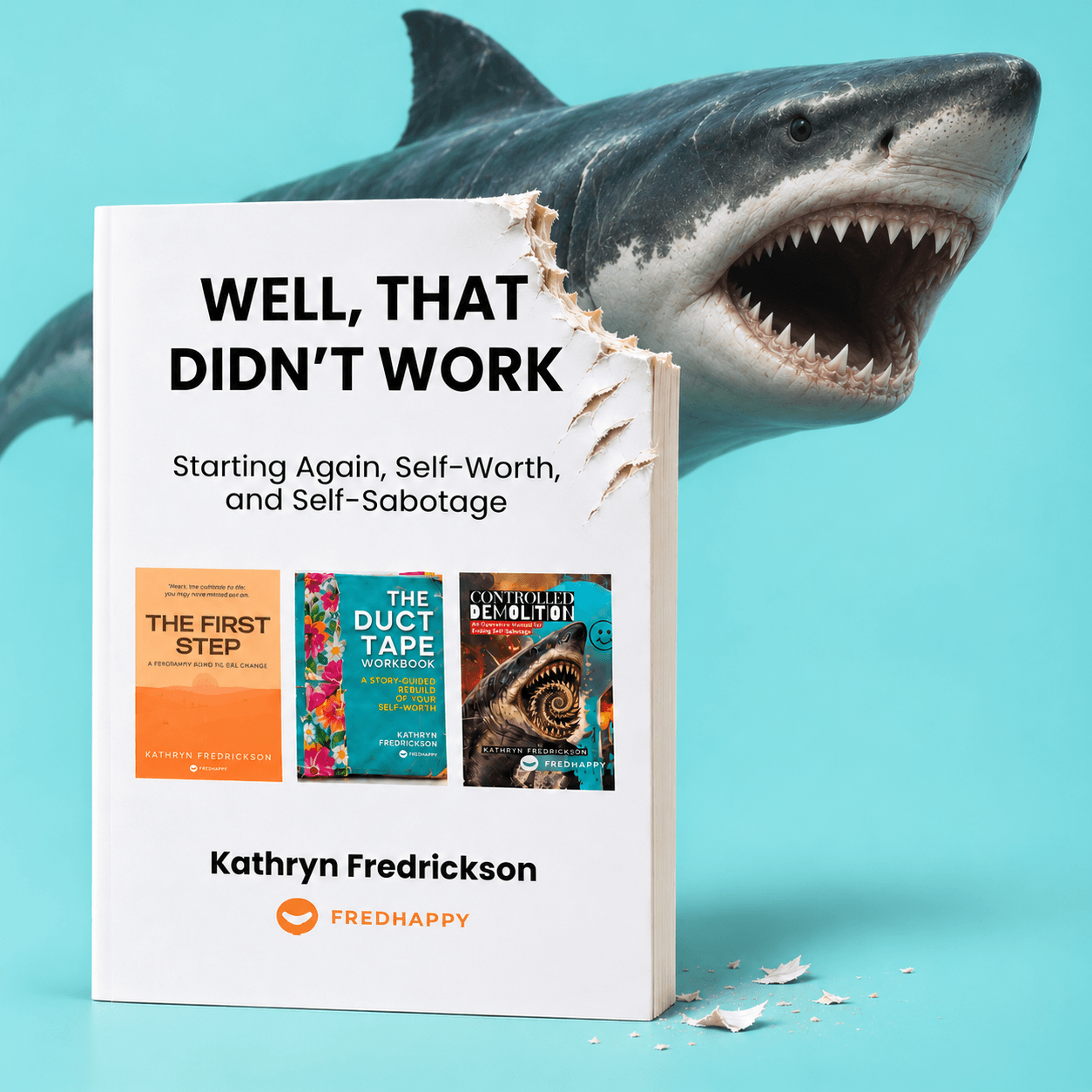
Well, That Didn’t Work
Starting Again, Self-Worth, and Self-Sabotage
Ever catch yourself picking a fight when what you really want is an honest answer? The First Step, The Duct Tape Story, and Controlled Demolition give you somewhere to start. All three books come in one 93-page PDF.
That’s a lot to ask of a PDF
I put three books together in Well, That Didn’t Work.
All three books are $7.99 together. The shark took a bite out of my margin.
The First Step gives you somewhere to begin. It moves slowly on purpose. I hustled to make sure you wouldn't throw it across the room.
The Duct Tape Story takes you into Ella’s kitchen, where her dad is trying to figure out when his daughter got so quiet. There’s a floral duct-taped binder nobody remembered to bring to the dojo in the garage.
Controlled Demolition is for the moment you catch yourself doing your signature move again, Slick. Just... circling back, eh?
If you need it, I want you to buy it
I want the person who opens it on a rotten afternoon to find something worth what they paid.
I’m more comfortable saying that last part these days. It feels good to say that without immediately offering to validate everybody’s parking.
What I’m learning to catch is the moment a perfectly reasonable deadline picks up a second job. Finishing the digital edition means I can sell it.
Finishing it tonight can start to mean I’m okay, I’ve come back. I can still do this, and nobody needs to worry about me, including me.
During this edit, I wanted another day. I wanted to see the river.
Years ago I’d have made a case for how much more productive I’d be when I got back. This time I just wanted to see the water.
You can get Well, That Didn’t Work in the Fredhappy shop.
I'll have this up on Amazon KDP in twenty minutes. Hahahahahaha... just kidding.
Kathryn Fredrickson is a B2B marketing professional with 30 years of experience navigating complex industrial markets. Having managed the high-level communications pipelines of corporate brands, she writes on human capacity, recovery mechanics, and self-governance after deep organizational harm. Her work provides actionable toolkits that help sensitive, highly perceptive professional talents step out of survival responses and back into their true executive capability.


