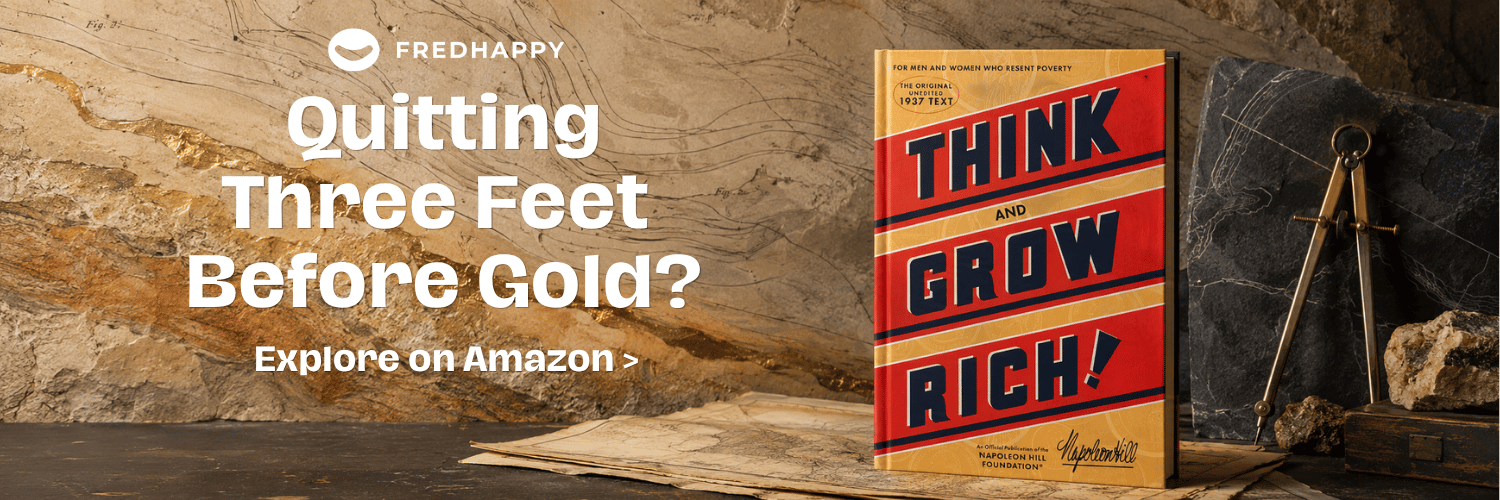
There is a story in Napoleon Hill’s Think and Grow Rich that has stayed with me for years. During the gold rush, a man goes west, begins digging, finds gold, raises money for equipment, and keeps working until the vein disappears.
After digging without success, he gives up and sells the equipment. The buyer consults a mining engineer, who determines that the previous owner stopped only three feet from where the vein continued.
Hill turned the story into one of the book’s most memorable lessons: the man stopped three feet from gold. It is generally told as a warning against quitting too soon, but I have been thinking about it differently.
I do not know whether Fredhappy is three feet from gold. Nobody does, and I do not believe that everyone who persists long enough will inevitably become wealthy or successful. Plenty of people have exhausted themselves digging in places where there was no vein at all.
What interests me is not the promise of nearby gold. It is the problem of making a consequential decision with incomplete information.
The man who quit did not know that the vein continued three feet away. If he had known, there would have been no test of persistence. He would simply have kept digging.
That is the difficult territory: deciding what to do when you cannot see what comes next.
The Story Is Really About Missing Information
“Never quit” is memorable advice, but it is not particularly useful on its own. It does not tell us whether the objective remains sound, whether the method is working, whether the market has changed, whether the available resources justify continuing, or whether the problem has been defined correctly.
Hill’s prospector had some evidence in his favor. He had already found gold. The original discovery gave him a rational reason to believe that more might be present, but it could not tell him exactly where the vein continued.
The critical change in the story occurs when the second owner obtains information the first owner did not have. A mining engineer examines the ground and explains the geological fault line. The new owner’s advantage is not greater faith, stronger desire, or a superior tolerance for motivational quotations. He has better information.
That makes the mining engineer the most important person in the story.
Expertise changes the interpretation of the problem. What appeared to be a depleted mine became a navigational error. The gold had not vanished; the original method could no longer locate it.
That distinction applies far beyond mining. A business owner may believe the product has been rejected when the real problem is poor distribution. A writer may believe the subject is uninteresting when the headline never gave readers a reason to click. A job seeker may question an entire career after applying through a channel where qualified candidates routinely disappear into automated systems.
Before drawing a final conclusion, it helps to know what has actually been tested.
Low Traffic Is Not Market Rejection
I recently improved the analytics around Fredhappy and discovered that the traffic was much lower than I had believed. I did not enjoy learning that, but the information was useful because it corrected the question I had been asking.
Low traffic does not prove that a large audience has seen the work and rejected it. It proves that too few people are reaching the work for me to draw a meaningful conclusion from the response.
That distinction sounds obvious once it is stated plainly, but it changes the business problem. If thousands of well-matched readers visit a page and almost nobody buys, the offer, product, price, positioning, or buying experience may need attention. If almost nobody reaches the page, conversion data cannot answer those questions yet.
The first problem is persuasion. The second is distribution.
Confusing them can lead to expensive and discouraging decisions. A creator may abandon a useful product because the audience never encountered it, or continue rewriting the product when the real need is better search visibility, stronger promotion, a clearer route through the website, or a more appropriate sales channel.
In my case, the analytics did not deliver a flattering answer, but they delivered a more workable one. Fredhappy has not yet been tested under conditions that would justify a sweeping conclusion about its commercial potential.
That does not prove success is nearby. It tells me that I need a more valid test.
Creation and Distribution Are Different Kinds of Work
I have spent years creating. Fredhappy now includes a substantial catalog of books, articles, frameworks, products, and related intellectual property. Building that body of work required sustained effort, but the existence of a catalog does not automatically create an audience for it.
The next phase requires different work. Existing ideas need to be packaged clearly, connected to related content, placed where interested people can discover them, and presented with a direct invitation to buy.
That means improving search visibility, building internal links, developing email, promoting articles, creating stronger product pathways, testing advertising carefully, and using platforms such as Amazon, KDP, Pinterest, LinkedIn, Facebook, and TikTok with clearer purposes. It also means finishing the remaining books without allowing the unfinished queue to become a permanent shelter from commercialization.
This work can feel less exciting than invention. A new idea carries possibility, while distribution requires repetition, measurement, follow-up, and exposure to an answer.
A landing page is ordinary. So is an email campaign, an affiliate link, a sales conversation, a revised product bundle, or a report showing what people clicked. None has the romance of discovering gold, but each provides information about the ground.
Creative people sometimes treat creation as noble and sales as slightly grubby. Thirty years in marketing should have cured me of that distinction, but selling your own work makes it feel different.
I do not merely want to make useful things. I want them to travel, and that requires distribution and sales.
Persistence Is Not Repetition
There is a version of persistence that I no longer admire. It repeats the same behavior because changing the behavior would feel too much like admitting a mistake.
That is not persistence. It is attachment to a method.
Intelligent persistence keeps the objective under review while allowing the approach to change. It asks whether the evidence still supports the goal, whether the current method is capable of reaching it, and what new information would make the next decision more reliable.
Fredhappy has already changed repeatedly. The technology has changed. The websites have changed. The catalog structure, pricing, platforms, packaging, and promotional approach have changed. Some changes solved real problems, while others created new ones or consumed time without producing enough useful information.
That history does not mean every earlier decision was foolish. A decision can be reasonable under one set of conditions and wrong for the next. Persistence becomes more intelligent when learning is allowed to alter the plan.
This is one reason the Hill story should never be interpreted as an instruction to dig forever. Continuing to spend money, time, health, or attention without examining the evidence is not automatically courageous. Sometimes the correct decision is to stop. Sometimes it is to pause, earn income elsewhere, reduce the scope, find a partner, change the offer, or move to different ground.
The useful question is not simply, “Am I willing to continue?” It is, “What have I learned, and does my next action reflect it?”
Find the Mining Engineer
The second owner in Hill’s story does something the first owner did not: he brings another mind into the decision. That may be the most practical lesson in the entire book.
Entrepreneurs and creators can become trapped inside the intimacy of their own work. They know why it matters, how much labor it required, and what it could become. That knowledge is valuable, but it can also make it difficult to see the ordinary obstacles between the work and the buyer.
The right outside perspective can identify a technical problem, a weak offer, a missing audience, an unrealistic cost structure, or a channel that was never suited to the product. It can also recognize value the creator has stopped seeing clearly.
Expertise does not guarantee the answer. Experts can be wrong, incentives can distort advice, and no consultant can remove uncertainty from a young business. The point is to improve the quality of the decision, not to transfer responsibility for it.
A useful mining engineer may be a specialist, a strategic partner, an investor, a customer, or someone who understands a distribution channel better than you do. Sometimes the engineer is better data: analytics, search behavior, conversion rates, customer questions, repeat purchases, or evidence that one subject consistently attracts attention.
The source matters less than the function. Better information should help distinguish a depleted mine from a navigational problem.
What Has Actually Been Tested?
Before deciding that a project has succeeded or failed, I now want to ask what conditions produced the available result.
Business decisions are rarely made with perfect information. Waiting for certainty can become its own form of avoidance. The goal is not to eliminate risk but to design the next action so that it produces knowledge along with the possibility of revenue.
A useful test should leave the business owner knowing more than before.
Even a disappointing result can clarify the audience, message, price, channel, or product.
A test that produces no interpretable information may need to be redesigned before it is repeated.
This is where Hill’s emphasis on organized planning becomes more valuable than the mythology surrounding positive thought. Desire can identify what matters, but planning creates a way to learn from reality.
Why I Still Read Think and Grow Rich
At 55, I am not interested in treating my professional life as an epilogue. I have decades of experience behind me and an unusual amount of intellectual property in front of me. I also have lessons from building Fredhappy that I would have preferred to learn more cheaply.
I am finishing the catalog and taking its commercialization more seriously. I am exploring clients, professional opportunities, partnerships, and investment without requiring one option to cancel all the others.
- A job can support a business.
- A client can fund a publishing project.
- A partner can contribute knowledge, access, or capacity.
- An investor can change the scale and quality of the test.
The objective is not to preserve one pristine version of the plan. The objective is to build a body of work that reaches people and creates meaningful economic value.
The next phase must produce better information than the last one did. That is a form of persistence I can respect.
I recommend Think and Grow Rich because some ideas become more useful when we question them rather than merely repeat them. I return to books like Hill’s with more questions than I had when I was younger, interested in what survives experience, what requires qualification, what I reject, and what becomes unexpectedly useful after being tested against an actual life.
Read Think and Grow Rich by Napoleon Hill
If you have never read Think and Grow Rich, the original book is worth encountering for yourself rather than only through the enormous culture that has grown around it.
For me, three feet from gold survived. I do not know how far I am from the vein, but I know that the next decision should be based on a better reading of the ground.
This post contains Amazon affiliate links. As an Amazon Associate, I earn from qualifying purchases.