

“I am working from home now,” was met with a thumbs-up.
The gesture was meant to signal approval. The face told a different story—stiff, ghastly, and sardonic, almost a rictus.
The hand said fine. The face said something else entirely.
That is one of the hardest things about contempt. It hides inside gestures that sound harmless when you try to explain them later.
A thumbs-up is not a threat. A facial expression is not a policy violation. A body that hitches, sidles, or blocks space can sound too strange to document without feeling ridiculous.
Yet the body does not read behavior in fragments. It reads the whole field.
Contempt is more than superiority
Contempt does not only say, “You are beneath me.” That is the surface layer. The deeper injury is this: You do not matter as a person. Your pain does not count. Your dignity does not require my response.
This is why contempt feels devastating in workplaces, families, and groups. It does not simply rank someone lower—it places them outside the circle of concern.
Anger still recognizes the other person as real. Conflict still leaves room for repair. Contempt removes the obligation entirely. It tells the target that their distress, protest, or injury has no claim.
A cold look or a sardonic gesture lingers because the target does not merely feel disliked. They feel morally dismissed.
In workplace mobbing, this dismissal becomes dangerous. Once one person’s pain stops counting, witnesses look away, HR reduces it to process, leaders call removal “resolution,” and the group continues as if no human cost was paid. Contempt shifts from emotion to permission: permission not to care, not to intervene, not to ask what happened.
Anger Versus Contempt
Anger treats the other person as real. It carries heat, protest, and the sense that something mattered and was violated. It leaves open the possibility of boundary, consequence, or repair.
Contempt does the opposite. Contempt removes you from the circle of concern.
Your pain, protest, or dignity no longer registers as something that requires a response. That is why it lands differently in the body and why the sardonic thumbs-up, the cold face, or the deniable gesture can feel so final.
The two states are not symmetrical. One is still in relationship (even adversarial relationship). The other has already exited the obligation.
You do not have to resolve their contempt or make it make sense. You only have to see the difference clearly enough that you stop treating their dismissal as a verdict on your worth, and start treating it as information about the system you are in.
Contempt as an early tell
Paul Ekman’s research identifies contempt as a distinct facial signal, often a unilateral lip raise. John Gottman’s work names it one of the most destructive relational patterns because it combines superiority, disrespect, and dismissal.
In a workplace the same logic holds. Contempt corrodes psychological safety by signaling that the target is no longer being met as an equal. It can appear before the official story, before performance narratives, before the target fully understands that a social process has already begun.
The target often feels it first as unease. Something in the face, tone, gesture, or timing says, “You have been ranked downward.” That is not always paranoia. Sometimes it is perception arriving before language.
The body collects pattern before the mind has proof
Workplace mobbing rarely announces itself with a single dramatic event. It arrives as accumulating small signals that gradually organize around one person.
Each incident in isolation can be minimized: one odd moment, one awkward exchange, one deniable comment. The nervous system gathers data before the mind forms a clean theory. Not every signal is correct, but the body’s alarm deserves careful attention rather than instant dismissal.
Ordinary objects can become perimeter markers. A purse holds the infrastructure of a life. A coffee cup is intimate. In a healthy workplace they should be unremarkable. When contempt enters the field, ordinary trust collapses retroactively. The mind revisits every moment of exposure and asks whether safety was real or only assumed.
That is not self-blame. It is delayed recognition.
Imperfection is not consent
A person can be imperfect and still be harmed. A person can have flaws and still be targeted. A person can make mistakes and still deserve protection, process, dignity, and truth.
Shame tries to collapse everything into one verdict: “If you were imperfect, then maybe they were right.”
They were not right.
Documentation is not trivial
Targets often wait too long because individual incidents sound trivial. Document anyway.
Record the date, time, location, people present, exact words or gestures, how your body felt, and the larger pattern it connects to. Documentation protects memory against gaslighting and helps you see whether something is isolated or part of an escalating sequence.
Pay attention to:
- Contempt leaks: sneers, smirks, eye-rolling, mocking tone, or positive gestures delivered with disdain
- Mismatches: words that sound right while face, body, or timing communicate dismissal
- Access and space violations: blocking, cornering, controlling movement
- Boundary pressure and double standards
- Your own protective instincts: locking belongings, changing routes, avoiding spaces
These instincts are data. They show when your body began treating the environment as unsafe.
Once contempt is open, the triangle has already formed
By the time contempt is naked, the situation has usually moved beyond private conflict. The target has been socially assigned a role. The harm is no longer only in the contemptuous person—it lives in the triangle around them: one applies pressure, another absorbs or redirects it, and the audience watches, aligns, excuses, or looks away.
A sardonic thumbs-up may look minor on paper. Inside the triangle, these signals show how power is moving. When the system fails to correct open contempt, the question changes from “Can I make this person respect me?” to “Why is this environment permitting contempt to function as power?”
That is often the exit signal.
Document to protect memory and sequence. Also begin planning your departure. The shape moves faster than language can sometimes catch.
You do not need to turn every awkward person into a villain. You do need a clearer map for when contempt, power, repetition, and audience behavior begin forming a workplace mobbing system.
Read Next: Fredhappy TRIANGLES
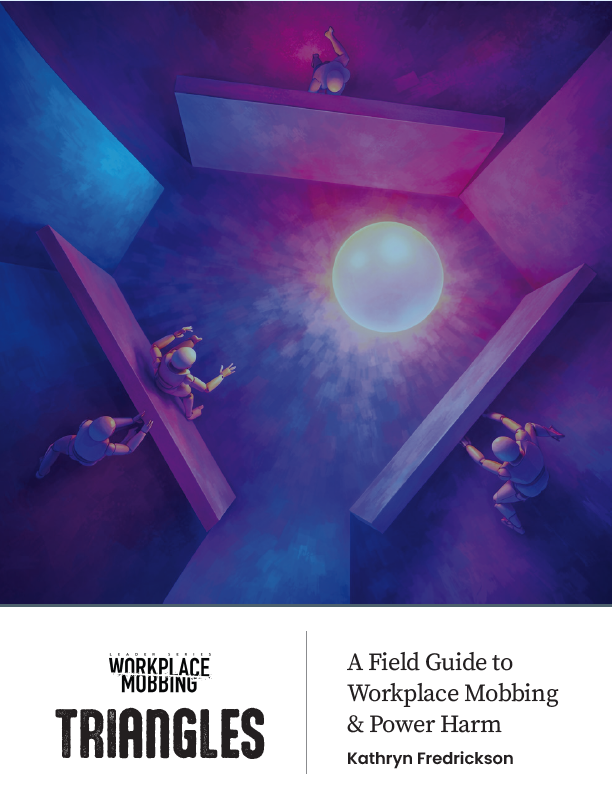
If this post helped you recognize the moment contempt became visible, TRIANGLES is the next map. Workplace mobbing is not driven by one bad actor. It is driven by a shape. Pressure lands on one person, another absorbs or redirects it, and the rest watch, align, excuse, minimize, or look away.
PROTECT
TRIANGLES
A Field Guide to Workplace Mobbing & Power Harm
TRIANGLES examines the structures of workplace mobbing and power harm: how relationships shift, pressure moves through groups, and ordinary workplace interactions can become part of a larger system. It is a field guide for seeing the structure more clearly when the situation itself has become difficult to read.
Sources
Paul Ekman’s research on the contempt expression (unilateral lip-corner raise).
The Gottman Institute on contempt as one of the Four Horsemen.
Workplace Bullying Institute definitions of repeated harmful mistreatment.
Documentation practices drawn from standard guidance on workplace harassment and retaliation.


