

Your face is wet.
Sweat leaves your hairline, slips past your temple, and hangs from your jaw before the submarine pitches hard enough to throw it across the control panel. Your shoulders are locked somewhere near your ears, your fingers are white around the edge of the console, and every muscle between your neck and spine is trying to hold the ocean back.
Above you, life is fine.
The calendar is full. The work gets done. Messages receive competent replies from a person whose punctuation suggests that everything remains under control.
Down here, the depth gauge is trembling.
The hull gives a long metallic groan. It begins beneath the floor, travels through the rivets, and enters your body through your hands—a low, tortured sound that says the pressure outside has found the shape of the vessel and is testing every seam.
You taste copper. The air is hot with oil, salt, and overheated wiring, and each breath feels used before it reaches you.
A glass dial cracks.
The needle marked SLEEP jerks left. IRRITABILITY shudders in the red while RUMINATION spins in tight, useless circles; AVOIDANCE barely moves at all, and COMPULSION keeps climbing as if speed might become an exit.
You lean closer because the instruments must be wrong.
You are still functioning. You attended the meeting, found the document, remembered the appointment, answered the question, and carried what everyone else placed in your hands.
The submarine rolls.
Your shoulder strikes the bulkhead. Somewhere behind you, steel tears with the deep animal shriek of something too strong to bend and too trapped to escape.
Inside the command center, no one gives a speech. No one says, “You’ve got this.”
The lights extinguish.
For one second, the dark has weight. It presses against your eyes, fills your mouth, and removes every boundary between your body and the millions of tons of black water waiting beyond the hull.
Then the emergency lamps ignite.
Red light moves over the command center in slow revolutions. Each pass catches the sweat on your arms, the tendons standing out in your hands, the violent little tremor in your jaw, and the depth gauge sinking toward a number the vessel was never built to hold.
Something hits the hull.
The impact throws your ribs against the console. A bank of switches erupts in sparks, the compass begins turning without direction, and a pipe overhead bursts open with a blast of scalding steam.
The second impact comes from below.
The floor rises under you. Metal twists, bolts scream loose, and the entire vessel lists until the command center becomes a steep red chamber full of sliding instruments and fractured glass.
That is when you see it.
Beyond the forward window, something vast moves across the black.
At first, your mind tries to make it machinery. It could be wreckage, a cable, a trick of the emergency lamps against the glass—but the shape curls, tightens, and draws itself around the nose of the submarine.
A sucker opens against the window. It is wider than your face.
Then another appears. Then six more, pale and muscular, fastening themselves to the glass with wet deliberation while the arm beyond them disappears into water too dark to measure.
The kraken pulls.
The submarine lurches forward. Your teeth strike together, your shoulder tears away from the armrest, and the ocean begins dragging the vessel toward a place no chart admits exists.
This is timeline drift.
It does not always look like collapse. Sometimes it looks like competence maintained several thousand feet below your own life.
You keep the appointments while the compass spins. You complete the work while something ancient tightens around the hull, and you tell anyone who asks that you are fine because the vessel is still moving.
Another arm strikes the port side.
The steel buckles inward with a deafening crack. Warning bells begin hammering the air, but the sound is almost a relief because it finally matches what your body has known.
The danger is no longer silent.
You look down at the control panel. Beneath the shattered glass, five gauges are still giving you information.
Sleep. Irritability. Rumination. Avoidance. Compulsion.
They are not accusations. They are coordinates.
The kraken contracts again, and this time you do not grip the rail harder. You turn toward the instruments.
Your hands are shaking too violently for finesse. You wipe your palm across your face, smear sweat and blood along your cheek, and place one finger on the first switch.
CONTAIN.
The command center seals. Unnecessary channels go dark, incoming transmissions cut to silence, and every remaining unit of power turns toward the integrity of the hull.
The creature thrashes.
Its arms batter the submarine from every direction. The vessel rocks, steel howls, and the forward window bows inward until your own red-lit reflection bends across the glass.
You stay with the gauges.
You read what is happening now instead of obeying what happened then. You separate pressure from direction, movement from escape, and the violent insistence of an old survival command from the quieter signal still coming from your own body.
The compass slows.
One degree. Then another.
The kraken has not vanished. The ocean has not become shallow, and the hull bears the deep inward scars of everything it survived.
But your hand is on the controls.
You feel the engines answer through the floor. The vibration enters your legs, rises through your pelvis, and settles beneath your ribs as the vessel begins to turn under its own power.
The arm across the window slides.
One sucker releases with a sound like flesh torn from glass. Another follows, then another, until the enormous limb peels away and recoils into the black.
The submarine rises three feet.
Nothing outside confirms that you will make it. There is only the needle, the pressure, the heat of your own body, and the next clean command.
You enter it.
The engines deepen. The vessel turns its battered face toward the surface, and somewhere far above this crushing dark, the life that looked fine is waiting to become yours again.
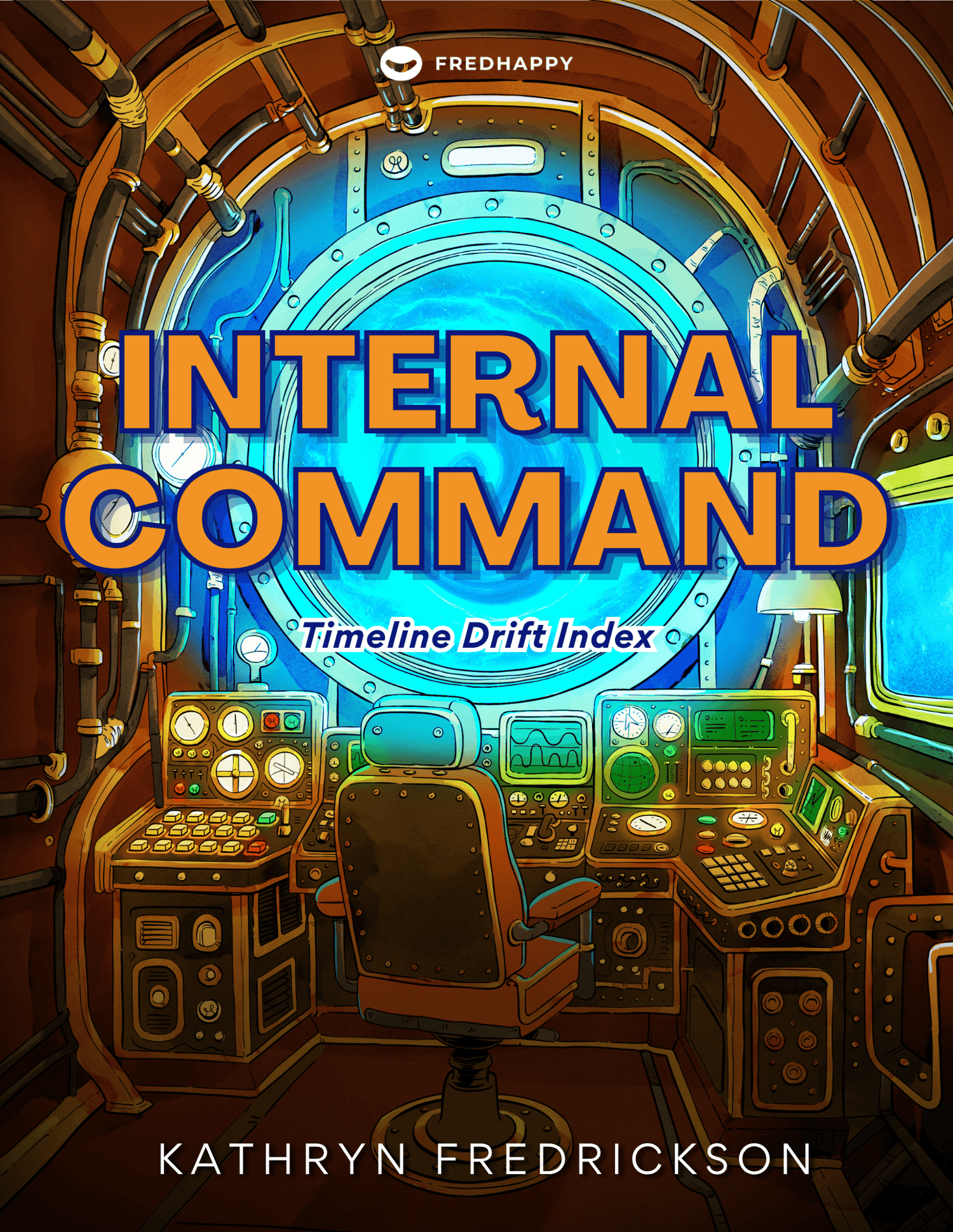
INTERNAL COMMAND: Timeline Drift Index™ was built for this moment.
It is a field manual for the person inside the functioning life—the one reading the gauges, feeling the pressure, and taking the chair back before the ocean decides the heading.
EMBODY
INTERNAL COMMAND
Timeline Drift Index™ Protocol
A working manual for a life that still runs and no longer feels like yours. Timeline Drift Index tracks five load gauges so you can read drift, quiet the system when the score spikes, and take the chair back before the hull has to scream.


