

Why I Wrote The Huxley Map
Why your body knew something was wrong long before your mind had language for it.
The printer specialist worked on the twenty-seventh floor of a glass tower overlooking the harbor. On clear days, the Ultra Large Container Ships looked like toy blocks moving silently between continents. From that height, everything appeared organized — every vessel had a destination, every crane had a purpose, every box belonged somewhere.
It was a sleek, very modern office and a really good job. The company sold digital media software to companies with budgets large enough to have opinions about fonts.
She loved the job at first.
Everyone did. That was part of the trick.
It was glamorous in the way expensive things often are, with chrome, glass, perfect lighting, and people who never seemed to sweat.
Then someone new started. Controlled. Unreadable.
The kind of person who made the room feel slightly overlit and the air very dry.
Their first conversation lasted less than three minutes. Nothing dramatic happened. No raised voice, no obvious threat. Yet she walked back to her desk feeling as if she had left fingerprints behind on something she couldn’t see.
That became the pattern and there was nothing she could report. Nothing she could clearly explain.
But every interaction left a subtle residue — a static charge, an internal audit, the uneasy sense that some invisible part of her had been weighed, measured, and catalogued. This is how Dark Triad behavior often operates in real life: quietly, strategically, and with almost no visible evidence.
Precision language that helps end manipulation fog
She began noticing things she normally ignored — the precise timing of smiles, the placement of hands, the micro-pauses before replies. Her nervous system was tracking something her conscious mind hadn’t yet named.
By five o'clock, she felt as though she had spent an entire day taking a test she had never agreed to take.
Weeks passed, and then months. She lost sleep and her mascara grew clumpy on the wand in the morning.
One afternoon she stood by the enormous window watching a massive container ship glide into port, thousands of containers stacked in perfect rows. In that moment she understood what her body had been trying to tell her for months:
She wanted to know what belonged to her.
She wanted to know what belonged to someone else.
She was tired of leaving every interaction carrying something heavier than what she brought in.
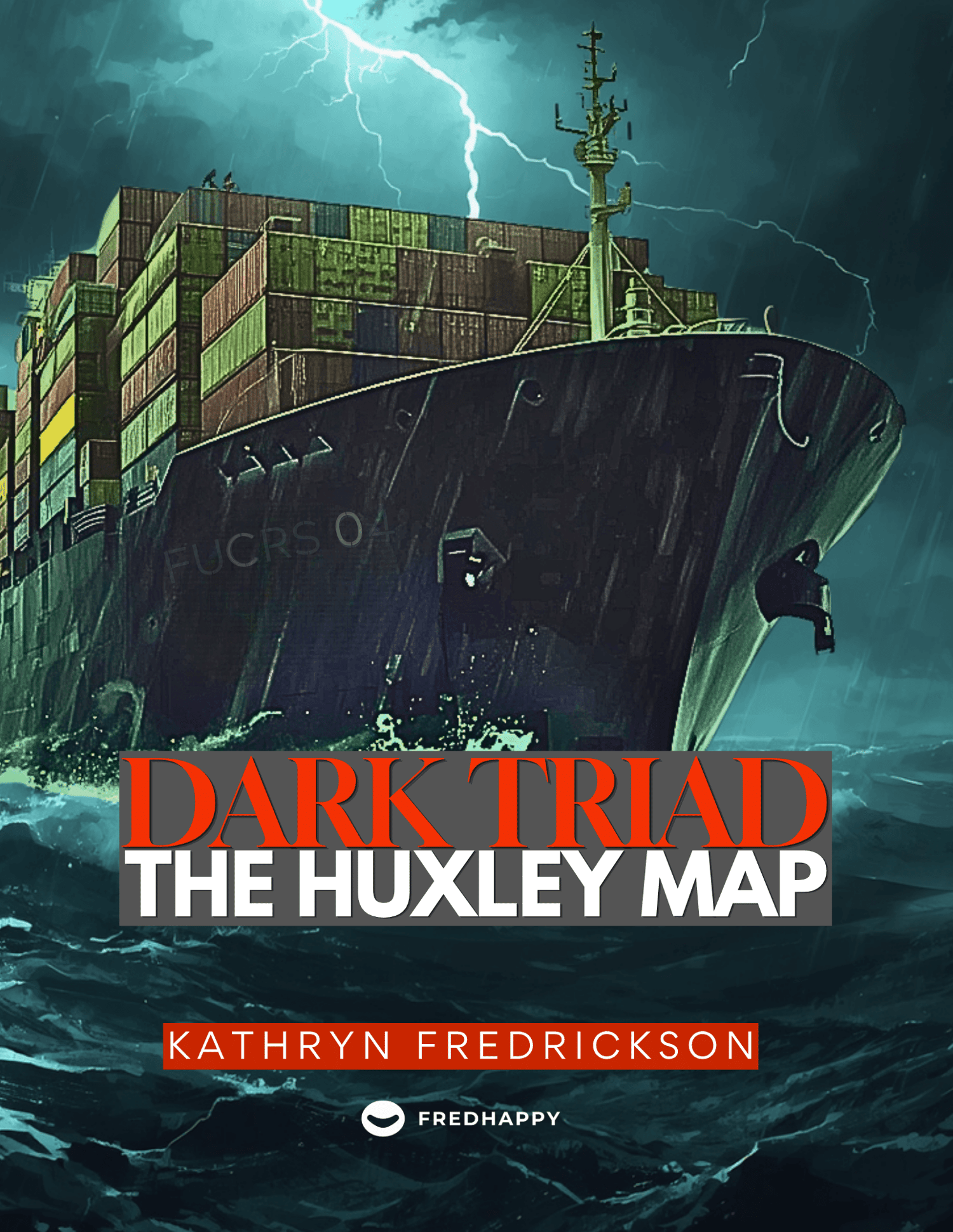
That single realization became Dark Triad: The Huxley Map — a sharp Dark Triad exposé about hidden roles, load transfer, frozen armor, narcissism, Machiavellianism, psychopathy, and the systems that keep running smoothly while someone else is quietly breaking..
Because there are people who can bruise your psyche without ever raising a hand.
There are people who can rearrange your sense of reality while appearing perfectly reasonable.
This book is for anyone who has ever walked away from a conversation, meeting, or relationship feeling heavier, smaller, or strangely uncertain — and couldn’t explain why.
It maps the hidden manipulation patterns that leave almost no visible evidence but slowly erode your confidence, clarity, and sense of self.
PROTECT
Dark Triad: The Huxley Map
The Huxley Map gives you a systems-level way to examine manipulation, role assignment, transferred cost, and hidden incentive structures. Follow the cargo, and the system begins to show itself.
Digital PDF · Immediate access
Inside Dark Triad: The Huxley Map
Here's a look inside the book.
Who gains. Who carries. Who gets out.
INTRODUCTION: The Port Was Not Broken. It Was Running.
At first, you may think you have entered a broken system: a chaotic office, a punishing family, a strange little town, a relationship with too many locked doors. Your body may know before your mind does, because the jaw tightens, the stomach drops, and some old animal part of you starts looking for the exit.
You tell yourself it is dysfunction, incompetence, bad communication, poor leadership, or one difficult person with a talent for making the room feel smaller. Those explanations are not always wrong, but they are often incomplete.
This book begins with a colder possibility: the system may not have been broken. It may have been running for someone else.
The harm was not random. Something was being moved, and the cost was being routed downstream.
In a port, cargo does not vanish because the manifest is unclear. It still lands somewhere, stacked under someone’s name, billed to someone’s account, occupying space until someone pays to move it.
Human systems work this way too. Shame, fear, boredom, envy, reputation risk, sexual charge, ambiguity, and accountability can all become cargo when the person who owns them refuses to process them.
A manipulative person may not look violent. They may look calm, helpful, wounded, polished, reasonable, charming, tired, important, or strangely untouched by the pain collecting around them.
That is part of the problem. The most dangerous systems often do not announce themselves as dangerous, because they arrive with procedures, smiles, concern language, jokes, favors, locked doors, and a clean desk.
This is not a book about diagnosing everyone who hurt you. It is an investigation into patterns of coercion, manipulation, low empathy, role assignment, and repair refusal.
Some of the evidence comes from criminology, criminal justice research, and penal sociology, because extreme cases show what human behavior can look like when ordinary brakes fail. That does not mean every pattern in this book is legally criminal, and it does not mean every cold person is dangerous.
The question here is narrower and more useful. Who gains, who carries, who enforces, who disappears into the stack, and what happens when the assigned carrier refuses the load?
You may have spent years asking why you felt so exhausted after conversations that were supposedly minor. You may have wondered why every attempt to clarify became another container on your dock.
That exhaustion matters. The body keeps records long before the group agrees to call them evidence.
This book asks you to follow the cargo. Not the apology, not the performance, not the polished explanation, and not the story told by the person standing closest to power.
Follow the cargo, and the system begins to show itself. Dysfunction is the label a system applies to harm when it refuses to name who gains.


