

Fredhappy Human Signal Theory™, Strange Attractors, and the Mathematics of Other People’s Bullshit
You understand what happened.
You have named the pattern, studied the history, recognized the trigger, improved your language, and chosen a better response. You can explain the entire thing with footnotes and perhaps a small laser pointer.
Then the next round begins, and somehow you are back in the same room.
The subject may be different. The words may be better. Everyone may have read the communication book. Still, the conversation bends toward the same ending. One person carries the blame. One person loses access. One person becomes responsible for everybody else’s comfort. The room calls this resolution because the inconvenient signal has stopped.
If understanding were the missing ingredient, the pattern should have changed by now.
What if insight is accurate but incomplete? What if the problem does not live only in what you think, feel, or say? What if it also lives in what the relationship rewards, what the room punishes, what the body remembers, and what the next move actually costs?
That is the problem The Shape of a Person was written to solve.
It began, naturally, with a brown number line in a hallway.
The Number Line Lied to Us
The line ran straight along the wall, as if the school had captured mathematics, house-trained it, and taught it to wait quietly between classes. The numbers stood in order. Each knew who came before it and who came after.
Nobody lunged sideways. Nobody vanished into another dimension. Nobody arrived carrying an infinite, nonrepeating decimal and a personal grudge.
Numbers behaved.
They were good little soldiers.
This was a lie.
It was a useful lie, like the map at the shopping mall that says YOU ARE HERE while declining to mention that the building is slowly settling into a sinkhole. The number line was real. It simply was not the whole territory.
Beyond those obedient integers were repeating decimals, irrational numbers that no fraction could contain, imaginary numbers that turned the line ninety degrees, complex numbers that carried two coordinates at once, and nonlinear systems whose next move followed rules while remaining magnificently difficult to predict.
Mathematics was not a well-lit corridor populated by hall monitors.
Mathematics was a wildlife preserve.
I learned this much later, and I became unreasonable about it.
I printed thirty pages because the screen was too small for what was happening. The printer warmed the paper and delivered it with that dry electrical smell of toner while one idea ignited the next.
Numbers had escaped the hallway. They were moving through networks, changing direction, carrying invisible coordinates, circling attractors, storing previous conditions, and making an absolute mockery of the idea that “rational” was the only synonym for “real.”
Somewhere in those pages, I found the Strange Numbers.
I do not mean a formally recognized class of numbers. A mathematician cannot order a crate of them from the Institute for Advanced Study, although I strongly feel the institute should consider a gift shop. Strange Numbers were the first name I gave to signals that would not sit neatly on a system’s accepted line but still carried structure the system needed.
The idea was not that certain people should be classified as strange. The idea was that human systems are forever mistaking easy to measure for real.
That mistake is where the bullshit begins.
Human Bullshit Has Coordinates
Bullshit is often discussed as though it were a fog emitted by one dishonest person. Sometimes it is. More often, it is an engineered environment with load-bearing walls.
The most durable bullshit is social. It has incentives, audiences, penalties, scripts, escape routes, and a small decorative plaque reading OUR VALUES. It survives because the people inside the system are responding intelligently to the prices the system has set.
This is why better words do not always create a better next round.
Suppose a manager asks for candid feedback. An employee offers it. The manager becomes chilly, removes the employee from a meeting, and later praises a quieter colleague for being “solutions-oriented.” The next time the manager asks for candor, the sentence is unchanged. The game has changed completely.
The room has learned the price.
Everyone may continue saying that openness matters. They may attend a seminar about openness. They may receive an attractive PDF featuring a bridge, a lighthouse, or a group of hands stacked in the center like a corporate sandwich. If the person who tells the truth still loses access, the payoff remains intact.
The bullshit is not hiding in the mission statement. It is living in the price of the next move.
That is what game theory contributes to Fredhappy Human Signal Theory.
A relationship is a repeated game when the same people meet again, remember what happened before, anticipate what may happen next, and adjust their moves accordingly. Marriage is a repeated game. A staff meeting is a repeated game. Thanksgiving is a repeated game conducted around poultry. So is any family text thread that begins, “Just so everyone knows.”
In a repeated game, an action means more than the dictionary says it means. It carries its history of rewards and punishments.
“Be honest” may mean that honesty is welcome. It may also mean that honesty is welcome until it alters somebody important’s comfort.
“My door is always open” may describe access. It may describe a door. The relationship between these claims should not be assumed.
“We want diverse perspectives” may mean the group wants information from different positions. It may mean the website needed a sentence beneath a photograph of four people laughing near a fern.
When the signal and the payoff contradict each other, behavior usually follows the payoff.
Insight can identify the contradiction. Insight does not automatically change its price.
The Straight Line Was a Public-Relations Campaign
Human systems develop accepted lines. There is a line for competent. There is a line for loyal. There is a line for calm, promotable, feminine, masculine, professional, grateful, cooperative, and “easy to have in the meeting.”
Once the line has been installed, the system can pretend it is merely observing where people naturally fall.
It is not. It built the ruler.
Then somebody brings information the line cannot hold.
- Perhaps she notices that the project numbers do not reconcile.
- Perhaps he hears the sentence underneath the sentence.
- Perhaps they remember the promise everyone else has silently agreed to forget.
- Perhaps a body registers danger before the group’s official vocabulary has approved the word.
- Perhaps somebody sees three moves ahead in a game everyone insists is not being played.
The system could add another axis. This would require curiosity, humility, and possibly a new spreadsheet.
Instead, it often relabels dimensionality as defect.
The signal becomes emotional, negative, confusing, intense, disloyal, dramatic, or difficult. This is much cheaper than improving the model.
Complex numbers offer a useful insult to that entire procedure.
A complex number has a real component and an imaginary component. The imaginary component is not fake. It occupies another axis. Engineers, physicists, and signal-processing systems use complex numbers because one visible line cannot carry all the information required to describe phase, rotation, oscillation, or change.
Fredhappy Human Signal Theory does not claim that a person is literally a complex number. It uses the structure to ask a disciplined question:
What information disappears when a system permits only one coordinate to count?
If the visible component is zero, the entire value does not have to be zero.
If a person goes silent, the internal state does not disappear.
If somebody stops objecting, the objection may not have been resolved.
If the room becomes quiet after the inconvenient signal leaves, the room has become quiet.
It has not necessarily become accurate.
ZERO, it turns out, has been framed.
The Fight Is Not Only the Words. The Fight Is the Room.
Human beings have a touching faith in scripts. We believe that if we replace the wrong sentence with the correct sentence, the scene will finally obey us.
Sometimes better language helps. Sometimes it is like installing a more articulate smoke alarm in a building where the landlord has disconnected the water.
One person raises a concern. Another minimizes it. The first person adds evidence. The second person changes the standard. An audience begins watching. Somebody makes a joke. The original concern disappears beneath a discussion of the first person’s tone. Everyone goes home with the mysterious impression that something happened, although the official minutes will report only that the team had a robust exchange.
From the level of dialogue, every argument looks new. From the level of dynamics, the system may be tracing the same orbit.
This is the usefulness of an attractor.
In dynamical systems, an attractor describes the set of states toward which a system tends to evolve. The path can vary. The system can wobble, loop, and arrive by different routes while still returning to a recognizable region.
Human Signal Theory borrows that structure carefully. It does not claim that your marriage is secretly a differential equation. It asks whether apparently different episodes keep returning to the same organization.
Does one person always become the translator? Does one person eventually carry the blame? Does the group repeatedly sacrifice accuracy to preserve rank? Does every attempt at closeness end in interrogation? Does every request for clarity become a trial of the requester?
Look at the orbit, not only the latest script.
The argument about the dishwasher, the budget, the tone, the holiday, and the family dog may be five separate events. They may also be five entrances to the same room.
The Pattern Has Shape Even When It Does Not Repeat Exactly
The term strange attractor comes from chaos theory. “Strange” does not mean that the attractor collects taxidermied squirrels or receives messages through the toaster. It refers to intricate geometry arising in a deterministic system whose long-term behavior can be highly sensitive to starting conditions.
The system has rules. The trajectory has shape. Exact prediction remains difficult.
This matters because popular accounts of human behavior often give us only two drawers. Predictable behavior goes into the drawer marked orderly and meaningful. Unpredictable behavior goes into the drawer marked random, irrational, or defective.
Strange attractors blow a small, mathematically respectable hole through the cabinet.
A trajectory can be irregular and still structured. A life can retain a recognizable shape without repeating point for point. A person can surprise you without becoming unintelligible.
That shape is not a personality label. It is not “who she is” pressed into a plastic badge. It is the recognizable path produced as a particular person moves through particular games with a particular history and a particular range of affordable moves.
Change the game, and the trajectory may change. Alter the cost of honesty, add a witness, remove an audience, protect recovery time, make a boundary enforceable, or offer one next-believable sentence, and a move that was previously too expensive may become possible.
This is much more useful than declaring somebody resistant and putting hot foot powder under her desk.
The Present Does Not Arrive Blank
Here is another popular fantasy: once the bad event stops, the system should return to baseline.
The threat is gone. The meeting ended. The bully left. The crisis passed. The email was clarified. The family has agreed never to discuss the casserole again.
Why is the state still here? Because zero input does not necessarily mean zero state.
Spintronics provided the bridge I had been missing. In magnetic systems, previous conditions can leave an orientation behind. Hysteresis means the current state depends partly on the path taken to reach it. Remanence is the state that remains after the driving field has been removed. Pinning helps explain why a configuration may stay caught. Switching requires enough precisely placed energy to alter the state.
Magnets are not brains, and nobody needs to lie beneath a refrigerator door until they feel emotionally aligned. The structural question is what matters:
How does prior play remain present in the next round?
A body that has learned the cost of speaking may load the old state before a new conversation begins. A team that has survived erratic leadership may continue protecting itself after the leader changes. A relationship may announce safety while every participant’s timing, posture, access, and expectation still carry the old game.
Safety announced is not safety loaded.
This is why greater effort does not always produce change. More pressure can deepen the very orientation a system is trying to alter. A smaller, more intelligent intervention may work better because it changes the exact parameter holding the state in place.
The right witness can matter more than a longer explanation. A consequence can matter more than an apology. A protected recovery window can matter more than a dramatic breakthrough. A boundary can change the game even when no one claps.
Small voltage. Big shift.
The more intelligent the structure, the less energy it may take to change it.
Here Is How the Bullshit Maps
Consider a workplace where a senior employee routinely humiliates a colleague in meetings. Leadership says the organization values respect. The targeted employee is advised to regulate, communicate directly, and avoid taking things personally.
The advice addresses the person who is paying the cost. Human Signal Theory maps the system setting the price.
The accepted axis defines professionalism in a way that favors people whose rank already protects their behavior. Calm delivery counts as evidence. Accurate alarm does not.
The spoofed signal says that respect governs the workplace, while observed consequences teach that status governs the workplace.
The repeated game rewards witnesses for staying quiet, rewards the senior employee with audience control, and charges the targeted person for objecting.
The attractor is the recurring destination: provocation, response, tone scrutiny, isolation, and restored comfort for everyone except the person carrying the cost.
The remanent state remains after the meeting. The employee anticipates the next round, edits speech, scans the room, and spends energy calculating whether ordinary participation is safe.
The false zero appears when the employee stops speaking. Management records improved harmony. In reality, observable output has dropped to zero while the internal state remains active and the organization has lost information.
The dimensional loss occurs when the system removes or suppresses the signal that could perceive what the accepted model excluded.
Nothing in this map makes every contrary person correct. An opinion does not become wisdom merely because it irritated the vice president.
The operational test is sharper:
Did suppressing the signal make the group’s model of reality poorer?
If the answer is yes, the group purchased quiet by selling off intelligence.
This happens in families, churches, schools, movements, marriages, committees, online communities, and book clubs that have spent forty-five minutes agreeing that the novel’s female protagonist was “unlikable” because she noticed the plot.
Life Is Much Weirder Than Our Explanations
The world is full of structures that refuse common sense while continuing to run the universe.
Light behaves in ways that make ordinary categories nervous. Time does not maintain one universal pace. A coastline develops more length the more closely you measure it. A tiny change in starting conditions can redirect the future of a nonlinear system. Imaginary numbers help operate technologies used by people who still believe “imaginary” means made up.
Reality has never agreed to remain intuitive for our convenience.
Why, then, are human beings expected to fit inside the smallest possible explanation?
We inherit stories about character because character sounds solid. She is difficult. He is weak. They are dramatic. I am bad at relationships. Our team fears change. The family is simply like this.
These statements compress a moving system into a noun.
This does not make human behavior less accountable. It makes accountability more precise.
A person has a shape. The person emits and receives signals. Those signals enter repeated games. The games leave orientation behind. That retained orientation influences which attractor catches the next move. A precise intervention changes what becomes possible in the next round.
Fredhappy Human Signal Theory is not a claim that people are equations. It is a refusal to keep using flat explanations for dimensional lives.
I wrote The Shape of a Person for people who already understand a great deal and still watch the same orbit close. The book does not ask you to become a Strange Number. It gives you a way to examine the machinery around a repeating human pattern:
What pattern keeps happening? What does the relationship reward? What state remains after the event ends? What would make a different next move possible?
The book contains the tight Human Signal Theory monograph and a plain-language companion. The monograph gives you the complete architecture. The companion helps you use it on an actual room, relationship, group, or recurring exchange.
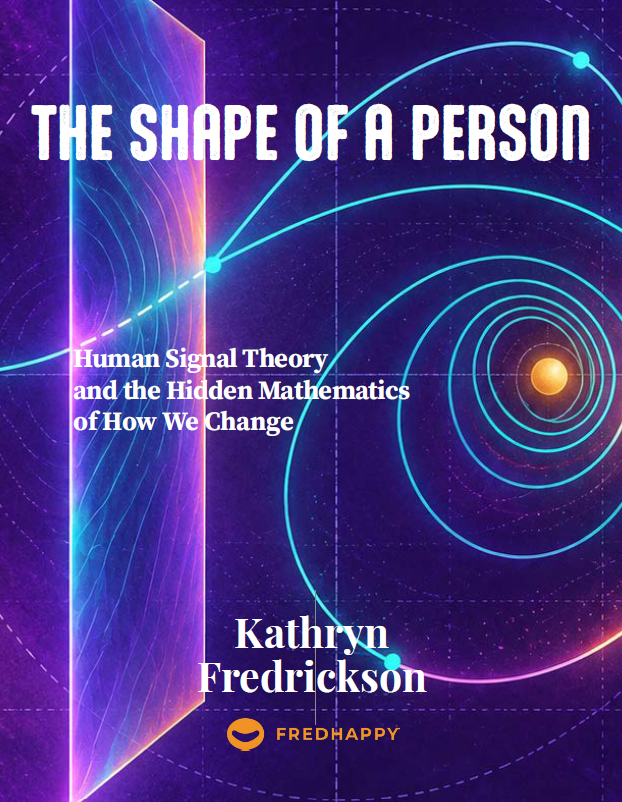
The Shape of a Person
A clear model of how identity, relationships, repeated patterns, and the body shape human change—and how a changed signal can open a different future.


