

This is written for people who have been the targets of coordinated workplace bullying and workplace mobbing. The moves are often small. The residue is not.
Technically, her statement started with the sentence “Ohhh, Kate. I HAVE to tell you. My husband drove past your house.” It landed as an intentional performance from start to finish, and here’s why it left residue.
Some sentences are hard to explain afterward.
A neighbor could have said, “I passed your house today. Your flowers look great,” and I’d have been happy to talk about what was blooming.
Then she told me the rest. Her face was crinked into a sneer, as though the words smelled bad.
“He said it looked okay. But it is a split property. You will have TRUBBLE out there later.”
She held the s in “split” several beats longer than I expected. That extended sibilance creates work in the theater of the mind.
The banality of it is what gives the tiniest trick such a long life. Try telling somebody at dinner that what bothered you was how long she held the s in a single word.
By the time you’ve finished, you’re listening to yourself explain a consonant, and even you have lost track of how your house came up for inspection.
Fredhappy exists to pull the curtain back on moves like this. Once you can see how much work you’ve been doing to explain your reaction, you can hand the original question back to the person who owes you an answer. “Why did you think I needed to know that?”
It looked okay.
Apparently my home had come up for review, and I’d done well enough for a passing grade.
What sort of trouble could he see from the road? Did he know something about the property that would be useful to me? And what made this news she had to tell me?
Home is supposed to be offstage. It’s where you go after a day of managing how you come across to people whose goodwill you have reason to doubt.
I did not give permission and I never disclosed my address to her
You eat, parent, rest, leave a job half finished, go back outside to look at something you planted. There’s considerable dignity in having somewhere you can do those things without wondering how they’ll be interpreted.
What bothered me was that they had made where I lived part of the story. Of the three people involved in this conversation about my home, I was the last to hear it.
The remark itself was small. What stayed was the sensation that a private space had been reviewed without invitation and that the task of making sense of the review had been handed to me.
The same pattern appears in workplace mobbing: a small observation is offered as neutral information, yet the work of deciding what it means, and what to do about it, is left entirely with the person it concerns.
What Poland’s workplace mobbing law helps us see
Poland, God love them, has given us a timely reason to talk about the word persistent. On November 5, 2026, changes to the Polish Labour Code took effect.
Poland’s National Labour Inspectorate explains that the revised definition of workplace mobbing centers on persistent harassment of an employee. The law gives examples of conduct and strengthens the protection available to workers. Państwowa Inspekcja Pracy
Persistence is difficult to convey when someone asks you for your single best example. Pick the comment about the house and a perfectly reasonable person might ask, “What’s wrong with driving down a public road?”
I would have asked that too. What I would want to know next is what had happened between these people before the house came up.
- Could the employee ask a straightforward question and get a straight answer?
- Had information shared with one person already started turning up in conversations with others?
- When the employee asked for some privacy, did people respect it?
Those are useful questions for a manager as well as for somebody trying to understand their own experience. A single remark tells you what was said.
To understand a possible pattern, you need the sequence, the relationships, and what happened when somebody tried to draw a line. My account of the driveway tells you why I grew watchful. Establishing what another person intended would require evidence I don’t have.
Hypervigilance after workplace mobbing
One cost of an ambiguous encounter is the work it leaves behind. The speaker goes about her day. You keep trying to decide whether you missed a warning, received a judgment, or simply had an odd conversation.
Later you catch yourself rehearsing the explanation. You picture saying it out loud at the kitchen table, or to a friend who asks how your day was, and you hear how it will sound: “What bothered me was how long she held the s in ‘split.’” Even before anyone has asked, part of the evening has already been spent defending a reaction that has not yet been questioned.
If you recognize that loop, try a question I find more useful than “Am I overreacting?” What did this sentence make me start protecting?
Maybe you started watching the driveway. Maybe you closed the curtains earlier than usual, or found yourself mentally drafting a reply you never planned to send. Maybe you grew even more closed off at work because a detail had already traveled farther without your participation.
Write down the actual remark, then write down one thing you changed afterward. Keep those two observations in your own words. Even if the other person’s motive remains uncertain, you now have something concrete on which to base your next choice.
Literary Support from Fredhappy: Dark Triad Sonnets — The Field Is Clear
In “The Battle of Ledger Fen,” somebody brings a pie. Only later does the recipient discover that the person who brought it has been keeping accounts.
The pies they bring are ledgers frosted bright.
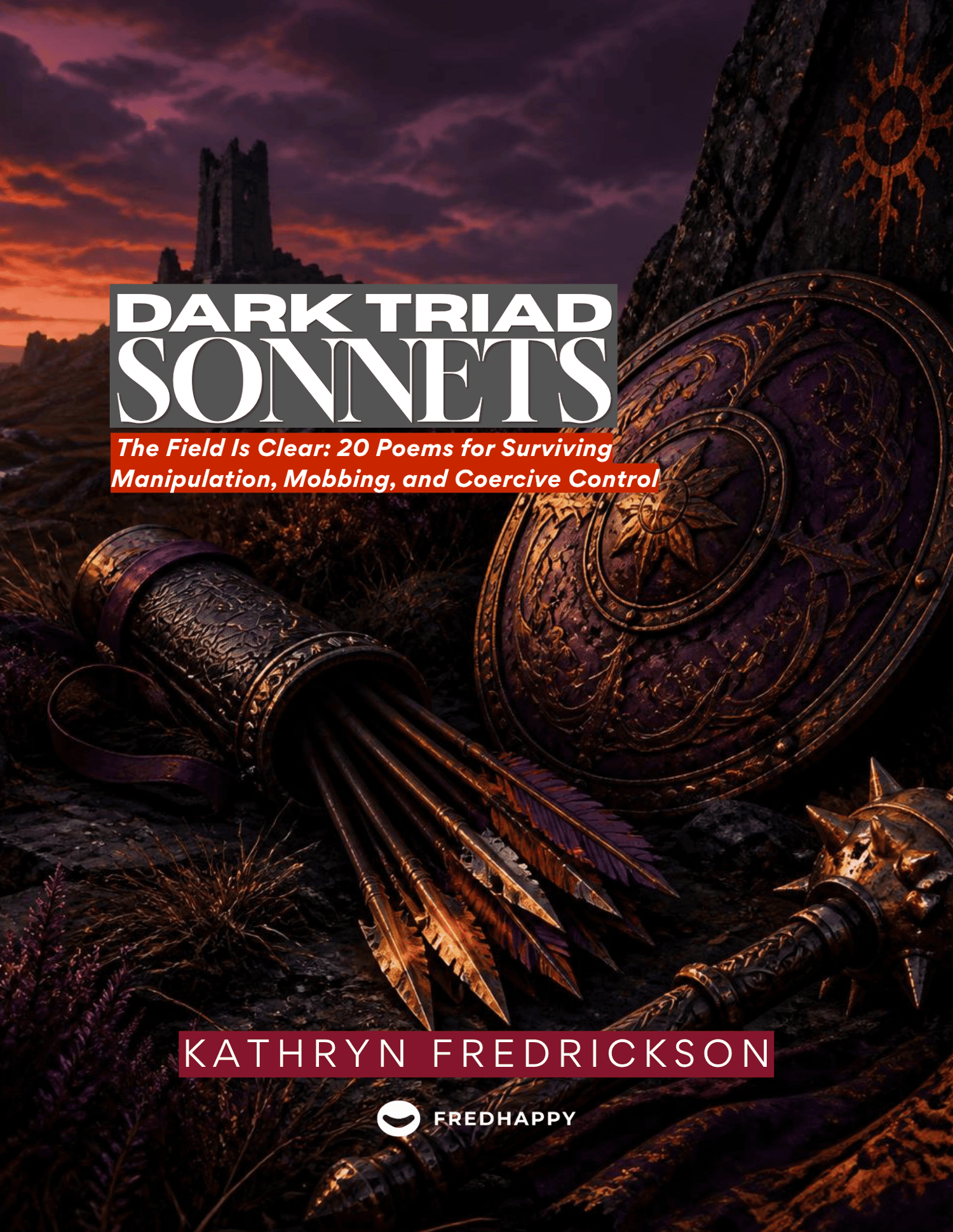
I wrote The Field Is Clear: 20 Poems for Surviving Manipulation, Mobbing, and Coercive Control for the person who remembers the pie perfectly and still has trouble explaining the debt.
A sonnet gives you fourteen lines in which to see what happened to somebody else. Sometimes that little distance is how you find words for what happened to you.
PROTECT
Dark Triad Sonnets: The Field Is Clear
Twenty sonnets trace manipulation, mobbing, coercive control, and the moment hidden patterns finally come into view.
Join Bronze for $7 a month to read the rest. I want to go back to those first five words, “I have to tell you.” They help explain how she got to leave the conversation having been honest, while I went home with an assignment I never agreed to take.