

Why We Wrote This
They were halfway through the Guggenheim when the room turned.
Six thieves had entered the museum with one blueprint, one extraction plan, and twenty-seven minutes before the security rotation changed. The quiet man had built the operation over eleven weeks. He knew the sweep of every camera, the timing of every guard, the blind spots along the great white spiral, the service doors that opened cleanly and the ones that caught at the threshold. The others had learned the plan. He had learned the building.
For the first sixteen minutes, this distinction made him valuable.
Then they had the painting.
It happened so subtly that he noticed the physical sensation before he understood the social one. A tightening beneath the ribs. A slight heat across the face. The peculiar awareness that comes when several people know something about you that you do not yet know yourself.
The leader stopped looking at him.
The safecracker began directing questions about the route to someone who had never seen the original plans. The man wearing the replica security badge took the blueprint from his hands and kept it. When the quiet man corrected a timing error, two of them exchanged the small, private smile of people whose opinion had already been settled elsewhere.
A minute earlier, his precision had been the reason they trusted him.
Now it was apparently the problem.
The route changed.
West instead of east.
It was a terrible decision. The west corridor crossed the reset path of a camera that had been blind when they entered but would be live again before they reached it. Everyone in the crew knew this because he had taught them. Yet when he objected, nobody checked the blueprint. Nobody checked the clock.
They watched him.
That was when he understood that the operation had acquired a second objective.
The painting still mattered. Getting out still mattered. But something else had begun moving through the group: the intoxicating relief of having one person become wrong.
His warning became resistance. His precision became control. His insistence on the route they had all agreed upon became evidence that he could not adapt under pressure. Every attempt to protect the operation supplied another reason not to listen to him.
The more accurate he became, the more difficult they found him. And the cruelest part was how much they enjoyed it.
Fear had been moving through the crew all night. Now it had somewhere to go.
The safecracker no longer looked frightened. He looked amused. The leader looked steadier than he had ten minutes earlier. Even the youngest member of the crew, who had spent the first half of the heist swallowing panic, had relaxed into the new arrangement.
Five nervous people had discovered that they could feel remarkably competent if the sixth person carried all the incompetence for them.
So they took his blueprint and went west.
He went east.
The alarm sounded less than a minute later.
The camera caught the crew exactly where he had said it would. The painting was dropped during the scramble. One thief injured his shoulder forcing a locked service door. Another lost the replica badge that connected them to the break-in. By the time they scattered into the city, the heist had collapsed.
The quiet man never reached the car.
He was arrested alone in the east stairwell.
By sunrise, the story had already hardened.
The failed route was forgotten. The ignored warning disappeared. The blueprint became communal property. The crew remembered a man who had become erratic under pressure, refused to cooperate, separated himself from the group, and endangered everyone by insisting he knew better.
Five people carried versions of the same story. The sixth carried the consequences.
That is the machinery at the center of TRIANGLES.
It does not require thieves, museums, or twenty-seven-minute clocks. It requires pressure, a group, and the moment when distributing fear becomes less attractive than assigning it.
In workplaces, the shift can be almost imperceptible. A colleague stops asking you and begins asking someone else about you. A concern travels farther than the evidence supporting it. Your competence becomes rigidity. Your questions become hostility. Your reaction to being excluded becomes the justification for excluding you.
Eventually, the group can become more interested in maintaining its explanation of you than examining what is actually happening.
That is how a human problem becomes a structural one.
TRIANGLES is a field guide to workplace mobbing and power harm because recognizing individual behavior is not always enough. You can identify the pressure and still miss the architecture carrying it. You can spend months trying to understand why one person behaved badly while an entire system quietly rearranges itself around the conflict.
The quiet man knew every corridor in the museum. What he could not see was the shape forming around him.
That is why we wrote TRIANGLES.
Inside TRIANGLES: A Field Guide to Workplace Mobbing & Power Harm
Here's a look inside the book.
PREFACE: Why Triangles Exist Now
The sun sits high over a Persian plain. Dust hangs in the air. The army stands in rows, armor clicking, mouths dry.
In the open space between them, one soldier kneels. Alexander does not shout. He speaks so the front rows hear, and the rest lean in to catch the sound. A charge is read. A story is told. The man on his knees barely moves.
The real action lives somewhere else.
It lives in the locked jaws along the front line. In the way shoulders shift a little farther back. In the way no one breathes too loud.
Every soldier understands what this moment means. One body takes the blow. An entire army receives the message.
From the hill, it looks like discipline. Inside the ranks, it feels like a choice with no real choice at all.
This shape shows up in your staff meetings too. Every workplace gathers unfinished human stories.
People walk in carrying old fear, old hurt, old hope, old hunger for safety and respect. They show up in clean clothes with passwords and job titles. Their nervous systems come with them.
Most days, this goes fine.
Roles absorb friction. People disagree, repair a little, move on.
Pressure changes everything.
When budgets shrink, when leaders wobble, when someone powerful feels watched, when a complaint lands, people stop relating person to person. They start orienting to position, protection, and audience.
That is when triangles form.
A triangle is a survival move.
Someone applies pressure. Someone carries it. Others watch, align, or turn away.
Once this shape appears, behavior follows a hidden script. Tone hardens. Jokes shift. Eye contact turns into a tool. Where people sit, who answers email, who gets copied and who is left out all begin to carry meaning.
You often feel it in your body before you can explain it.
- A tight band around your ribs.
- Heat in your face when you speak.
- Words that vanish mid-sentence.
- The sudden sense that every move counts, even if no one has said anything out loud.
That sensation feels private. It is not private at all. It is your biology tracking risk.
Humans are group animals. For most of our history, standing outside the group meant real danger. The body still treats shame, silence, and public exposure as survival events.
Triangles use that wiring.
Triangles can shield. They can stabilize a shaky team for a season. They can also grind a person down while everyone else tells themselves that “nothing really happened.”
This book exists for the moment before the email trail, before the exit interview, before the policy memo. The thin edge. The first turn of the room.
The moment where the shape clicks into place.
You will see three things here:
- How triangles work inside people
- How triangles work inside organizations
- How triangles repeat across history
You will meet soldiers, clerks, nurses, founders, ministers, teachers. You will also meet princes, prophets, and old thinkers who had sharp eyes for power.
Machiavelli wrote about rulers who chose stability over honesty.
Heraclitus wrote about conflict as the engine of change.
Ancient exile stories show how groups push one person out to feel clean again.
These are not distant ideas. They live in open-plan offices, Zoom calls, and closed-door “chats.”
If you have lived through workplace mobbing or quiet exile, this book gives language to what your body already knows. It does not ask you to perform forgiveness or dress your pain up as “learning.”
If you write safety standards, policies, or laws, this book offers patterns you can name and measure. It treats mobbing as a structural hazard, not a personality clash.
See the Shape Before It Becomes the Story
TRIANGLES is a field guide for recognizing how pressure, alignment, exclusion, and power move through workplace systems. If you have felt the room turn but struggled to explain what changed, continue with the full book below.
PROTECT
TRIANGLES
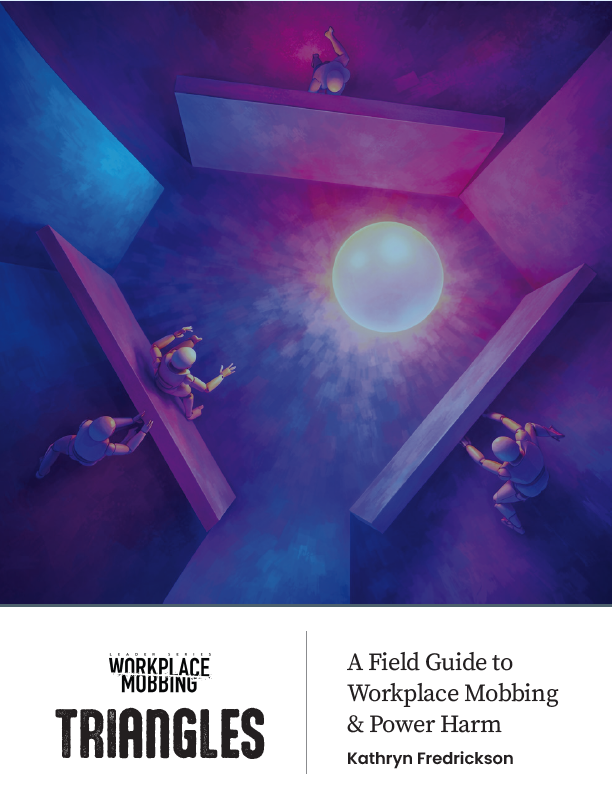
A Field Guide to Workplace Mobbing & Power Harm
TRIANGLES examines the structures of workplace mobbing and power harm: how relationships shift, pressure moves through groups, and ordinary workplace interactions can become part of a larger system. It is a field guide for seeing the structure more clearly when the situation itself has become difficult to read.


