

The invitation to come back can arrive before anyone has corrected what they said about you.
Someone humiliates you, encourages other people to dismiss you, or participates in conduct they would prefer not to explain. Later, they apologize privately.
They miss you. They want to clear the air. Perhaps you could get together.
That invitation may touch the exact place the harm created: your wish to recover the relationship, the room, the work, or the version of your life in which you belonged.
But consider what happens if the private apology produces a public reunion while the damaging story remains intact. Your presence can become an endorsement you never agreed to give. Someone else gets to say, “See? Everything is fine.”
An apology can become another request for access before it becomes an act of accountability.
I do not need them to become different people. I needed to stop trading my clarity for a place in the room.
This is where fake apologies, workplace mobbing, coercive control, and weaponized attachment intersect. The central question is what you are being asked to exchange for belonging—and who benefits when you agree.
“The guy is WRONG when he drinks. So funny.”
WRONG. That word stayed with me.
I wondered whether he had already been talking about me in ways I knew nothing about. The comment does not establish that, even if it came complete with additional gossip. I cannot reconstruct an unseen conversation from one remark.
What I can describe is the pairing: conduct characterized as “wrong,” immediately followed by amusement.
That pairing interests me because it leaves something conveniently unspecified. Wrong how? Funny to whom? At whose expense?
A person hearing that remark might take it as affectionate teasing. Someone who later experiences the behavior may remember it differently. What sounded like a personality anecdote can become a question about what the speaker recognized and was willing to excuse.
I do not need to turn that question into a claim I cannot prove. The question itself is worth keeping.
Why belonging makes such effective leverage
Wanting acceptance is ordinary. You might want a mentor who recognizes your ability, colleagues who include you, a community that shares your interests, or a relationship in which your attention is returned.
Baumeister and Leary’s influential review of belonging research argued that forming and maintaining meaningful interpersonal bonds is a fundamental human motivation. Belonging affects much more than whether an evening feels pleasant.
That gives conditional acceptance something valuable to work with.
Imagine a workplace where one influential person controls introductions, information, and informal approval. Their warmth feels like professional possibility. Their withdrawal leaves you wondering whether you have lost your future. You begin spending time interpreting them.
Or imagine a group where your standing improves when you laugh at someone else. You discover that cruelty gets a warmer reception than disagreement. Eventually, keeping your place requires participating in something you would have found embarrassing outside that room.
These positions are different, but the desire for belonging can operate in both. One person keeps trying to recover acceptance. Another helps mistreat someone to retain it.
The person performing dominance may also be working desperately for somebody else’s approval.
That possibility helps explain the behavior. It does not excuse it.
What “dark empath” research actually tells us
“Dark empath” is a compelling phrase. It suggests someone who understands your feelings and can still behave destructively.
There is research behind the term, although it is more specific than the online mythology. In a study of 991 participants, Nadja Heym and colleagues identified a profile combining elevated dark personality traits with elevated empathy. That group showed more aggression than the lower-dark-trait comparison groups, but less aggression than the traditional high-dark-trait, low-empathy group.
The study did not establish a uniquely dangerous class of psychological masterminds. The useful distinction is that emotional understanding does not automatically produce ethical conduct.
Someone can recognize your longing, embarrassment, or uncertainty without consistently treating it with care. But “dark empath” is a research construct, not a diagnosis you can make from a cutting remark or a perceptive conversation.
For your own decisions, the more useful questions concern conduct.
- What happens to information you share?
- Does the person respect a refusal?
- Does their kindness survive an audience that rewards cruelty?
- When they understand that something hurts you, does the behavior change?
You do not need to settle their personality classification before taking those answers seriously.
Understanding a mechanism is not the same as needing the person to change. Most people are acting from the capacities and incentives they currently have. That does not obligate me to keep offering access while the pattern continues.
Everyday sadism: when distress becomes entertainment
Sadism adds another possibility: sometimes the unpleasant effect is part of the attraction.
Research by Erin Buckels and colleagues examined everyday sadism through laboratory tasks involving apparent cruelty and aggression. In one experiment, sadism uniquely predicted willingness to work for an opportunity to hurt an innocent person.
These were controlled research tasks, not evidence that a particular colleague is sadistic. They nevertheless challenge the comforting assumption that all cruelty is accidental or misunderstood.
Sid from Toy Story offers a recognizable fictional image of destructive experimentation.
Real life usually supplies less convenient characterization. The person may also be helpful, socially competent, or regarded as generous.
What matters is whether the conduct continues after the distress becomes clear.
There is a particular disgust in realizing that you were trying to restore an ordinary interaction while someone else appeared interested in prolonging your discomfort. You do not have to diagnose that interest to describe the repeated remark, the audience, your request to stop, and what happened next.
Peer pressure, hazing, and cruelty performed for status
A crude remark can serve two audiences. It humiliates the person being discussed while offering the surrounding group a performance: look how far I am willing to go.
Research on adolescent peer groups describes “deviancy training,” in which social responses reinforce discussion and participation in problem behavior. Those findings concern young people and cannot simply be transferred to every adult workplace.
They do, however, give us evidence for a mechanism worth examining: peers can reward conduct that becomes more harmful over time. Hazing makes the connection between harm and membership especially visible.
A 2008 National Study of Student Hazing showed:
- 55% of participating college students involved in clubs, teams, and organizations reported behaviors meeting the study’s definition of hazing.
- Among students involved in social fraternities or sororities, the figure was 73%.
A separate longitudinal study followed 772 male students, including 116 fraternity members, from before college through their second year. Fraternity membership was prospectively associated with sexual aggression after accounting for measured selection factors, and with increased binge drinking and perceived peer sexual aggression.
The question for any group is what membership requires in practice.
Must you tolerate humiliation? Keep a secret? Demonstrate loyalty by mistreating somebody else? Accept a powerful member’s behavior because challenging it would spoil the atmosphere?
The membership fee can become another person’s dignity. It can also become your own.
Envy and moral disengagement: making harm feel justified
Envy is one possible ingredient in social undermining. It is not an explanation we can automatically assign whenever someone behaves badly.
Research by Michelle Duffy and colleagues linked envy, moral disengagement, and undermining, with group identification and group norms shaping the relationship. The social environment matters alongside the individual feeling.
Albert Bandura’s work on moral disengagement describes ways people make harmful conduct compatible with a favorable view of themselves. They can minimize consequences, distribute responsibility, use sanitizing language, or blame the person harmed.
In an ordinary room, that might sound like “We were only joking,” “Everyone was involved,” or “She needed taking down a peg.”
The language makes participation easier to defend. Someone who would resist calling themselves cruel may readily describe themselves as honest, protective, funny, or loyal.
Growth becomes difficult when admitting the harm also means admitting that the group rewarded something ugly. Accountability may cost approval from the very people the performance was designed to impress.
An adult can change. But change requires more than finding a sympathetic explanation for why they joined in.
Workplace mobbing: when the group’s story becomes your working conditions
Workplace mobbing concerns sustained harassment and social targeting at work. Heinz Leymann’s foundational research described processes through which hostile conduct can systematically undermine a person’s position.
The practical issue is what happens to your ability to work.
Suppose information is repeatedly withheld, and then your lack of information is cited as incompetence. You request inclusion and acquire a reputation for being demanding. Colleagues begin routing ordinary communication through someone else.
An explanation of your personality starts doing the work that an examination of events should have done.
A single missed meeting does not establish mobbing. A repeated sequence deserves examination.
For leaders, this means asking concrete questions before accepting a polished account of who the “difficult person” is.
- Who controlled the information?
- Which expectations were communicated?
- What happened after a reasonable request?
- Who benefits from treating the complaint as a personality problem?
Support for a distressed employee can be valuable. It also needs to coexist with attention to the reported conduct. Helping someone tolerate an environment does not establish that the environment is acceptable.
I explore the recurring-departure version of this problem in How Many People Have to Leave Before You Call It Workplace Mobbing?.
NXIVM, coercive control, and compromising material used as leverage
At the extreme end, belonging can be tied to material that makes leaving frightening.
The NXIVM prosecution provides a documented example. Within DOS, women were recruited under the false pretense of joining a women-only mentorship group. They were required to provide “collateral,” including sexually explicit material, rights to financial assets, and damaging statements about themselves or loved ones—statements that could be true or false. That material was used to deter departure and disclosure.
Keith Raniere was convicted in 2019 and sentenced to 120 years in prison in 2020.
This matters because the leverage did not depend on proving that the person had freely committed wrongdoing. Shame, threatened exposure, fabricated claims, and fear for other people could all serve the controlling structure.
The Lawrence Ray case supplies another example. According to the evidence described after his conviction, Ray extracted false confessions from victims and used supposed debts arising from those confessions to extort money and labor. Prosecutors explicitly credited the victims who testified.
These cases do not make every manipulative group a criminal enterprise. They show why seemingly voluntary participation, a confession, or an image cannot be interpreted responsibly without examining the conditions surrounding it.
When someone controls compromising material, the questions include how it was obtained, whether coercion was involved, and what threats accompany its use.
The promise of belonging can become a threat of exposure. That is a very different situation from an awkward disagreement about friendship.
Fake apologies, DARVO, and the invitation to “hang out”
DARVO stands for deny, attack, and reverse victim and offender.
In a study using a fictional sexual-assault scenario, Sarah Harsey and Jennifer Freyd found that exposure to DARVO shifted observers’ judgments in the accused person’s favor and against the person reporting harm. Insincere apologies had minimal effects in that particular experiment. The findings support concern about blame reversal; they do not prove that every inadequate apology is a calculated tactic.
Now consider a separate situation: someone apologizes to you privately but leaves their public account untouched.
They acknowledge that they were unfair, then ask you to attend a gathering. The people who heard the original allegations receive no correction. Your attendance becomes available for interpretation as reconciliation, exaggeration, or proof that nothing serious happened.
That is the risk I am describing when I question the invitation to “hang out.”
The concern is not that apologies happen privately. Privacy can be appropriate. The concern is a mismatch between where the damage occurred and where the person is willing to repair it.
Research on apology effectiveness found acknowledgment of responsibility and an offer of repair especially important to participants’ evaluations. That research measures responses to apologies; sustained change still has to be observed.
If someone spread an inaccurate account, repair might include correcting it with the people who received it. If they interfered with your work, repair might involve restoring access or addressing the record. If they violated a boundary, accountability includes accepting that you may continue to limit contact.
You do not owe anyone a reunion they can use as evidence of their own absolution.
Karma, the Wheel of Fortune, and the person the room underestimated
Human beings have spent a long time imagining what happens when the powerful lose their position.
In Boethius’s Consolation of Philosophy, Fortune’s wheel raises and lowers people. The image challenges confidence in lasting worldly status; it does not promise that every reversal will distribute justice neatly.
Buddhist teachings on karma address intentional action and its consequences. In the Nibbedhika Sutta, intention is central. That is more demanding than the popular fantasy that the universe will shortly arrange a satisfying embarrassment for someone you dislike.
The Hebrew Bible repeatedly presents reversals of power. Hannah’s song in 1 Samuel 2 describes the poor being raised from the dust and seated with nobles. The passage confronts arrogance and places human rank within a larger moral account.
These traditions differ. They should not be collapsed into one theory of cosmic repayment. What interests me is their recurring challenge to the assumption that today’s hierarchy will last forever.
Someone who seems isolated may have relationships you cannot see. They may find support later. People who were initially dismissed can become witnesses, organizers, writers, or sources of evidence.
But nobody should have to become an impressive survivor to deserve protection. A person with no connections, no money, and no triumphant comeback deserves it now.
The Road Runner and the Coyote give us a comic reversal: the elaborate scheme meets a consequence its designer failed to anticipate. In real life, you cannot schedule that consequence. You can make decisions that do not require waiting for it.
Forgiveness does not require renewed access
I can release the wish that they will eventually see it the way I do. Forgiveness, for me, has meant stopping the internal argument about what they should have understood. It has not meant restoring the same access.
You can forgive and decline the invitation. You can remain angry and still make careful decisions. You can accept that someone regrets their conduct without trusting them with the same access.
You also do not have to prove that an apology is consciously fraudulent before deciding it is insufficient.
Look at what changes. Does the person name what they did? Correct inaccurate information? Stop the conduct? Respect your pace? Accept a boundary without recruiting an audience against it?
If you are documenting events, keep the sequence clear: what happened, what you requested, what followed, and what effect it had. Separate direct observation from interpretation. Seek support outside the circle whose account you are trying to assess.
For leaders, accountability includes protecting the person who raised the concern from being pressured into a friendly ending. A photograph, a lunch, or a pleasant meeting cannot substitute for examining the conduct.
For survivors, your recovery can include examining your own hopes and choices. That examination does not transfer responsibility for another person’s behavior to you.
Your belonging should leave room for your life
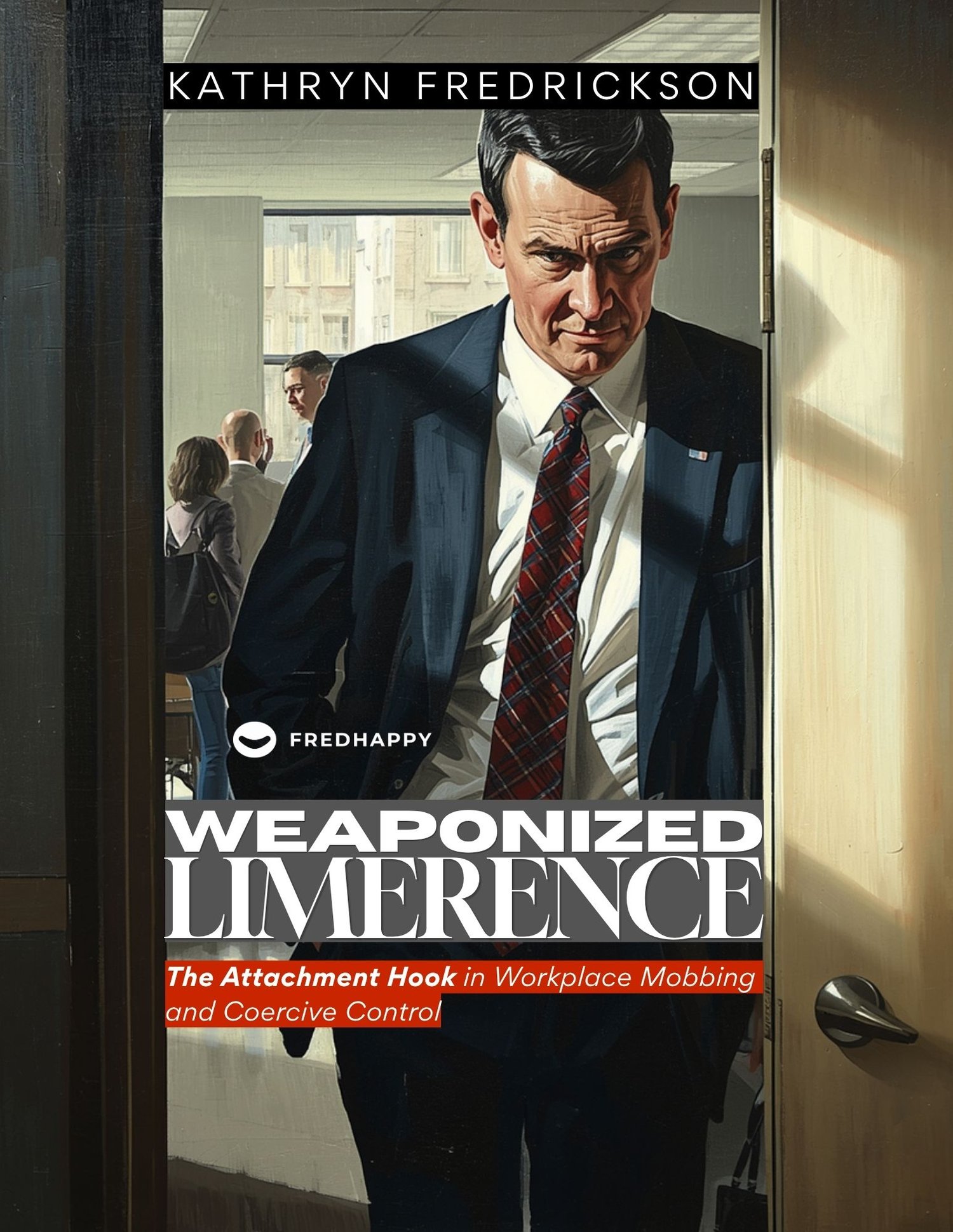
This is the problem behind my Fredhappy book, Weaponized Limerence: The Attachment Hook in Workplace Mobbing and Coercive Control.
I wanted a way to examine the connection and the conditions around it together: the intense recognition, the cold withdrawal, the uncertainty, the shame, and the growing amount of attention required just to feel temporarily secure.
I call the experience an attachment heist. The phrase names what can be taken when your attention, hope, and sense of possibility become organized around someone else’s shifting approval.
You can want connection without granting a group or organization permanent authority over your worth. You can care about people while declining the price they have attached to inclusion.
Everyone is on their own path. I learned a great deal from the harm. The learning does not require me to keep the door open on the same terms.
If you are ready to examine what kept you hooked—and what you want your attention available for now—start the debrief with Weaponized Limerence.
PROTECT
Weaponized Limerence
The Attachment Hook in Workplace Mobbing and Coercive Control
What keeps you reaching for a connection that keeps costing you?
You may be attached to a person, a team, a mission, or the future they seemed to offer. Weaponized Limerence examines how alternating warmth and withdrawal, unequal power, and uncertain belonging can keep your attention fixed on recovering the connection—even after you recognize the harm.
Explore the Hot/Cold Thermometer, the reversal that turns your distress into the problem, and the choices available when you begin reclaiming your attention. Your feelings can be real while the arrangement remains unsafe.


