

Why I Wrote This
The map was wrong. Of course it was. The paper had been folded, scorched, bled on, and sweated through inside a canvas jacket that already carried three bad decisions and one half-dead mule. Ink ran like guilty confessions. The compass rose pointed straight into hell.
I followed it anyway.
By noon the canyon sun was a white blade overhead. Air tasted of copper and ground bone. Every bootfall triggered a hiss of gravel that slid into the abyss below. A single bird screamed once, then shut up for good.
Lost Dignity waited somewhere down here. The villagers never said the name outright. They circled it like a wound.
“Used to have it.”
“Buried it after the first public shaming.”
“Whoever finds it stands upright again.”
They laughed when they said it. The kind of laugh that hopes the story stays buried.
The entrance was exactly where the old woman warned: behind a curtain of dead vines, under a stone face carved in a scream that wasn’t quite grief and wasn’t quite warning. I shoved the vines aside.
The smell hit like a backhand—cold stone, bat guano, old blood, and metal left too long in a fist.
Torch flared.
First chamber pressed in tight. Ceiling low enough to teach humility in a hurry. Walls carved deep in dead languages that still screamed the same lines:
Do not make a scene.
Learn to take a joke.
That’s just how they are.
I ran my fingers over the grooves. Worn smooth by thousands of hands that had touched these words hoping the stone would lie to them better than people did.
A narrow slit opened left. I turned sideways, shoulder scraping rock, heart hammering against ribs that suddenly felt too loud. The passage spat me into the second chamber.
Mirrors. Floor to ceiling. Each one warped differently.
In one I looked ridiculous.
In the next, guilty.
In the next, pathetic. Needy. Cold. Worthless.
Whispers slithered across the glass.
Too sensitive.
Difficult.
Dramatic.
Ungrateful.
I spun away. The mirrors followed, throwing my face back at me from every angle. The temple wasn’t attacking. It was measuring. Deciding. Waiting for me to agree with the reflection.
I broke for the far door. Locked. The keyhole shaped like an open, hungry mouth.
I’d seen enough of these locks in temples, boardrooms, family kitchens, and schoolyards. Gold wouldn’t open it. Truth might.
I leaned in and spoke the words no one was ever allowed to say out loud.
“That was humiliation.”
The lock clicked like a bone snapping.
The next chamber opened into a buried hall lined with chairs. Kitchen chairs. Office chairs. School chairs. Folding chairs from church basements where the coffee always burned. One chair sat slightly apart, scrape marks on the stone showing exactly how far it had been moved. Just far enough.
A cough echoed in the dark. Not mine.
Torch up. High on the far wall, fresh-cut letters burned in the stone:
The body knows exile before language can defend it.
The floor slanted. Walls closed. Torch sputtered. I kept moving, boots splashing through shallow black water that smelled like old verdicts.
Laughter hit the next chamber first—sharp, social, hungry. The laughter that teaches the room where everyone stands.
Painted scenes covered the walls: the boy in the wrong clothes, the girl under the spotlight she never asked for, the man diminished at the head of the table, the woman smiling while her eyes screamed. At the center, an altar. On it, a grinning mask.
I didn’t touch it. I knew what it did. Put it on and you survive the room. Leave it on long enough and the room survives inside you.
The laughter surged, thick with pipe smoke, cheap cologne, burnt coffee, and the clink of ice in glasses that always sounded like judgment. I pushed through it like chest-deep current.
The temple fought back. Floor tilted harder. A stone panel slammed open with a new inscription:
Not all bonding is love.
I almost laughed. Truth has a nasty sense of timing.
Final corridor. Final door. No handle. Just a polished plate at eye level reflecting my own exhausted, dust-streaked face. Behind me the whispers rose in a chorus:
Go back.
You’re making too much of this.
They didn’t mean anything by it.
You’re lucky they included you at all.
I slammed my hand against the door. It vibrated, alive.
This lock wanted the last thing I had left.
“They were not my people,” I said.
Silence. Real silence. The kind that comes after something breaks.
The door swung open.
No treasure. No pedestal. Just a small clean space and one shaft of light spearing down from a crack far above. In the light: a plain object wrapped in rough cloth.
I knelt. Knees cracked. Hands—hands that had gripped knives, ropes, steering wheels, grudges, and prayers—trembled like they’d never done before.
I unwrapped it.
A mirror. Plain. Unwarped. It didn’t flatter. Didn’t accuse. Didn’t shrink or rank or explain.
It simply gave me back my face.
Mine. Human. Unassigned.
I looked until the constant bracing in my chest finally let go.
That was the moment.
Not to drag everyone else out. Not to force admissions from the people still worshiping the old temple. I came for the face shame stole. The dignity that wasn’t destroyed—just buried under rooms and chairs and laughter that taught you your place.
When I climbed out, the canyon had gone copper under a low sun. The wind carried sage and the faint promise of water. The map was still wrong.
I wasn’t.
That’s why I wrote SHAME. This book focuses on the male experience. Women and non-binary people may also recognize the mechanisms.
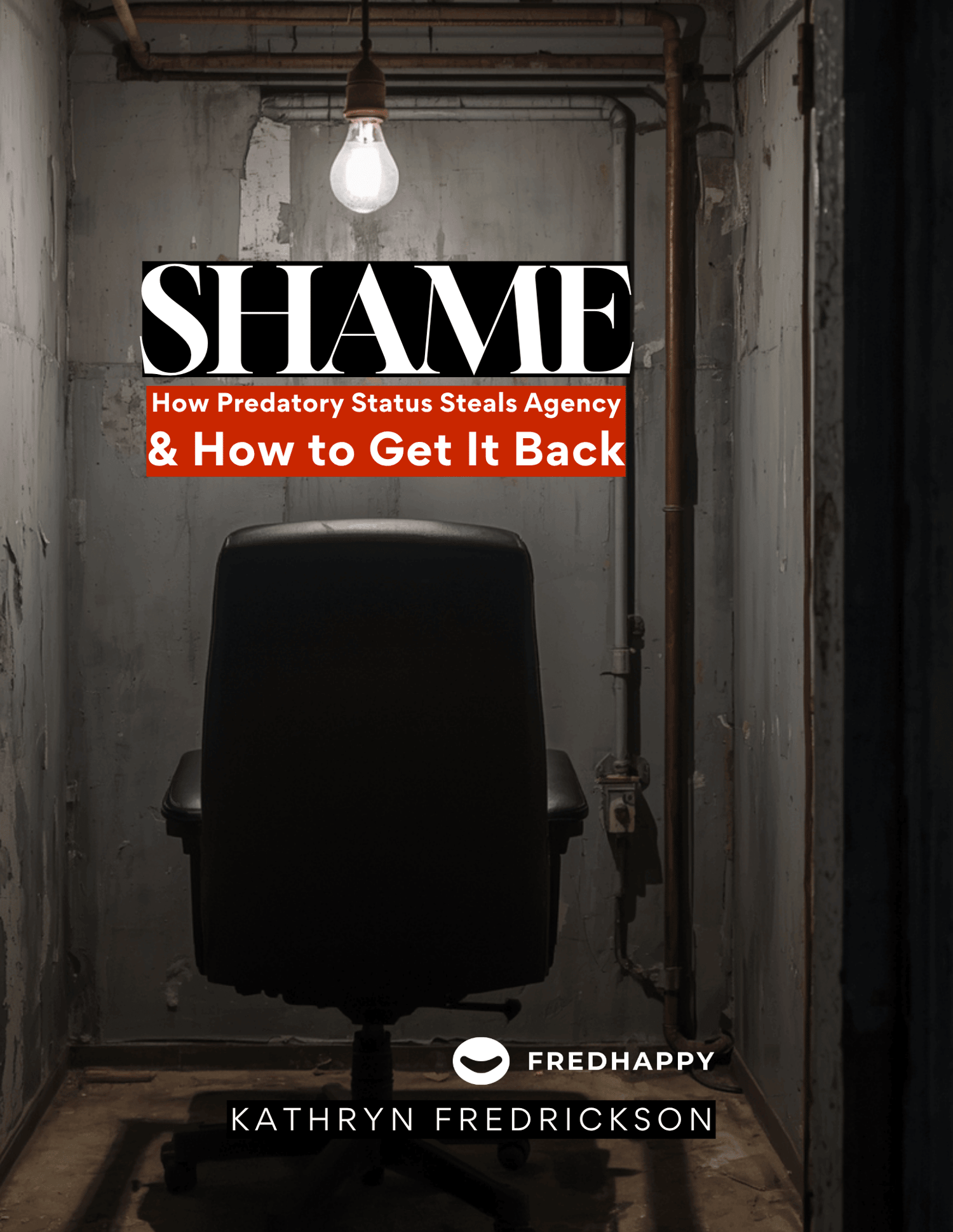
RECOVER
SHAME
How Predatory Status Steals Agency and How to Get It Back
When someone else’s judgment starts acquiring authority inside you, shame becomes more than a feeling. SHAME maps how human measurement becomes verdict, how verdict begins shaping identity and choice, and how to reclaim authorship.
Digital PDF · Immediate access
Inside SHAME: How Predatory Status Steals Agency
Here is what you'll see inside the book.
Part I: The Human Measurement System
A man does not usually buy a book called SHAME out of mild curiosity.
Something happened.
Whatever it was, it left a mark.
- Maybe you were on the receiving end of something that broke your trust in yourself or the group around you.
- Maybe you did something under pressure that still sits heavy.
- Maybe you learned to use shame on others because that was the only language modeled for you.
- Maybe you drink, grind, game, chase wins, disappear, or stay pissed off because stillness brings the old signal back loud and clear.
This book starts exactly there.
Not with soft talk about embarrassment or tidy self-esteem lessons.
Shame is not just a bad feeling about yourself. In predatory status systems, shame is a control system. It trains your body to enforce a sentence you never signed up for.
Part I maps the human measurement system before it goes fully predatory.
Humans measure humans. We read faces, voices, posture, silence, confidence, hesitation, strength, rank, usefulness, danger, loyalty, competence, masculinity, and every other cue that signals belonging or threat.
- A kid learns which parent runs the room.
- A recruit learns which laugh means trouble.
- A man learns when the group has already sized him up before he opens his mouth.
Shame starts when measurement gains authority and identity-shaping power.
The reading stops being data and becomes a verdict.
The person is no longer the guy who fucked up.
Now, they call him weak. Unstable. Disloyal. Dirty. Dangerous. Not a real man. The problem. Lucky to even be here.


