

Why I Wrote Controlled Demolition
The hotel had the kind of lobby that did not so much receive people as appraise them. Marble everywhere. A chandelier hanging above the room like a frozen inheritance. The air itself seemed conditioned by private equity.
The elevator doors closed with that expensive, padded hush. The kind of hush that says, Everyone here knows what fork to use, and no one has recently eaten shredded cheese from the bag.
Executives stood with the bored confidence of people whose money had a landscape attached to it. Their watches looked insured. Their luggage looked calmer than I was. They had soft, controlled faces of people who make decisions in rooms with no visible clocks.
The women's toenails looked independently wealthy. They were polished. Fragrant. Armored in jewelry. One of them had diamonds at her ears, throat, wrist, and ankle, as if her body required several points of authentication before entry.
Everything about them continued. The hair continued. The lashes continued. The bracelets continued. The silk continued.
I was wearing a beige poly-blend shift dress from Casual Corner.
Not vintage. Not ironic. Not “archival.” Just beige. Just poly-blend. Just shift. A dress that had once believed in office lighting and reasonable expectations.
My shoes were chunky. Not sculptural. The heel was less “European restraint” and more “youth pastor’s wife attends a conference luncheon in 1998.” I was also...unmoisturized. This detail matters. There are levels of social exposure one can survive with enough hydration in the skin. I had not chosen that path.
Still, one tries.
One of the power couples pressed the button for the eleventh floor. And then I heard myself assume out loud that the room needed levity.
“This one goes to eleven,” I said in my best Nigel Tufnel voice.
A perfectly good joke. A modest reference. A harmless little fossil from This Is Spinal Tap. A heritage joke with a proven load-bearing history in less hostile environments.
It landed like I had dropped a sandwich in a cathedral.
The silence did not fall. It organized.
Several faces turned toward me with the slow, pale gravity of livestock considering a distant storm. Tallow eyes. Soft hostility. A faint tightening around the mouth.
Not enough to be called rude. Too much to be called confusion.
One woman studied my shoes with the slow precision of a person deciding whether or not to involve security.
In my body, the old machinery started up.
Heat in the chest. Tight jaw. Stomach drop. The instant audit.
Too much. Wrong joke. Wrong dress. Wrong woman. Why are your elbows like that?
And there it was. An ancient offer of myself and my shredded cheese dignity.
Make another joke. Make it worse. Go silent. Shrink. Get sharp. Float out of your body and leave the beige dress to finish the ride alone. Punish yourself before the room can finish the job.
I did nothing out loud. That is the part people miss.
Self-sabotage does not always enter with sirens. Sometimes it enters as a tiny internal signature on a contract you did not mean to sign.
Later, at the bar, the second drink arrived looking helpful. The third was already waving from the runway.
The same system was still running.
Keep moving. Keep smiling. Keep the edges softened. Keep the joke machine warm. Maybe then you will not have to feel the full weight of being seen before you were ready.
That was the bargain. Not dramatic. Not cinematic. Just familiar.
Sometimes self-sabotage is the third drink.
Sometimes it is the joke that sprints out ahead of you with no adult supervision.
Sometimes it is the way you abandon yourself in a room full of people who never asked for that kind of power.
I wrote Controlled Demolition for that moment.
The moment right before the reach.
Before the drink. Before the smoke. Before the scroll. Before the cruel text. Before the vanishing act. Before the part of you that learned to survive by leaving decides to grab the wheel again.
Because that moment is small. But it is not nothing.
That is where the structure can change.
Inside Controlled Demolition
Here's a preview look inside the book. If this feels useful, Controlled Demolition goes much further: 114 pages connecting where you were, or still are, with practical methods for moving toward your preferred state.
Chapter 1. Safety Under Load
Stabilize the System Before You Inspect the Pattern
Foreman’s Brief
Do not start demolition inside a system that is already overloaded. A calm
crew makes cleaner cuts. A flooded system grabs the nearest tool and calls it
truth.
Your nervous system is not a metaphor. It is the first structure you are working with.
Before you inspect old patterns — avoidance, risk, shame, numbness, conflict, panic, overcontrol, self-punishment, or the private bargains you made to survive pressure — check the body running the inspection. If your jaw is locked, chest tight, breath shallow, stomach braced, or shoulders near your ears, your system is already preparing for impact. That is not failure. It is memory.
The material in this manual may activate you. You may feel tired, irritated, defensive, foggy, restless, sad, angry, or suddenly convinced the work is pointless.
That reaction is not proof the work is wrong, it’s proof the old system noticed an inspection crew.
We don’t start with confession or dramatic excavation. We start with site control. You are not here to rip yourself open for sport. You are here to create enough steadiness to tell the truth without triggering another collapse.
Safety is not a delay in the work. It is the first condition that makes the work accurate.
A flooded nervous system does not read clearly. It turns neutral information into threat, a question into an accusation, a memory into a command, and one uncomfortable feeling into proof that the whole structure is failing. That is how old patterns hijack new tools.
Before you answer anything difficult in this book, ask the question that will follow you through the rest of the manual: Am I in danger, or am I in pattern?
This question does not solve everything. It creates a pause between alarm and action. It gives your system room to stop treating every surge as an instruction.
Ready to Inspect the Structure?
Controlled Demolition by Fredhappy is an operating manual for the patterns that keep running long after the emergency that built them has passed. If you are ready to find out what is still load-bearing, what has outlived its purpose, and what can finally come down, continue with the full book below.
RECOVER
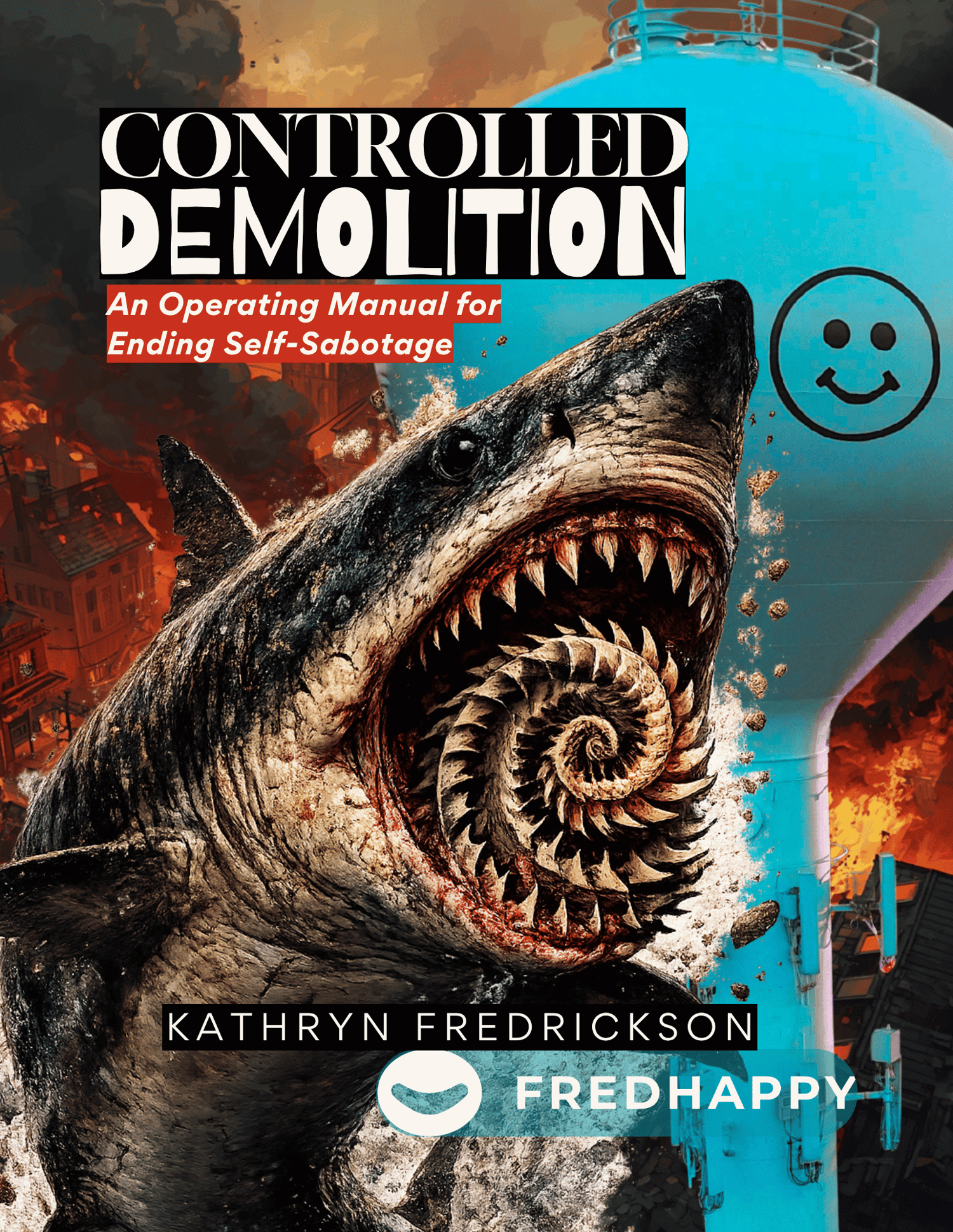
Controlled Demolition
Controlled Demolition examines what happens when survival strategies that once protected you begin limiting the life you can build. Learn to recognize what has outlived its purpose, dismantle it deliberately, and make room for choices that no longer have to answer to an old emergency.


