

Why I Wrote Heavy Bags
There is a narrow daybed against the wall in my office. Narrow enough that my body always knows where the edges are.
That matters more than it sounds like it should.
A wider surface asks more of me somehow. More uncertainty. More drifting. The daybed holds a line down both sides of my body and my nervous system seems to appreciate the honesty of that arrangement.
Here is the edge. Here is the blanket. Here is the wall. Nothing hidden. Nothing rushing in.
I have small blankets and rolled towels tucked exactly where I want them. That makes me feel better.
There is a warm lamp near my head casting amber light across the pillow and the side of my hand. The bulb hums softly if the room gets quiet enough.
To my right is a thick wall of books. Real weight. Real paper. Spines leaning against one another after years of being carried from house to house and life to life.
I sleep better beside books. They make a room feel insulated somehow.
To my left is open space and height. When I turn my eyes that direction, there is distance instead of compression. The ceiling rises upward cleanly and my chest follows it a little.
A wave of release moves through me like warm water flowing over a round rock in a small brook.
The breath lowers first. Then the muscles around the breastbone stop pulling inward quite so hard. Then the back of the body begins handing weight to the cot inch by inch, like it finally believes the cot will hold.
I exhale.
It has been hard
Hard in the way long strain becomes normal and then invisible. Hard in the way a person can continue functioning while carrying far too much for far too long. Hard in the way survival rearranges posture, appetite, timing, ambition, relationships, sleep, and eventually identity itself.
And still, something is better now.
The body knows before the mind does. The body knows because it starts giving things back. A little more willingness to rest against support instead of bracing against impact.
That is what this book became.
Not a performance about pain. Not a demand to heal beautifully. Not a dramatic breakthrough story.
Just a careful place to set something down.
I have made an enormous fuss over the words in this book
I have moved sentences around like stones in a wall, testing weight, pressure, sequence, and fit. Some paragraphs took hours because one wrong word increased the load instead of reducing it.
People can feel when language was arranged by someone who has actually carried heavy things.
That matters too.
Tonight the lamp is warm. The blankets and rolled towels are exactly right. The books stand guard at my right side and the open space rises quietly at my left.
For the first time in a long while, I do not want to move at all. I feel safe.
Inside Heavy Bags
Here's a look inside the book.
A Page You Can Start With
You are here, and that is already enough for this moment. There is nothing you need to do to earn your place on this page.
Your body has come with you, carrying its weight, its temperature, and its quiet signals. Your breath is moving in whatever way it has learned to move, and that movement is welcome here.
Something heavy has been carried for a long time. You may feel it in your shoulders, your chest, your jaw, or deep in your belly, as if the body has been bracing even while resting.
Right now, that weight can begin to lower. It does not need to drop all at once, and it does not need to go anywhere special.
Lowering a long-held weight takes care. Even gentle change asks for energy, especially when the body has learned to stay ready.
Many bodies hold still because stillness once kept things safer. Arms draw inward, the neck tightens slightly, and the breath stays closer to the surface, all in service of protecting something tender.
These responses did not appear by accident. They came from a part of you that learned how to live through difficult conditions, and that part deserves respect. This moment carries a different quality. There is more room here than there may have been before.
The body senses this slowly. Muscles soften a fraction, the breath lengthens just a little on the way out, and the eyes may take in the room without scanning. You are held here in steady attention. There is space for quiet, heaviness, and pause without anyone leaving or asking you to move faster.
If it feels supportive, you might rest one hand somewhere warm on your body. The chest, the belly, or the upper thigh can offer a simple sense of contact and weight. Feel the warmth under your hand and the weight of your hand in return.
Let that contact be enough.
A Place to Set Down What You’ve Been Carrying
Heavy Bags continues from here, with gentle, practical ways to work with the weight your body has learned to carry. If you are ready for a little more room, a little more support, and a way forward that does not ask you to force yourself, continue with the full book below.
EMBODY
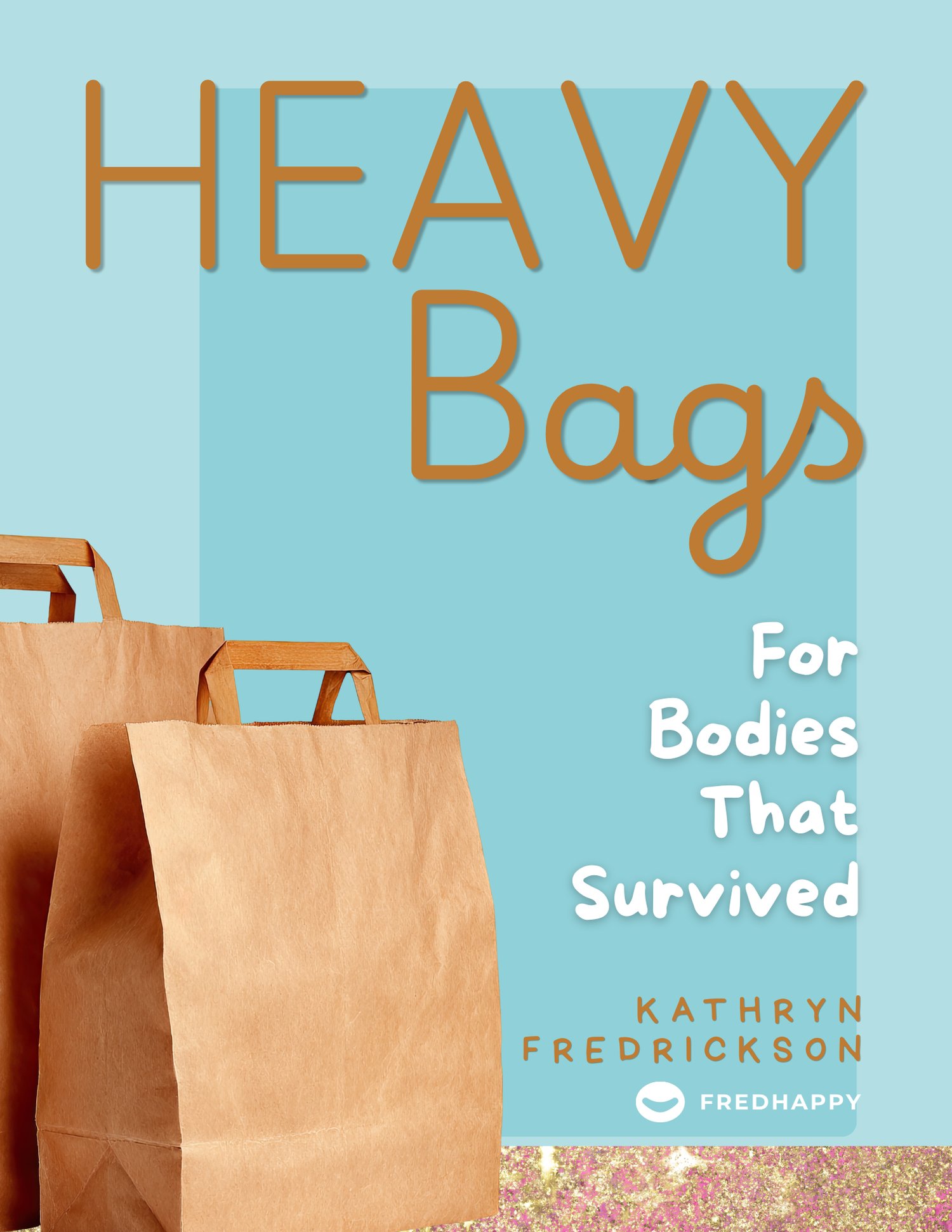
Heavy Bags
For Bodies That Survived Coercive Control
A body-centered work about carrying the residue of coercive control, reclaiming choice, and discovering what becomes possible when you no longer have to organize yourself around someone else’s control.


