

Threshold Things
Today, I am wearing amber at my throat because I need it there. I do not mean that I need jewelry.
I mean that I need a small, warm fact resting against the place where breath, speech, appetite, grief, and refusal travel through the body.
I need the weight of a thing that was once alive, was altered without being erased, and has come through a pressure I cannot imagine.
The necklace was not born this way. I restrung it from an old antique store find.
At the center is a large caramel bead my sister brought home from Russia in the 1990s. The rest are smaller, irregular, honey-colored, cognac-colored, clouded, clear, each cut or worn into its own shape.
A few of the beads I tested were plastic or modern resin. They looked plausible until I held them long enough. I cut them away.
That sounds picky until you understand what I am making.
The 1990s had their own foolishness, as every decade does, but they had a raw, headlong faith in movement. The wall had come down.
Borders were opening and changing. People crossed distances that had once seemed fixed.
Freedom had a material life then: a passport, a train ticket, hard currency folded inside a sock, a little object bought at a market and carried home for somebody else. My sister’s bead arrived here by way of that moment.
It was not simply purchased. It was brought across a newly permeable world.
Now it sits at the hollow of my throat.
It settles there so well that I have stopped asking why. Warmth rises from the marrow of my femur, fills my hips, settles in the solar plexus and sacral field, and buzzes lightly in my hands.
I feel anchored and alerted at once.
There is a conversation taking place. Clairtangency is simply a name for knowing through contact: the hand knows, the skin knows, the body recognizes something before the mind has assembled its footnotes.
Not everybody has an interest in this. Not everybody can bear the depth of it.
That is fine. The depth was here before I found a word for it, before I restrung the necklace, before this particular body knew what pressure could do.
The first thing amber does is protect a wound
Amber began as resin. A tree was breached: bark torn, branch broken, insect boring in.
Resin moved toward the injury. It sealed, defended, and covered what had been made vulnerable.
The first act was not ornament. It was protection.
Then the resin hardened. It gathered dust, leaves, air bubbles, insects, fragments of a living forest.
It moved through rivers and coastal deposits. It was buried. It changed chemically under time, pressure, and the exclusion of air.
In the Baltic region, much of what we call Baltic amber was redeposited into glauconite-rich marine sediments known as Blue Earth, then shifted again by water, ice, storms, shorelines, trade, and human hands.
The original tree itself is gone.
Scholars still argue about exactly what kind of conifer made the vast Baltic deposits. The maker vanished, but the protection remained.
That is not a metaphor imposed from outside. It is the material’s actual life.
Amber is preservation, but it is not stasis.
Amber survives because it changes. Resin does not stay resin.
- It polymerizes and cross-links.
- It becomes something durable enough to outlive the tree, the forest, and the entire social world that first called it useful.
- It does not preserve life by keeping it untouched.
- It preserves a trace of life by consenting to transformation.
There is a lesson in that which does not need to be made polite.
Amber has always had utility. It can be carved, pierced, worn, exchanged, buried, carried, traded, and rubbed until it takes on an electrostatic charge.
The Greek word elektron meant amber; electricity took its name from the old observation that amber, stroked with cloth, could draw light things toward itself.
The ancient people were not foolish for being struck by this. They had touched a golden stone and watched it pull the invisible world closer.
I am not interested in reducing that to one register. The charge is physics.
The recognition is real.
A material can be scientifically knowable and still have a relationship with a human being. The categories have never been as separate as some people would like them to be.
Honey is a body becoming food for the future
Honey belongs with amber because it is another golden substance made by labor, altered by time, and kept against loss.
A hive does not make honey as décor. Honey is the colony’s stored future.
Thousands of bees fly from blossom to blossom, take in nectar, return, pass it mouth to mouth, fan it, reduce its water, cap it, and save it for the season when the flowers are gone.
A jar of honey is not just sweetness. It is flight, pollen, digestion, labor, cooperation, heat, hunger deferred, and the wager that there will be a future worth preparing for.
The differences matter. Clover is not basswood. Spring is not late summer.
One colony does not make the same honey as another, even when the hives stand in the same field.
Different flowers, different rain, different soil, different years, different bee temperaments.
Honey is an archive of attention.
I have top-bar hives I have not yet started.
I am renting. The neighbors are close. I do not know yet whether I will choose to buy land again.
That question is not an abstraction to me. Bees need forage, room, steadiness, and a keeper who is honest about what the colony can spare.
People need much the same. A hive cannot be romanticized into thriving. Neither can a life.
Bees gather at a cost. So do we. The first honey is for the bees. The rest is a negotiation with appetite, care, winter, money, and gratitude.
I am not interested in pretending that taking is pure. I am interested in learning what enough looks like.
Ancient Egyptians understood honey as food, medicine, and offering.
They also understood that the dead required provision, continuity, and ongoing relationship. Tombs received food.
Bodies received oils, resins, linens, natron, and skilled human labor. The point was not simply to prevent decay.
It was to make travel possible. The dead needed somewhere to return, something to receive, a body held intact enough to remain in relationship with the living and the divine.
That is why the story of Alexander the Great's body being preserved in honey has lasted, whether or not we can prove every detail of it. His body had to travel.
A body is never merely a body when it belongs to a king, a mother, a child, a beloved, a people. The problem is always the same: how do we carry someone through the part of the journey where keeping is no longer enough?
And then there is the mellified man.
This is the part where many people look away. They should not have to like it.
But if we are talking about preservation, utility, sacrifice, and the ancient human need to make death answerable to life, we cannot stroll past it with our hands in our pockets.
The mellified man story reaches us through Chinese textual tradition as an account of elderly men in Arabia who gave themselves over to honey before death. They were then sealed in it after death, and became medicine a century later.
It may be history, exchange, myth, or all three braided together. What matters is that someone imagined it, told it, wrote it down, and treated the idea seriously enough to pass it forward.
Sit with the idea for a moment.
A person believes so fiercely in being of use that he imagines his own body becoming medicine after he is gone.
It is appalling. It is beautiful. It is the terrible, tender end point of self-sacrifice: I will become the remedy.
I will turn myself into something that can be carried, divided, administered, and used to heal another person.
Some of us know that impulse in less dramatic forms.
- We know the wish to become so useful that no one can discard us.
- We know the temptation to turn every injury into service, every sorrow into product, every hard-earned insight into something that will keep somebody else alive.
- We know what it is to believe that our value may depend on how much of ourselves we can render into a remedy.
That is not a small subject. It is not a decorative subject. Honey keeps asking it.
The dead were provisioned, not abandoned
In the Baltic, amber went into the ground with the dead for millennia. It was not thrown in as sparkle.
At Zvejnieki in northern Latvia, a Stone Age cemetery used across thousands of years, archaeologists have found amber among the grave goods.
In one striking double burial, dated to about 4000 BCE, amber pendants were laid from a woman’s waist to her knees, while beads were placed around a man’s head and lower legs.
- Someone sat with those bodies.
- Someone chose the objects.
- Someone placed them where they would touch bone long after the hands that placed them were gone.
We can call them status objects. We can call them grave goods.
All of that is true and none of it is the whole truth.
These were provisions for a boundary people knew they could not cross alongside their beloved. They placed a material that had already crossed deep time beside the dead and said, in the only language available to them: take this with you.
Be protected. Be recognized. Do not go empty-handed.
The Lithuanian story of Jūratė remembers amber in another register.
Jūratė, the sea goddess, had an amber palace beneath the water. When the palace was shattered, amber washed ashore as its fragments, or as her tears.
The story is not archaeology. It does not need to be.
It understands that amber is wreckage and beauty at once. A palace is broken.
The sea carries the evidence to shore. People pick it up and make something of it.
I am interested in a material that says: I was altered, I was buried, I was carried, I was found. I remained useful.
What I am preserving
The necklace is a threshold object because it joins several forms of travel. It carries my sister’s movement through Russia in the 1990s, in that ragged period of new possibility.
It carries whatever Baltic forest first bled the resin. It carries the sea and sediment that received it.
It carries the unbroken human habit of putting meaning on a string and taking it across a border, into a house, onto a body, toward a grave, through a difficult season.
It also carries me.
I did not preserve the whole necklace. I did not preserve the false pieces simply because they had been there a long time.
I chose. I cut. I kept what was true.
I gave it a new order. That is not sentimentality. That is discernment.
Preservation is often mistaken for keeping everything. It is not.
Preservation asks what still contains life, what can still serve, what needs to be carried, and what has completed its work.
It is an ethic of utility, yes, but not the brutal kind. It is utility with tenderness.
Nothing is made sacred by being old. Something becomes sacred when it can still bear meaning.
I like a roll-on perfume from Auric Blends. It is a modern, skin-level version of the same current.
This is not fossil amber in a bottle. “Amber” in perfume is an accord: cedar and spice, warm vanilla, amber, oud.
It is rich, sweet, dark, and a little excessive. It says resin without requiring a person to be buried in it for forty million years.
I would rather have amber than diamonds. I would rather have a jar of honey than another object purchased to demonstrate that I have arrived.
One must still eat. One must still travel. One must still become useful to oneself.
So I offer honey from the hives when they are running, the amber I work with, and the Amber roll-on through an Amazon affiliate link, from which I receive a small commission at no charge to you.
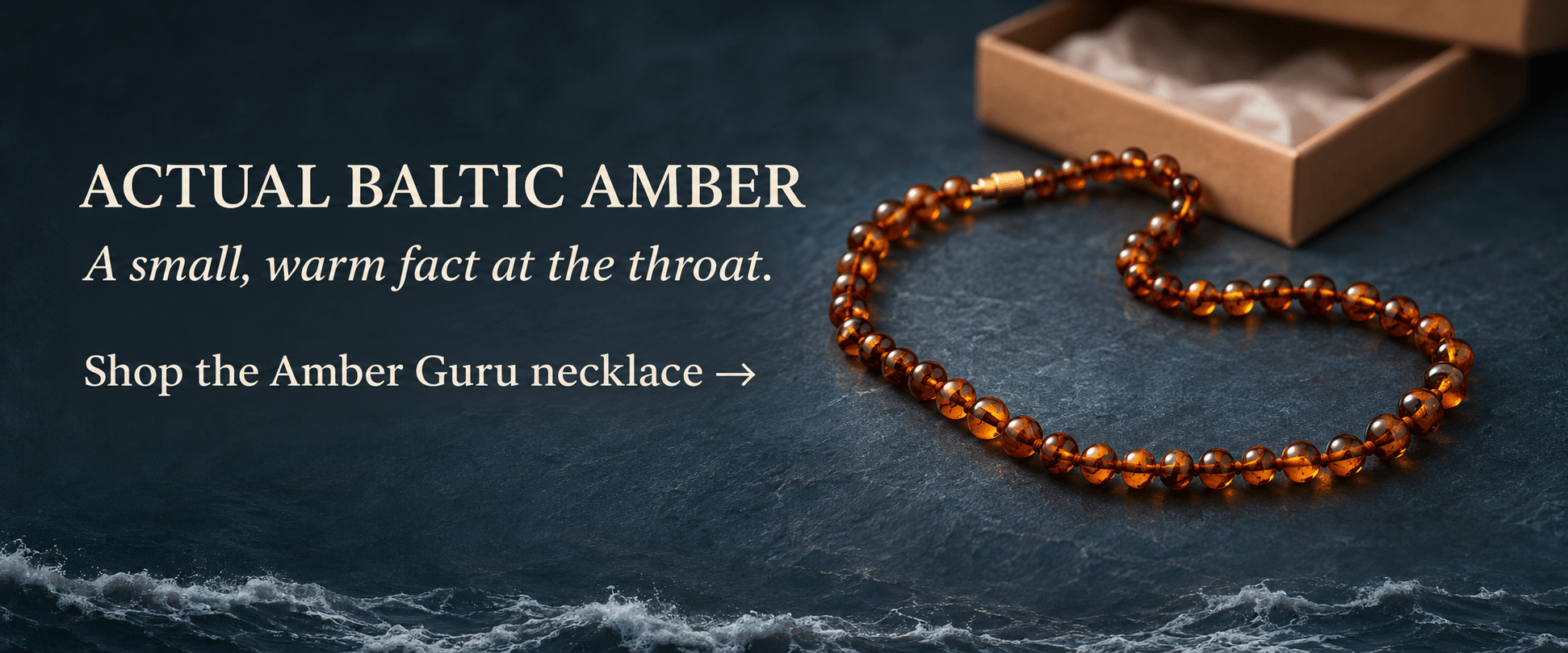
Certified authentic Baltic amber tested by a Lithuanian lab
Shop Egyptian cotton towels
Shop Tupelo honey
Try the Amber roll-on
These are not merely beautiful things. They are things that survived change. They remember that the body may be asked to cross more than it expected.
They offer warmth at the throat, sweetness on the shelf, and a small instruction from the oldest materials we know: Keep what is true and carry it forward.
Let the rest become part of the soil for the future.
Items available in season, I'll attempt to keep up with the post. Email me at sales@fredhappy.com if you have questions about the Amazon products.


