

Sometimes perfectionism is the nervous system trying to prevent punishment, not about excellence.
That distinction matters because perfectionism is often treated like a personality flaw. People are told to relax, lower their standards, or stop being so intense. But many high-performing people are not chasing perfection because they think it is fun. They are chasing it because some part of them learned that mistakes create danger.
The danger may not be obvious anymore. It may not look like a person standing in front of you. It may show up as dread before sending an email, panic over a typo, shame after a small delay, or the sudden feeling that everything must be fixed immediately.
Underneath the pressure, there may be one ancient sentence running the whole system.
"You're in trouble, Kate. You're in REALLY BIG TROUBLE."
For some people, that message came from childhood. For others, it came from a relationship, a workplace, a family system, a spiritual community, or a room where power was uneven and belonging felt conditional.
The sentence does not have to be dramatic to lodge in the body. It only has to arrive at the right moment, from the wrong person, with enough authority behind it.
When attachment wounds are involved, the effect can be even stronger. If love, approval, safety, or belonging once depended on staying pleasing, accurate, useful, quiet, impressive, or easy to manage, the body may learn to treat imperfection as a threat to connection.
That is why perfectionism can feel so urgent.
It is not only, “I want this to be good.”
It is, “If this is not good enough, I may be abandoned, judged, corrected, shamed, exposed, or removed.”
In workplace mobbing and coercive control, this pattern of approval can become weaponized.
A person may be placed inside a system where approval is unpredictable. One day there is warmth, praise, mirroring, and inclusion. The next day there is coldness, silence, withdrawal, contempt, or public correction. The target begins scanning for the rules, but the rules keep changing.
This is where attachment becomes a hook.
The person is not only trying to do good work. They are trying to recover safety, belonging, and coherence inside a structure that keeps destabilizing them.
They may work harder. They may explain more. They may apologize for things that were never fully named. They may try to become smaller, sharper, more useful, less disruptive, more impressive, more available, or less needy.
From the outside, this may look like overthinking. Inside the body, it can feel like survival.
That is one of the reasons weaponized limerence can be so disorienting.
Limerence is not always romantic. It can also form inside workplace mobbing, coercive control, attachment trauma, and asymmetrical power. The attachment hook may fasten to a mentor, a boss, a team, a room, a mission, a role, an opportunity, or the person who seems to hold the door to your future.
When approval, belonging, attention, or access are given and withdrawn unpredictably, the nervous system may begin scanning for the next signal. This is why weaponized limerence can feel so powerful. It is not only emotional longing. It is also the body trying to restore safety, status, and connection inside an unstable structure.
- The attachment is not imaginary just because the structure is unsafe.
- Real feelings can form inside distorted power.
- Real hope can form inside strategic ambiguity.
- Real longing can form inside intermittent reinforcement.
- Real distress can form when the nervous system is trained to chase a signal that keeps moving.
Weaponized Limerence is conditioning that touches an old wound.
For some people, the attachment forms around a hot-and-cold authority figure.
For others, it forms around a team, a mission, a professional identity, or a coveted opportunity. The common denominator is the repeated activation of hope, belonging, uncertainty, and attachment.
Approval feels like relief. Withdrawal feels like danger. Ambiguity becomes a task. Silence becomes a puzzle. Attention becomes validation.
You may start organizing your life around someone else’s distorted signal.
You may replay conversations, monitor tone, edit yourself constantly, and mistake nervous-system activation for meaning. You may believe you are solving a relationship concern when you are actually trapped in an attachment loop.
This is why “just stop thinking about it” rarely works.
The mind may understand the pattern before the body releases it.
The body may still be bracing for the next correction, the next exclusion, the next reversal, or the next moment when warmth becomes cold without warning. The system keeps asking, “Am I safe now?” and the answer never fully arrives.
That is also why recovery begins with naming the mechanism.
When you can name the attachment hook, the shame begins to loosen.
When you can name intermittent reinforcement, you stop calling your confusion a personal failure.
When you can name strategic ambiguity, you stop treating every mixed signal as a sacred puzzle.
When you can name coercive belonging, you stop mistaking access for love.
When you can name the phrase that lodged in your body, you can begin separating the present task from the old threat.
The document is not the danger. The email is not the danger. The typo is not the danger. The unfinished project is not the danger.
The old alarm may be real, but it may not be accurate.
That distinction is the beginning of freedom.
Perfectionism may have helped you survive rooms where mistakes were used against you. It may have helped you read tiny shifts, prevent criticism, and stay attached to people or systems that made approval feel scarce. But the same strategy that helped you survive can become a cage once the danger has passed.
You do not have to shame the strategy. You can thank it for trying to protect you.
Then you can ask a better question.
What am I afraid will happen if this is not perfect?
The answer may reveal the real wound.
It may not be about the task at all. It may be about abandonment, humiliation, exclusion, punishment, exposure, or the old terror of being in trouble.
That is where the deeper work begins.
Not with becoming careless, or by lowering your standards. It starts when you stop pretending the past did not affect you.
The work begins by teaching the body that a small imperfection is not the same thing as danger.
- You can make a mistake and stay connected.
- You can be unfinished and still be worthy.
- You can be learning and still be safe.
- You can stop organizing your life around someone else’s distorted signal.
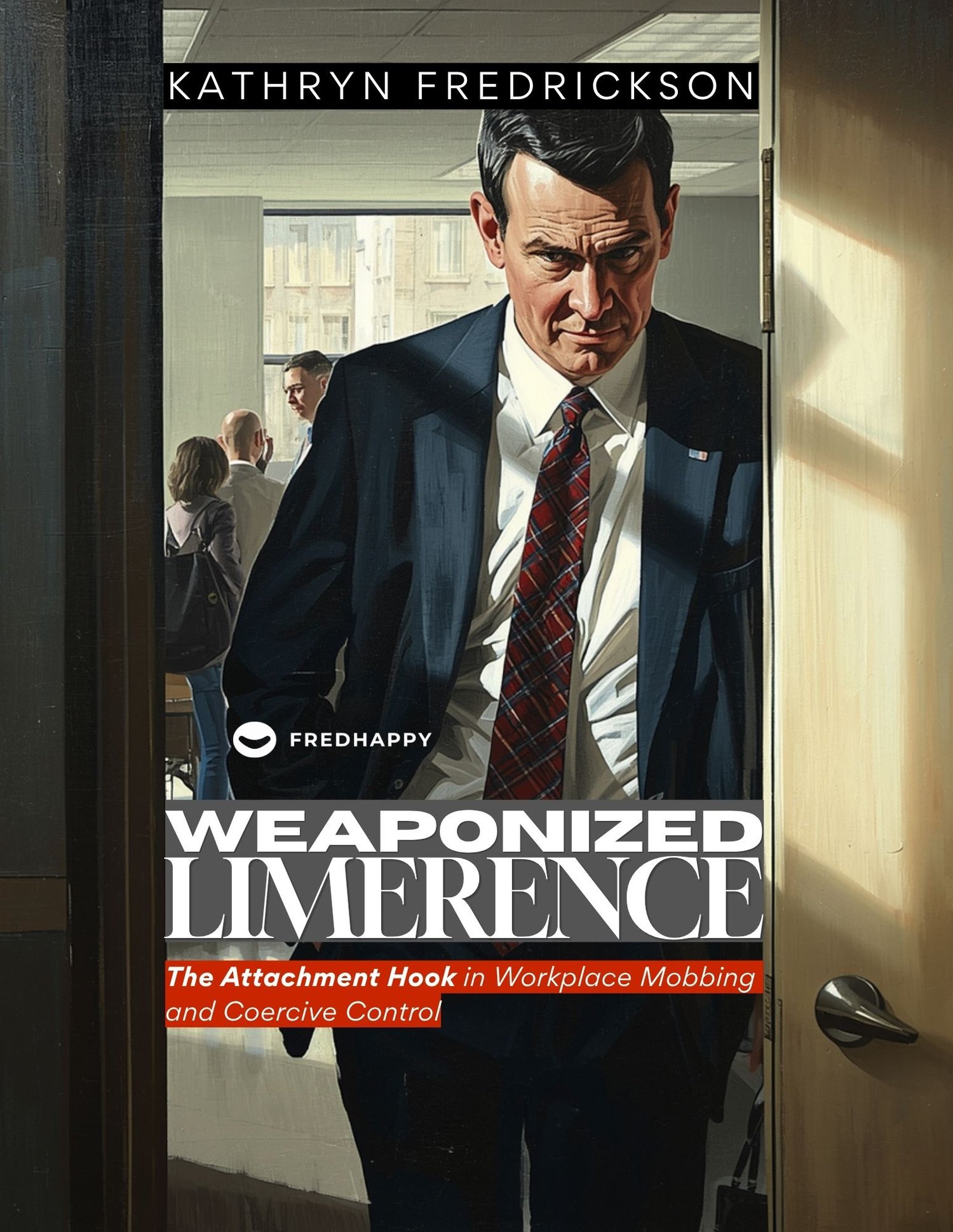
If this pattern feels familiar, I wrote Weaponized Limerence: The Attachment Hook in Workplace Mobbing and Coercive Control because I could not find the map I needed.
Most limerence books focus on romantic longing. This one focuses on what happens when attachment is activated inside asymmetrical power, strategic ambiguity, intermittent reinforcement, and distorted belonging.
It is for anyone who has felt hooked, diminished, and destabilized by a connection that alternated between intense mirroring and cold withdrawal.
It is not a soft-focus recovery book. It is a grounded debrief of how real feelings can exist inside an unsafe structure.
If you are ready to stop organizing your life around someone else’s distorted signal, start the debrief here.
PROTECT
Weaponized Limerence
Weaponized Limerence examines what happens when attraction, ambiguity, intermittent access, and asymmetrical power become tools of control. It maps the difference between private longing and engineered attachment, then turns toward reclaiming clarity, authorship, and choice.
Science Note: Threat Detection and Prediction
The brain is not primarily a thinking machine. It is a prediction machine. According to neuroscientist Lisa Feldman Barrett, the brain constantly attempts to predict future outcomes based on past experience. When a person has repeatedly experienced criticism, rejection, or punishment, the brain may begin treating small mistakes as signals of larger danger. The emotional reaction often reflects the brain's prediction, not the actual level of threat present in the moment.
Source: Barrett, L. F. (2017). How Emotions Are Made: The Secret Life of the Brain.
Science Note: Attachment and Conditional Belonging
Attachment research demonstrates that humans are biologically wired to monitor relationships for signs of acceptance, rejection, and safety. The work of John Bowlby and later attachment researchers suggests that inconsistent approval can create heightened monitoring of social cues. In environments where warmth and withdrawal alternate unpredictably, individuals may become increasingly vigilant to changes in tone, status, and belonging.
Sources: Bowlby, J. (1969). Attachment and Loss; Mikulincer, M. & Shaver, P. R. (2016). Attachment in Adulthood.
Science Note: Intermittent Reinforcement and Persistence
Behavioral psychology has repeatedly shown that rewards delivered unpredictably often create stronger persistence than rewards delivered consistently. Research originating with B. F. Skinner found that variable reinforcement schedules can produce remarkably durable behavior patterns. When approval, recognition, affection, or inclusion arrive intermittently, people may continue investing effort long after the exchange becomes unhealthy because the nervous system remains oriented toward the possibility of the next reward.
Sources: Skinner, B. F. (1953). Science and Human Behavior; Ferster & Skinner (1957). Schedules of Reinforcement.


