

Why I Wrote Weaponized Limerence
Look, I’m just going to say it.
If 1984’s Revenge of the Nerds went head-to-head against Dark Triad-style workplace behavior, the Nerds would get smoked in the first five minutes, and then someone would write a solemn memo about how the Nerds created a “hostile culture.”
Let me set the scene.
Team Nerds: Lewis, Gilbert, Poindexter, and the gang. Pocket protectors, homemade systems, big brains, zero political armor. Their strategy? Build something better, tell the truth, throw an awkwardly magnificent party, and win through sheer chaotic good engineering.
Team Dark Triad Behavior: Vague title. Practiced smile. Excellent mirroring. Emotional range of a refrigerated brick. Strategy? Smile warmly while slowly compressing a high-value employee into a decorative box labeled “Not a Culture Fit.”
Round One: The Meeting
The Nerds show up with charts, data, good faith, and a doomed belief that facts will matter.
Dark Triad-style behavior shows up with plausible deniability, moral license, and one carefully polished concern phrase.
“We’re just trying to protect the team.”
Winner: Dark Triad behavior.
The Nerds are still explaining Appendix C while the narrative has already been laundered through “care,” “culture,” and “leadership alignment.”
Round Two: The Mirror
The Nerds attempt honest connection.
Dark Triad-style behavior mirrors your values, humor, rhythm, vocabulary, and possibly your gait until your nervous system thinks, “Finally. A witness.”
Then the warmth vanishes.
Not cleanly. Not honestly. Just enough to leave your brain running emotional forensics at 3:17 a.m. like it has been deputized by the FBI.
That is where limerence can begin — not because the target is weak, foolish, or secretly wants the confusion, but because intermittent reinforcement and status pressure can hijack the attachment system.
Winner: Dark Triad behavior by plausible deniability and nervous-system capture.
Round Three: Moral License
This is where the game gets filthy.
Dark Triad-style behavior rarely announces itself as cruelty. It arrives wearing concern like a church hat.
“We’re worried about him.”
“We’re protecting the team.”
“We’re preserving the culture.”
“We just want everyone to feel safe.”
And suddenly, exclusion sounds responsible. Reputation damage sounds prudent. Social diminishment sounds like leadership.
That is moral licensing.
A person or group positions itself as ethical, protective, community-minded, or mission-driven, and then uses that moral self-image as permission to behave in ways that are controlling, contemptuous, or unfair.
The Nerds never see it coming because they think virtue means better behavior.
Dark Triad-style systems understand something colder. Virtue language can be used as cover.
Winner: Dark Triad behavior, by a sharp inhale.
Round Four: The EAP Call
At some point, a high-value employee under sustained pressure may reach out for support.
That is not being dramatic, or unstable, or “too much.”
That is someone whose nervous system has been carrying social threat, ambiguity, isolation, public pressure, reputational risk, and emotional whiplash long enough to need orientation.
If that person reaches for a cultural reference like Revenge of the Nerds, that is not a clever clapback. It is not intellectual performance. It is a flooded person trying to explain an absurd power imbalance because ordinary workplace language has failed.
Sometimes the mind grabs the nearest image it can find.
The Nerds had heart, skill, sincerity, and a genuine belief that building a better system would be enough.
Dark Triad-style behavior had plausible deniability, moral license, status leverage, and a pre-installed support network of fellow goblins.
Round Five: The Aftermath
The Nerds think the truth will eventually sort itself out.
Dark Triad-style systems understand that narratives can be arranged before truth gets its shoes on.
Many targets start looping.
What did that mean?
Why did they say it that way?
Why did I react?
Was I the problem?
Did I make it worse?
Why am I still thinking about this?
That is the hidden damage.
Not just workplace mobbing.
Not just manipulation.
Attachment hijack.
The system gets inside the target’s interpretive machinery. The person begins trying to solve internally what should have been addressed structurally.
That is the basement level of workplace harm.
Final Score
Immediate battle:
Dark Triad behavior: 3
Nerds: 0
Human dignity: somewhere in HR’s spam folder
But long-term? The Nerds win.
Not because they beat the system at its own rancid little game. Because eventually they stop trying to earn fairness from a room that was rewarding distortion.
They stop explaining themselves to the compactor. They write the book and clearly name the mechanism.
I wrote Weaponized Limerence to help your nervous system stop trying to resolve ambiguity under asymmetrical power.
Sometimes “concern” is not care.
Sometimes moral license becomes the velvet glove over control.
And sometimes the most important questions are: “Who benefited from keeping me uncertain, and HOW did they do it?”
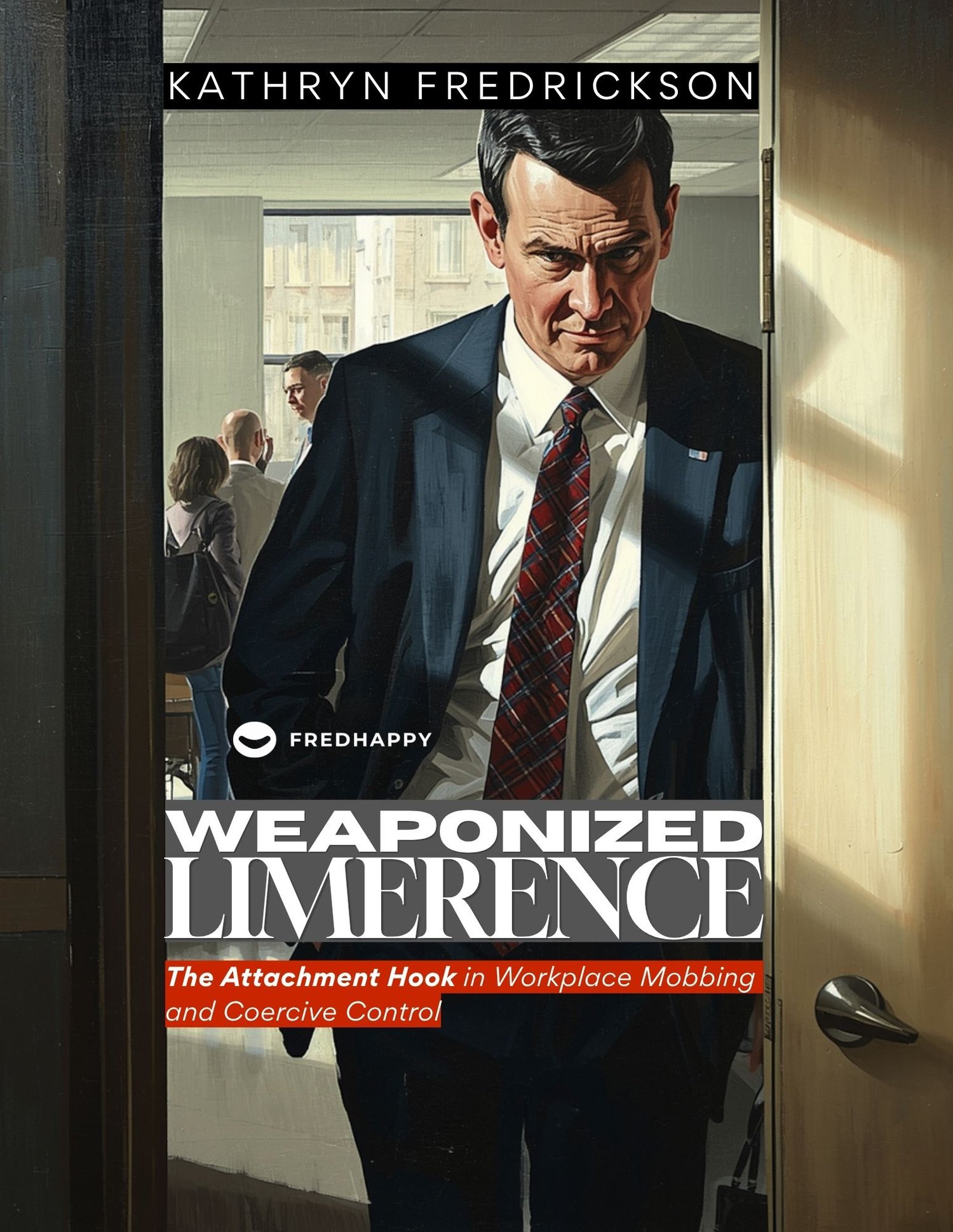
Weaponized Limerence examines what happens when attraction, ambiguity, intermittent access, and asymmetrical power become tools of control. It maps the difference between private longing and engineered attachment, then turns toward reclaiming clarity, authorship, and choice.
Grab Your Copy →


