

There are seasons when the work looks like nothing.
Dirt. Heat. Sweat. Waiting. A body bent over the same ground again and again, tending something that has not yet proven it intends to live.
That is what building an orchard can feel like.
You begin with starts.
Small, unimpressive things. Fragile roots. Little promises wrapped in damp paper.
You soak them before planting because that is what the instructions say. You understand that living things need a chance to receive before they are asked to survive.
So you soak them in big plastic trugs and then plant. Not one or two. Hundreds of them.
You kneel in the dirt and measure rows. You dig open the ground and try to place each start with care. You cover it, pressing the soil around it and move to the next.
Again and again, over and over and over.
At some point, the romantic idea of “planting” disappears. It becomes labor. Repetition. A long conversation with the earth where the earth does not answer quickly...but the lower back most certainly does.
And then comes the drought.
Not the gentle kind that makes you thoughtful. This is the fierce, steely kind of drought that makes your dreams feel totally insignificant.
The air feel metallic and the ground feel sealed shut. Watering turns into a daily act of stubbornness. Every plant looks like it might be asking whether this was a good idea.
So you hand-water...bucket by bucket. Your new neighbors drive by slowly and stare.
You buy a 4-outlet hose faucet manifold with individual shut-off valves. You move all the hoses all the time and have to replace the splitter midway through the season from overuse; and you replace the hoses, too.
You water what does not yet feed you. You water what may not make it.
This is not glamorous work. It is not efficient. It does not look like abundance. It looks like hauling water toward an invisible future while the present keeps asking for receipts.
Then come the beetles, because of course they do. Then the rabbits. And the deer.
Every living thing in the vicinity seems to discover your little planting and decide it has a claim on it. You learn that pressure does not always arrive as one dramatic event.
Leaves disappear. Tender growth gets clipped. Small hopeful stems become evidence of overnight appetite.
You make adjustments and protect what you can. Many of the plants die.
And still, you keep tending. Not because you are certain, but because certainty is rarely available at the beginning of anything worth growing.
You keep tending because some part of you knows that if you stop too early, you will never learn what this ground was capable of becoming.
The next year, there is one berry.
One berry.
After all of that.
After the soaking and planting and watering and protecting and checking and doubting and starting again, there is one berry.
It would be easy to laugh. It would be easy to call the whole thing foolish.
It would be easy to stand there, looking at that one small piece of fruit, and think: this cannot possibly be the return on everything I gave.
But then you taste it.
And it is dry.
After all of that, after the soaking and planting and watering and protecting and checking and doubting and starting again, the first berry does not taste like triumph.
It tastes like effort and drought. It tastes like a plant that survived, but did not yet know how to give sweetness.
And that is its own kind of truth.
It would be easy, in that moment, to make the wrong conclusion.
To say the work failed, or the ground was wrong. To say the planting was foolish. To say the whole thing was proof that you gave too much for too little.
But the first fruit is not always the final message. Sometimes the first fruit is only the system saying: I am alive.
Not abundant yet. Or ready yet. Or sweet yet.
The plant is alive.
So you keep tending.
You do not romanticize the dry berry, or pretend it was delicious.
You do not build a theology around disappointment and call it maturity.
You simply receive the data.
The plant lived. The roots held. The season was hard and the sweetness was not here yet.
And then the year after that, there are 4,000 berries.
The living system had been gathering itself. Slow, incremental growth of hidden work had been happening the whole time.
The plants had been learning the place. The soil had been adjusting. What looked like delay was not always delay.
Some of it was the long, unphotogenic labor required before increase can hold its own weight.
And somewhere among those 4,000 berries, there is one berry that stops you in place under the dome of the sky and the bright yellow sun.
Not because it is large, or because it's perfect. It's because when you taste that one berry, it tastes like the feeling of love.
Tenderness made edible. Sunlight that survived. A small black testimony that the ground had been learning how to give.
That one berry does not erase the drought or repay every bucket. It does not make the beetles noble or the rabbits charming or the deer wise.
But it tells you something the dry berry could not. Sweetness can arrive later than proof and early results are not always accurate forecasts.
It tells you that a living system may need time before it can turn survival into fruit.
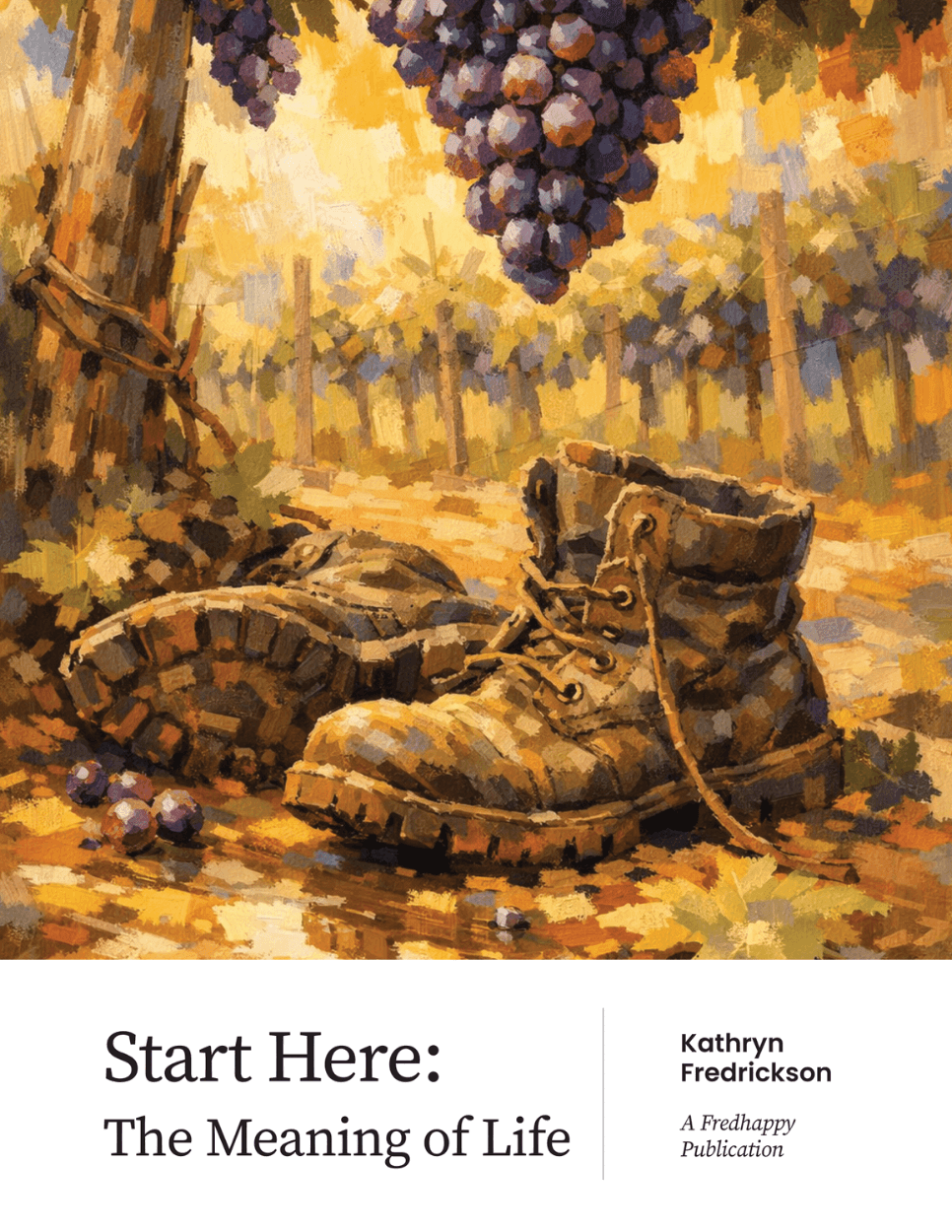
That is the kind of season Start Here was written for.
It's the part between the hopeful beginning and the triumphant harvest. The stretch where you are carrying pressure and trying not to waste it.
Where you are tired of being told to be positive.
That messy middle when the ground is dry, the pests are real, and the fruit has not yet become sweet. This is when you wonder whether you are building something, surviving something, or simply walking uphill with a bucket again.
There are hard seasons that do not need to be glorified.
There are losses that do not become acceptable just because someone later finds language for them.
There are pressures that should never have happened.
And still, inside a life, the question eventually comes:
What can grow a bounty here without destroying me? That question matters.
EXPAND
Start Here
A Field Guide for Hard Seasons
Start Here is for the seasons when everything feels like too much and figuring out where to begin becomes its own burden. It is a practical field guide for finding your footing, identifying what matters now, and taking the next workable step.


