

My grandfather polished his silverplate religiously. He was a World War II veteran with severe PTSD who could be loud, erratic, and frightening, but the silverplate gleamed because taking care of good things mattered.
There was a phrase in my family that carried considerably more meaning than I understood when I was young: We have nice things. Nice things were not simply possessions. They were evidence that you had maintained a standard, taken care of what you owned, and perhaps traveled some distance from whatever circumstances had come before you.
Some of those things eventually became PRICELESS.
At least, they remained priceless until I tried to sell them and discovered that the same priceless object was currently listed for $29.99 on Etsy, while another optimist had theirs on Facebook Marketplace for $149.99 and appeared willing to wait for the Louvre to call.
This is one of the stranger lessons of selling family possessions. Emotional value and market value are entirely different currencies, and the exchange rate can be brutal.
When Keeping Everything Made Perfect Sense
My father grew up in an extremely rural area where saving things was not eccentric behavior. It was practical household economics in a place where replacement parts were not necessarily five minutes away and where repairing what you already owned could make considerably more sense than buying another one.
There was an enormous shed called the shop, with a sand floor and a huge work surface covered with the most astonishing assortment of screws, bolts, hardware, tools, parts, scraps, and mysterious little pieces of machinery. You did not throw away a perfectly good screw because there was every possibility that someday you would need exactly that screw, and on that glorious day your foresight would finally be vindicated.
My father once sutured a wheelbarrow. I do not mean that metaphorically, and frankly I resent any sentence that requires me to explain further.
There was also the PRICELESS antique rocking chair that we were going to repair someday. Someday remained remarkably patient about the arrangement.
During one family cleanout, we found approximately 350 spools. At some point, preparedness had crossed an invisible border and become a strategic thread reserve.
None of this felt particularly strange to me. When I encountered the Art Farm at Sheldon Art Museum in Lincoln, Nebraska, its accumulated world of objects, tools, machinery, scraps, repair materials, and possibility made an enormous impression on me because I understood the material language immediately. There were even a few mouse skeletons, of course.
Nothing was useless because everything might become useful again. That is an extraordinarily adaptive philosophy until the number of possible futures becomes larger than the space available to store them.
We Identify With Things
This is where ordinary decluttering advice becomes much too shallow. Objects are rarely just objects once human beings have lived with them long enough.
They can become evidence that your family made it. They can represent respectability, preparedness, taste, continuity, competence, memory, self-reliance, or the comforting conviction that you are a family who has nice things.
A china cabinet can hold dishes and identity simultaneously. A workshop can hold hardware while preserving an entire philosophy about scarcity, repair, responsibility, and what a decent person does with something that might still be useful.
Research on hoarding makes this connection between possessions and meaning much less peculiar than it may sound. People with hoarding disorder often experience possessions as useful, emotionally meaningful, unique, potentially needed in the future, or morally difficult to waste. The American Psychiatric Association notes that the objects themselves are often the same perfectly ordinary things everyone saves; the problem is the degree to which saving, acquisition, and difficulty discarding begin to interfere with life.
That distinction matters because clutter is not automatically hoarding disorder. Clinically, hoarding disorder involves persistent difficulty parting with possessions, distress associated with discarding, and accumulation severe enough to compromise the normal use of living areas or cause significant impairment.
In other words, owning fourteen mixing bowls does not constitute a psychiatric diagnosis. It may simply mean you have fourteen mixing bowls and should probably stop going to estate sales with me.
When Clutter Becomes Part of Safety
I learned something else while cleaning my parents' house. I could clean the kitchen, but I learned not to clean it too much.
I would deliberately leave a little clutter for my dad. If everything disappeared at once, he could become agitated.
That changed how I understood the problem because the clutter was not merely obstructing the environment. Some amount of it appeared to be participating in his sense of what the environment was supposed to look like.
The clinical literature offers an important caution here. People with hoarding disorder can experience substantial distress when possessions are removed, and simply clearing a home without addressing the beliefs, decision-making difficulties, acquisition patterns, and distress underneath the clutter often does not solve the problem.
I am not diagnosing my father from the kitchen counter, and I do not need a diagnosis to respect what I observed. I learned that an environment one person experiences as peaceful can feel strangely empty, altered, or unsafe to another person.
That is why the television version of hoarding can be so misleading. A crew arrives, removes the mountain, reveals the floor, and visually completes the story, but the human nervous system does not necessarily experience the newly empty room as the triumphant final shot.
Sometimes the stuff was doing a job.
The Hoard Can Be a Freeze
I have begun thinking about some accumulation as decisions that stopped moving. The object remains because making no decision about it can feel safer than making the wrong one.
We will fix it later. We will sell it later. Someone may need it. It was expensive. It belonged to Grandma. They do not make these anymore. I can use the fabric. Somebody needs 350 spools.
Each individual argument may be perfectly reasonable. The problem is that thousands of reasonable postponements eventually require real estate.
Someday is an extraordinarily spacious storage facility. Apparently it has unlimited square footage and very relaxed zoning.
Decision-making difficulties are actually relevant to clinical hoarding. The APA describes indecisiveness, procrastination, disorganization, distractibility, planning difficulties, and problems with working memory among features that can accompany hoarding disorder.
That does not mean every delayed household decision is a symptom. It means there is something worth noticing about the relationship between difficulty deciding and physical accumulation.
A box can become a deferred decision with cardboard walls. A garage can become several thousand deferred decisions with a garage door.
That is where the word freeze becomes useful to me, not as a diagnosis but as a description of suspended movement. Nothing has been decided, so nothing has to be lost.
Unfortunately, nothing can circulate either.
The PRICELESS Antique Rocking Chair Meets Etsy
I am learning this because I finally started selling things. Books, wool, pottery, vintage household objects, old tools, art, and assorted artifacts of several generations have begun migrating out of my house.
The marketplace is providing a brisk education in family mythology. The PRICELESS object may indeed be precious to us while simultaneously possessing a robust secondary-market value of $29.99 plus shipping.
That is not an insult to the object or to the person who loved it. It simply means emotional value and market value answer different questions.
One asks, What did this mean to us? The other asks, What will a stranger pay for it right now?
Those answers do not have to match.
I Had Confused Keeping Value With Preserving Value
This may be the largest shift for me. I had confused keeping value with preserving value.
Sometimes preserving value means caring for something yourself. Sometimes it means allowing the thing to become useful somewhere else.
The wool has more value in the hands of someone who will hook the rug, knit the sweater, weave the cloth, or make the project my family never got around to making. The pottery has more value on somebody's table than it does wrapped in newspaper in my garage.
Even money behaves differently once it begins circulating. Five enormous totes of wool may contain considerable theoretical value, but theoretical value cannot pay a bill, fund an experience, improve our home, or create another opportunity until exchange occurs.
I am not interested in throwing away everything I own and moving into an empty white room with one ethically sourced spoon. I like shelter, decoration, books, art, pottery, textiles, strange old tools, and objects that carry human workmanship.
What I want is choice.
I want the things around me to be there because somebody decided they belong there. I do not want my house to function primarily as climate-controlled storage for decisions nobody wanted to make.
Prosperity Requires Circulation
I am trying to enter a more prosperous era of my life, and prosperity is beginning to mean something different to me. Accumulation alone is not prosperity, even when everything accumulated has value.
Prosperity requires circulation. Resources need to be available for the life being lived rather than permanently frozen inside objects being preserved for hypothetical futures.
Something remarkable happens when an object sells. Someone chooses it, money comes back, physical space returns to my family, and one decision becomes complete.
The object is no longer waiting. Neither am I.
That does not mean everything must leave. Some things stay because I use them, some because I love them, and some because their beauty, history, or usefulness still earns the space they occupy.
The inheritance I want to keep may not be the inventory. I can keep my father's ingenuity without maintaining an emergency wheelbarrow surgical unit.
I can keep my grandfather's respect for beautiful things without requiring silverplate to prove that I have nice things. I can keep gratitude without turning gratitude into permanent custody.
Why I Wrote GRAVITY as Fiction
This is also why I increasingly believe in fiction as a teacher.
Some human patterns become strangely resistant when we explain them directly. The reader understands the concept intellectually, agrees with the argument, closes the article, and then walks past the same seventeen boxes in the hallway.
Fiction gets into the room another way. It can let us experience attachment, scarcity, clutter, memory, grief, identity, decision paralysis, and the physical pressure of possessions without immediately putting ourselves on trial.
That is part of what I wanted from GRAVITY. It belongs in Fredhappy’s EMBODY collection because clutter is not only a question of organization; possessions can become an extension of the self, carrying memory, identity, preparedness, unfinished decisions, and even a felt sense of our own boundaries. The physical environment can begin to function almost like an external nervous system, holding parts of what we know, who we are, and what makes us feel safe. When that happens, changing the space can feel less like moving objects and more like changing the size and shape of the self.
A room changes the body that moves through it. A home full of unresolved objects can require constant navigation, visual processing, remembering, protecting, postponing, and deciding.
The goal is not to make every home sparse.
The goal is to recover enough movement that the home can participate in the life happening inside it.
That is what I am beginning to experience now.
My kitchen table can become a kitchen table again. My garage can eventually hold my car, and the leaf blower is waiting for its moment of almost indecent triumph.
The result is not deprivation.
It is coherence.
If your belongings have begun carrying memory, scarcity, identity, obligation, possibility, and seventeen imaginary future projects in addition to their own physical weight, GRAVITY explores what happens when those forces begin to loosen.
Sometimes information teaches us by naming the pattern. Sometimes fiction teaches us by letting us finally recognize ourselves inside it.
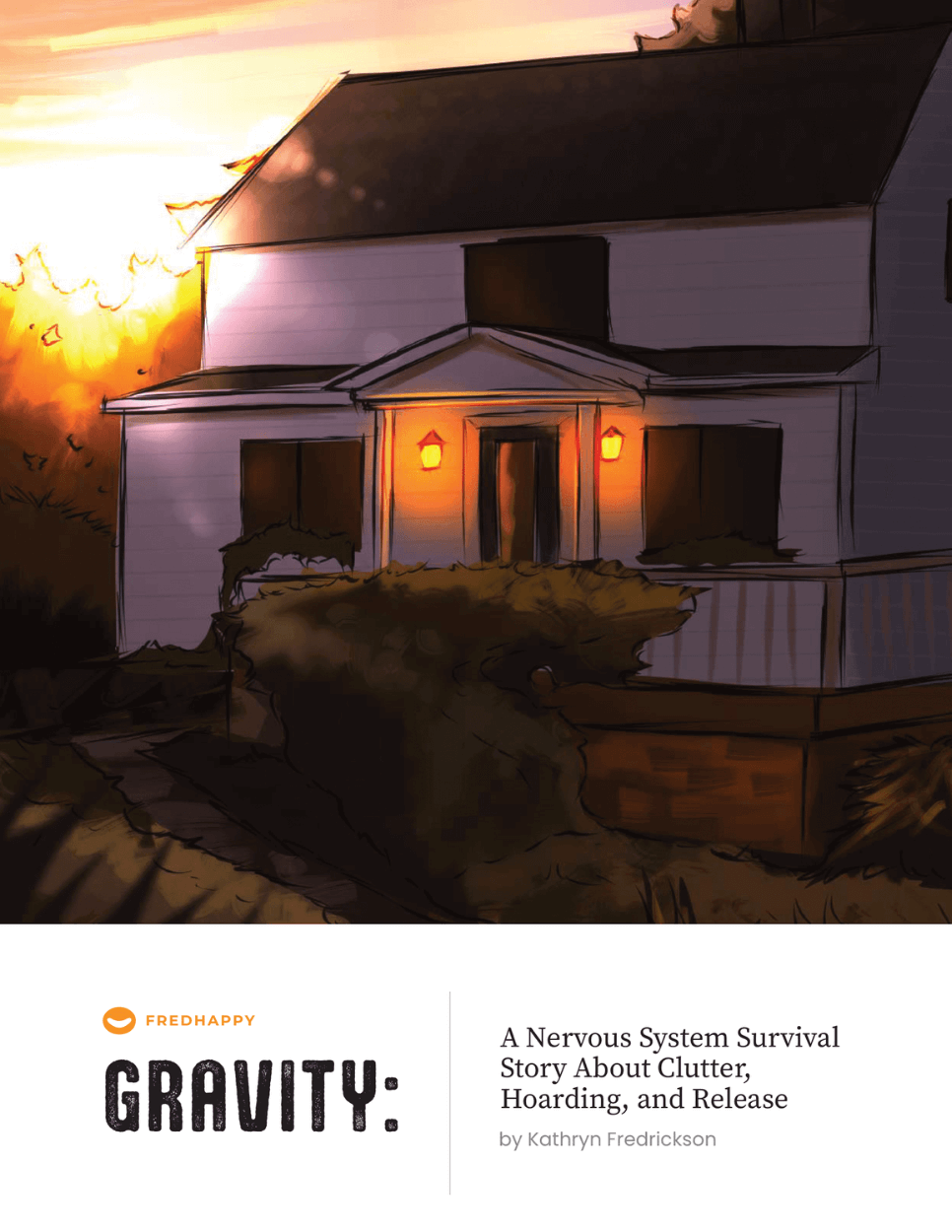
GRAVITY: A Nervous System Survival Story About Clutter, Hoarding and Release
A story about what we keep, why it accumulates, and how clutter can become an extension of the self, carrying memory, identity, safety, and the weight of unfinished decisions.
Inside the Book
Preface
This is not a book about tidying.
This is about what happens when a body gets asked to carry too much for too long, and it starts storing the overflow in places that have walls and doors.
It is about a house that learned to hold its breath.
It is about the quiet physics of decisions deferred, grief deferred, comfort deferred. It is about the way a nervous system turns into architecture when there is no one steady enough to hold the weight with you.
Some people will look at a space like this and see failure.
This story sees something else.
A complex of complexes. A life that tried. A mind that can build entire worlds and still freeze in front of one envelope. A person who can keep a porch light on like a lighthouse, even when the inside feels like a storm.
The point is not to win against the mess.
The point is to understand how it starts, how it persists, and what changes it.
Not shame or heroics.
Presence.
8:03 AM
The porch light is still on, even though dawn has already arrived.
It throws a clean cone over the threshold, a small stage where the welcome mat sits centered like it was measured. The mat reads WELCOME in a cheerful font that belongs to a different kind of day.
The door knob shines.
It is the only thing in the house that behaves every week, reliably, like a pet that still comes when called.
If you lean close enough you can smell the vinegar. It clings to metal, sharp and honest, a smell that means: I did something. I controlled one inch of the world.
Behind the door, the air is warmer. Still. Thick with held time. The house does not creak. It waits.
Something in it is awake already, not a person exactly, not a ghost either. More like a set of invisible whiskers stretched through the frame of the building. More like a cilia field. Every vibration outside is translated into posture inside.
A car door closes two houses down.
The house tightens its jaw.
A laugh floats from the sidewalk, too close, too casual.
The house pulls its shoulders forward.


