

Most of us receive a long education in how not to become unbearable human beings.
We are taught not to brag. We learn to share credit, consider other people's feelings, give someone the benefit of the doubt, forgive mistakes, cooperate with the group, and examine our own behavior when something goes wrong. We are encouraged to be humble about our abilities and cautious about our judgments of other people.
We also learn to be fine.
Fine is useful. We cannot conduct an emotional excavation every time someone asks how our morning is going, and communities could not function if every inconvenience became an indictment. Human beings need generosity, restraint, perspective, humor, forgiveness, and the ability to tolerate one another's imperfections.
But there is a problem hidden inside this otherwise excellent cultural education. It works best when the people around us have received some version of the same education.
When they haven't, the equation changes.
The Problem of Asymmetry
In a healthy relationship, workplace, family, friendship, school, organization, community, or culture, the work of maintaining relationships moves in more than one direction. I examine my behavior, and you examine yours. I try to understand your perspective, and you make room for mine. I forgive your ordinary imperfections, and you do not interpret my forgiveness as permission to repeat the same behavior indefinitely.
Neither of us has to perform this perfectly. Reciprocity is not an accounting exercise in which every kindness must be repaid by Thursday afternoon. It is simply a pattern in which both people recognize that the other person has a reality, dignity, interests, boundaries, and point of view.
Something very different happens when only one side is practicing that kind of self-examination.
- A conscientious employee may encounter a troubling interaction and wonder whether she misunderstood it.
- A generous friend may search for an explanation for behavior that hurt him.
- A family member may spend years trying to understand why another person behaves in ways that repeatedly damage the relationship.
- A partner may keep improving the way she communicates because she has been told that better communication will eventually solve the problem.
Sometimes that reflection produces exactly what we hope it will produce. We discover that we did misunderstand something. We recognize our contribution to a conflict. We apologize, adjust, and become wiser.
But self-reflection is not an infallible instrument. Used without attention to reciprocity, it can become a place where reality goes to disappear.
When Virtues Become Vulnerabilities
Many of the qualities that make people wonderful colleagues, friends, partners, leaders, and community members can become vulnerabilities in the wrong environment.
Humility is a good example. We are taught not to brag, which can gradually become a reluctance to accurately describe our own competence. Someone can become extraordinarily accomplished while still feeling uncomfortable saying, plainly, “I am very good at this.”
That matters in a workplace. It matters in a family. It matters anywhere status, credibility, resources, opportunity, or authority are being distributed.
A person who consistently minimizes her own contribution while generously magnifying everyone else's may believe she is simply being gracious. Meanwhile, the surrounding system is learning from the information she provides. If she continually says that her contribution was nothing, eventually someone may believe her.
The same distortion can happen with judgment. “Don't be judgmental” is excellent advice when it means resisting snap conclusions about people. It becomes considerably less useful when it means refusing to draw conclusions from repeated evidence.
“Look for the best in people” is a beautiful principle when it protects us from cynicism. It becomes dangerous when it requires us to manufacture increasingly elaborate benevolent explanations for behavior that keeps producing the same result.
“Be a team player” can encourage cooperation. It can also become an instruction to tolerate conditions we would immediately recognize as unacceptable if they were happening to somebody we loved.
Even forgiveness can become confused with something it is not. Forgiveness may change what we carry internally, but it does not automatically tell us how much access another person should have to our time, money, work, home, confidence, body, reputation, or future.
Good qualities do not stop being good because somebody can exploit them. They simply need companions.
- Humility needs accurate self-appraisal.
- Compassion needs boundaries.
- Forgiveness needs discernment.
- Cooperation needs the ability to dissent.
- Self-reflection needs observation of the external world.
Integrity needs reciprocity to create a healthy relationship.
The Habit of Looking Inward
There is a peculiar cultural habit that many people develop without ever consciously choosing it. We learn to look for the best in other people while looking for the worst in ourselves.
Something goes wrong and the internal inquiry begins. Perhaps I misunderstood. Perhaps I was too sensitive. Perhaps I communicated badly. Perhaps I expected too much. Perhaps I should have been more patient. Perhaps I should have worked harder, explained it better, been kinder, spoken sooner, spoken later, spoken differently, or not spoken at all.
Again, these are not foolish questions. The ability to ask them is part of maturity.
The distortion occurs when we apply one standard of interpretation to ourselves and another to everyone else.
If we consistently interpret another person's behavior generously while interpreting our own behavior suspiciously, we have not necessarily achieved humility. We may simply have introduced a systematic error into our perception.
We are gathering evidence with a scale that has been weighted on one side.
A more accurate inquiry includes both directions. What did I contribute to this situation, and what did the other person contribute? What might I misunderstand, and what do I know? What explanations are possible, and which explanations remain plausible after the behavior repeats? Am I extending generosity because the evidence supports it, or because reaching a less generous conclusion makes me uncomfortable?
This is not an invitation to become suspicious of everyone. It is an invitation to become fair to yourself, too.
When the Past Becomes the Rubric
There is another way self-examination can quietly become distorted. After a painful relationship, workplace, family conflict, or experience inside a difficult culture, we may begin using that experience as the test case for everything we learn afterward.
We learn something about boundaries and immediately revisit all the boundaries we should have set. We learn about accountability and reconsider every reaction we had. We learn about manipulation and search the past for the moment we should have recognized it. We learn about relationships and use the new information to conduct another examination of an old one.
Some of this is how human beings learn. Looking backward with better information can help us recognize patterns, make sense of confusing experiences, and decide what we want to do differently in the future. The problem begins when reflection loses its stopping point.
Eventually, an experience can become so important as a source of learning that it remains the reference point long after we have understood what it has to teach us. New knowledge keeps traveling backward instead of forward. Rather than helping us imagine better friendships, workplaces, partnerships, communities, or choices, it becomes another instrument for auditing the past.
At some point, we are allowed to change the question. Instead of continually asking what a new insight explains about what happened before, we can ask what that insight makes possible now.
Accountability can help us build healthier relationships rather than endlessly reassess old ones. Discernment can help us choose people and environments rather than simply catalog those we wish we had avoided. Boundaries can become part of ordinary life rather than emergency equipment. New knowledge can become material for the future.
The past can remain part of our education without remaining the rubric for everything that comes next.
“Fine” Can Hide a Great Deal
Then there is fine.
Fine keeps meetings moving. Fine gets children to school. Fine makes small talk possible. Fine allows us to buy groceries without explaining our lives to the cashier.
But fine can also become a cultural costume.
People can learn to remain agreeable while something is costing them dearly because naming the cost feels dramatic, selfish, disloyal, boastful, weak, impolite, or inconvenient. They may become exceptionally skilled at appearing untroubled while spending tremendous energy managing what is happening underneath.
This can happen anywhere. A workplace can have excellent engagement surveys while employees privately know which subjects cannot be discussed. A family can look wonderfully close while one member has learned that belonging depends upon silence. A friendship can continue for years because one person has become extraordinarily good at absorbing the imbalance. A community can describe itself as welcoming while quietly enforcing a narrow range of acceptable difference.
The appearance of harmony and the existence of health are not the same thing. Sometimes a healthy system is noisier because people are allowed to tell the truth.
Understanding Is Not the Same as Access
For compassionate people, this may be one of the hardest distinctions to learn.
Understanding someone can feel very close to excusing them. Once we know that a person had a difficult childhood, experienced loss, works under terrible pressure, feels insecure, struggles socially, or has been hurt before, we may feel obligated to keep extending ourselves because we can see how the behavior developed.
Understanding matters. Context matters. Human beings are complicated, and reducing people to their worst behavior makes the world smaller and crueler.
But understanding someone and granting them access are different decisions.
We can understand why someone behaves a certain way and still decide that the behavior is incompatible with a close friendship. We can appreciate someone's talents and decide we cannot work for them. We can love a family member and limit what information we share. We can forgive someone without recreating the conditions in which the same injury occurred.
Compassion does not require us to surrender observation.
Integrity Is Not a Security System
Perhaps this is the most important distinction of all.
Integrity tells us how we want to conduct ourselves. It helps us decide whether we will tell the truth, keep our promises, treat people fairly, acknowledge our mistakes, and use power responsibly.
Integrity cannot make another person do the same.
Our goodness does not create a force field around us. Our sincerity cannot force sincerity from another person. Our willingness to repair cannot make someone else interested in repair. Our refusal to manipulate does not prevent manipulation from existing around us.
This is not a reason to abandon integrity. It is a reason to stop asking integrity to perform a job it was never designed to perform.
Discernment has a different job. It helps us decide where to place our trust, attention, vulnerability, labor, loyalty, money, love, and time.
Together, integrity and discernment create something far more useful than either can create alone. We can remain the people we want to be while becoming much more accurate about the environments in which we place ourselves.
A Better Kind of Humility
The answer is not to reverse the old distortion. We do not need to begin looking for the worst in everyone else while assuming the best about ourselves.
We need a fairer instrument.
We can look for the best in other people while remaining willing to see the rest. We can examine ourselves honestly without beginning from the assumption that we are the problem. We can acknowledge our strengths without turning them into superiority, and acknowledge another person's limitations without turning them into condemnation.
Perhaps humility was never supposed to mean becoming smaller. Perhaps it means seeing ourselves at the correct scale.
Not larger than everyone else. Not smaller than everyone else. Human among humans, responsible for our conduct but not responsible for producing all the health in every system we enter.
We do not have to become harder to become wiser. We can keep looking for the good in people. We can simply remember to include ourselves among them.
Learn to See the Room More Clearly
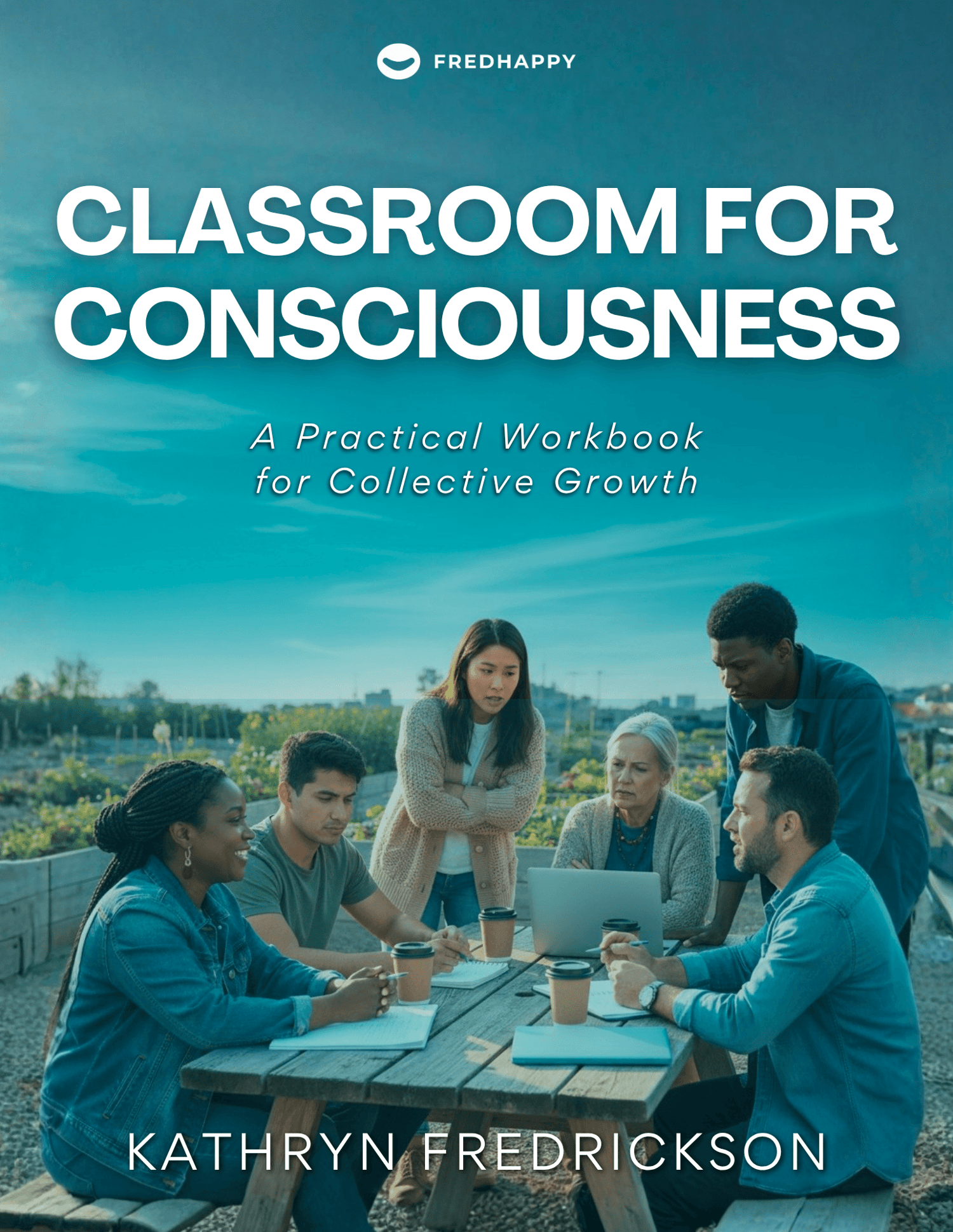
If this essay brought up a familiar question, How do I stay open, kind, and self-aware without disappearing inside the people or cultures around me?, Classroom for Consciousness was built for that work.
Across 13 structured lessons, the workbook explores what happens when social pressure, ridicule, exclusion, manipulation, and our own instinct to accommodate begin changing the way we see ourselves. It offers a place to practice something more balanced: honest self-examination without automatic self-blame, compassion without surrendering clarity, and participation without making yourself smaller in order to belong.
Because the goal is not to become harder or more suspicious of other people. It is to become more accurate about yourself, other people, and the rooms you enter.
EXPAND
Classroom for Consciousness
A Practical Workbook for Collective Growth
Stay kind without folding under social pressure, ridicule, or the threat of exclusion. Across 13 structured lessons, practice meeting tension with clarity, compassion, and the steadiness to choose instead of react.


