

Anger has built a lot of things.
Books have been written because someone was angry. Companies have been started because somebody became furious with the way an industry worked. Laws have changed because people refused to continue accepting what had been presented as normal. Careers have been rebuilt, boundaries established, investigations launched, art created, and entire movements sustained because somebody’s response to a condition eventually became: No. This needs to be different.
We tend to talk about anger as something that needs to be controlled. That is understandable because people can do tremendous damage when they act from the hottest moment of fury. But it leaves out half the story. Anger is also energy for change, and learning how to use it well requires more than learning how to calm down.
It requires learning to recognize anger while it is happening, understanding what happens when you cannot recognize it, and noticing what happens when another person interferes with your ability to understand what you are feeling.
That is where anger and manipulation become much more interesting.
The Flash of Anger Is Not the Same as the Slow Burn
Sometimes anger arrives at full volume. There is heat, muscular tension, pressure, narrowed attention, and an immediate sense of NO before you have completely understood what the no is about.
That flash can be useful. It may tell you that something has crossed a boundary, violated an expectation, threatened something important, blocked you, humiliated you, or struck your sense of fairness. The body has mobilized before the mind has completed its report.
The flash can also get you into trouble. People send emails during it. They say things they cannot retrieve. They make decisions while their attention is narrowed. They can be absolutely correct that something is wrong and spectacularly incorrect about what should happen next.
This is why I think the first surge of anger is better treated as data rather than verdict. The fury is real and worth listening to, but you do not have to obey its first interpretation.
Something much more interesting happens if the anger remains after the flash is gone.
You sleep. You investigate. You get more information. You consider whether you misunderstood something. You listen to somebody who sees it differently. Your heart is no longer hammering and your jaw is no longer trying to pulverize your molars.
And you still think: No. This is not acceptable.
Now the anger has changed.
The hottest flash of anger is good at mobilization, but tenacity requires a different fuel system. Nobody can remain at peak fury while writing a book for two years, changing an organization, pursuing a case, building a company, creating art, organizing a community, or working to change a system. The body cannot indefinitely maintain that temperature, and useful work requires capacities that fury can temporarily crowd out: patience, perspective, planning, judgment, and the ability to tolerate boredom.
The slow burn can do something the flash cannot. It can become conviction.
You no longer need to keep yourself furious to remember why the thing matters. You know why it matters. The anger has been incorporated into a decision about what you value, what you will protect, what you will no longer accept, or what you intend to build.
The flash can get you out of the chair.
The slow burn can keep you working six months later.
Anger Is Also a Defense
This is where anger becomes particularly interesting in the context of manipulation.
Anger does more than motivate action. It can help us differentiate ourselves from other people.
It can tell us: You are over there. I am over here. Your desire is not automatically my obligation. Your interpretation is not automatically reality. Your disappointment does not automatically require my compliance. I do not have to sacrifice myself simply because maintaining harmony would be easier for everyone else.
That is a powerful defensive function.
A clean flash of anger can make a boundary astonishingly obvious. Something happens and the internal response is immediate: Absolutely not.
But manipulation does not always give us the luxury of a clean response.
We tend to imagine manipulation as somebody convincing us to believe something false. Sometimes that happens. Manipulation can also interfere with our ability to get a clean read on our own reactions.
Instead of clarity, there is fog.
Something happens and you feel unsettled, but you cannot quite explain why. You become preoccupied with whether you misunderstood. You start defending yourself against an accusation you never expected. You are trying to preserve a relationship, protect your job, understand a changing social situation, establish that you are a reasonable person, manage somebody else's emotions, or simply figure out what in the hell just happened.
Your defenses are still there. They are simply competing with a dozen other demands.
That can make anger surprisingly difficult to recognize.
Manipulation Can Turn Anger Into Fog
Under confusing conditions, anger may not arrive as a magnificent clean NO. It may arrive as an exhausting attempt to make sense of things.
You explain more than usual because you think better communication will fix the problem. You become unusually accommodating because the situation feels unstable. You worry about whether you are being unfair. You replay conversations because something does not fit. You become embarrassed by your own reaction and start managing that embarrassment instead of examining what produced it.
Meanwhile, the most elementary information in the entire situation may be struggling to get through:
I don't like what is happening.
This is one reason manipulation can be so difficult to recognize while it is occurring. The person inside the situation has more jobs than the person looking back on it later. They are experiencing the event while simultaneously interpreting it, responding to other people, considering consequences, regulating their own behavior, protecting things that matter to them, and working with information that may still be incomplete.
If somebody adds shame, urgency, ambiguity, social pressure, affection, fear, obligation, or the possibility of losing something important, the internal workload increases again.
The result can feel less like being controlled than being unable to get a clean grip on anything.
That is the fog.
And anger, which might otherwise have provided useful differentiation, can become buried underneath the effort to solve it.
Sometimes the Anger Comes Later
This is one of the stranger experiences after a confusing or manipulative situation. You may become much angrier afterward.
At the time, you were busy functioning. You were reading the room, managing consequences, trying to understand contradictory information, protecting relationships, doing your job, questioning your interpretation, or solving whatever problem had suddenly appeared in front of you.
Then something changes.
You get distance. You learn something you did not know. Another event supplies context for the first one. You stop trying to make incompatible explanations fit together. The situation becomes easier to classify.
The fog begins to clear.
And suddenly you are furious.
Delayed anger can be disorienting because we often assume a legitimate emotional response should have appeared immediately. If I was really angry about it, shouldn't I have known I was angry then?
Not necessarily.
Human beings do not experience difficult situations from the luxurious position of already knowing how the story ends. We experience them while they are unfolding, with incomplete information and competing demands on our attention.
Sometimes later anger is not a new response to an old event. It is information that was difficult to access while the event was still happening.
The sequence finally makes sense. The interference drops away. What was previously experienced as confusion, anxiety, embarrassment, appeasement, relentless analysis, or the need to fix something becomes easier to understand.
And underneath it is anger.
That does not mean every delayed burst of anger produces an accurate interpretation. Anger still requires judgment. New information can be wrong. Memory can be incomplete. Our preferred explanation can be as seductive as anyone else's.
But delayed anger deserves curiosity.
Why can I feel this now when I could not feel it then?
That can be an extraordinarily useful question.
Building With Anger
There is an enormous difference between living in anger and building with it.
Living in anger requires continual activation. The event must remain large because the body needs to keep generating the state. You revisit it, rehearse it, and reactivate it. Eventually the anger begins consuming some of the energy it originally appeared to provide.
Building with anger is different.
The information becomes usable.
Something mattered. A boundary mattered. A condition was unacceptable. You learned something about yourself, another person, an organization, a relationship, or a system that you do not want to unknow.
Now you have choices.
You can write the book. Start the business. Make the art. Change the policy. Learn the subject. Document the problem. Protect the next person. Leave the organization. Repair what can be repaired. Teach what you discovered. Build something that did not exist when you needed it.
The anger no longer has to remain hot because it has been converted into direction.
This may be one of anger's most useful transformations. Fury becomes information. Information becomes clarity. Clarity can become conviction. And conviction, given enough time and work, can become sustained action.
The original emotion has done its job.
Awareness Is the Protective Skill
The goal is not perpetual calm. A person who is never angry is not necessarily safer, wiser, or harder to manipulate.
The more useful capacity is awareness.
When anger arrives, notice it before deciding what it proves. Notice what happened immediately before the body changed. Notice whether you are being asked to make a decision quickly. Notice whether you suddenly feel compelled to defend your character rather than discuss the actual issue. Notice when confusion is making you surrender your own interpretation simply because somebody else sounds more certain.
And notice the absence of anger too.
If a situation leaves you foggy, preoccupied, excessively accommodating, ashamed of your own reactions, or strangely unable to determine what you think, that deserves attention. You do not have to manufacture anger where none exists. You can simply remain curious about what your system is doing.
- Sometimes clarity will tell you that nothing terrible happened.
- Sometimes it will tell you that you were wrong.
- Sometimes it will tell you that you were angry for reasons that had more to do with you than the other person.
- And sometimes the fog will lift and the anger will arrive with extraordinary precision.
Then you have information.
You still get to decide what it means.
You still get to decide what happens next.
And, perhaps most importantly, you get to decide what you are going to build with it.
When Manipulation Turns to Fog
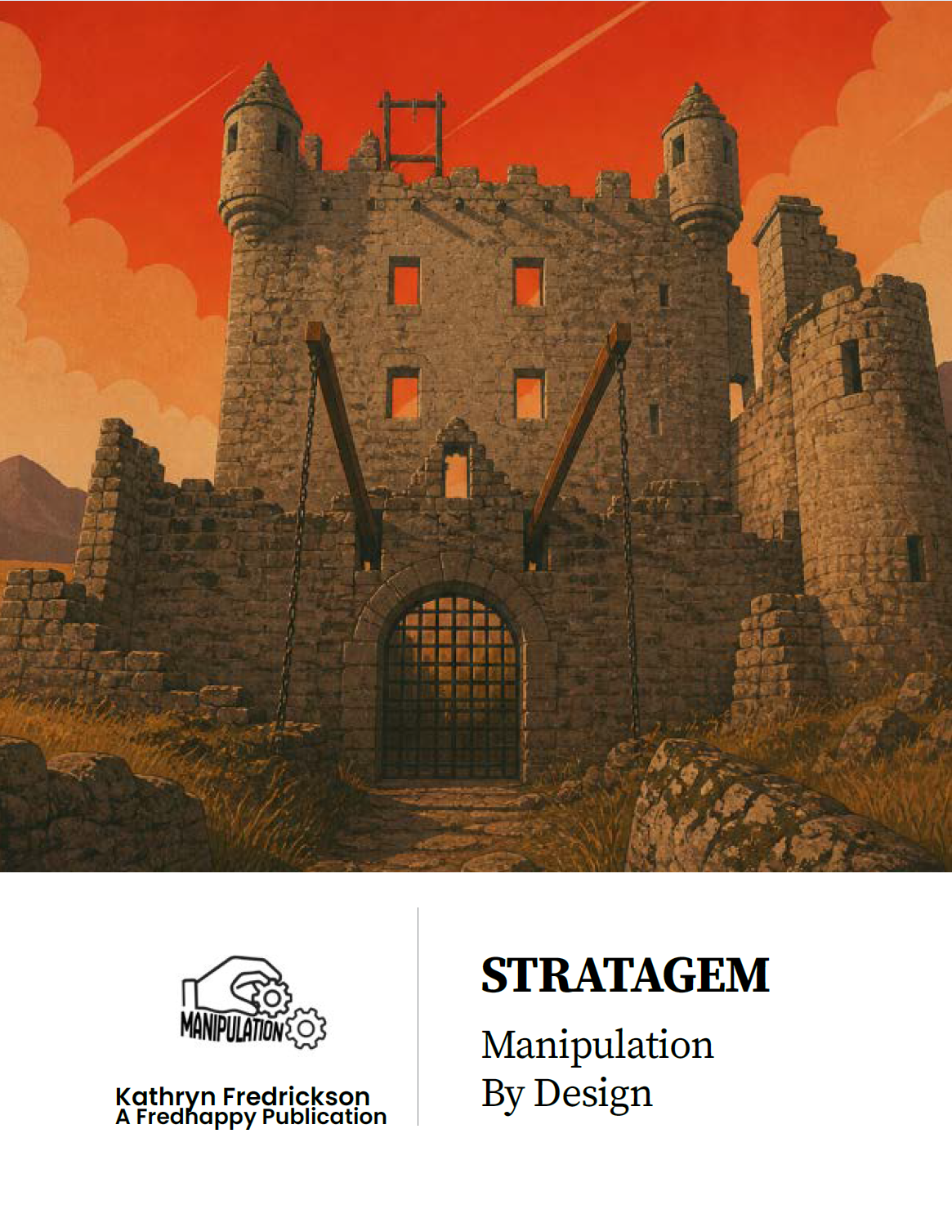
This is one of the reasons I wrote STRATAGEM: Manipulation by Design.
Manipulation is much easier to describe after we can see the whole sequence. It is considerably harder when we are standing inside an interaction trying to understand the signals, our own reactions, other people's reactions, and what any of it means.
STRATAGEM is about that problem.
It is a book for understanding manipulation as something that can happen around human perception, emotion, attention, boundaries, and response. It is meant to help make confusing experiences more legible without requiring you to become suspicious of every uncomfortable human interaction.
If you have ever emerged from a situation and thought, Why couldn't I see this clearly when I was in it?, that is exactly the kind of question worth investigating.
Because awareness does not require you to stop feeling.
It helps you understand what you are feeling while the information can still be useful.
The fury is data. The verdict comes later.
Then you decide what to build.
PROTECT
STRATAGEM
Manipulation by Design
Examine how manipulation works when it is designed through ambiguity, reversal, selective access, pressure, and engineered uncertainty, so you can recognize the structure of the game before you get pulled deeper into it.


